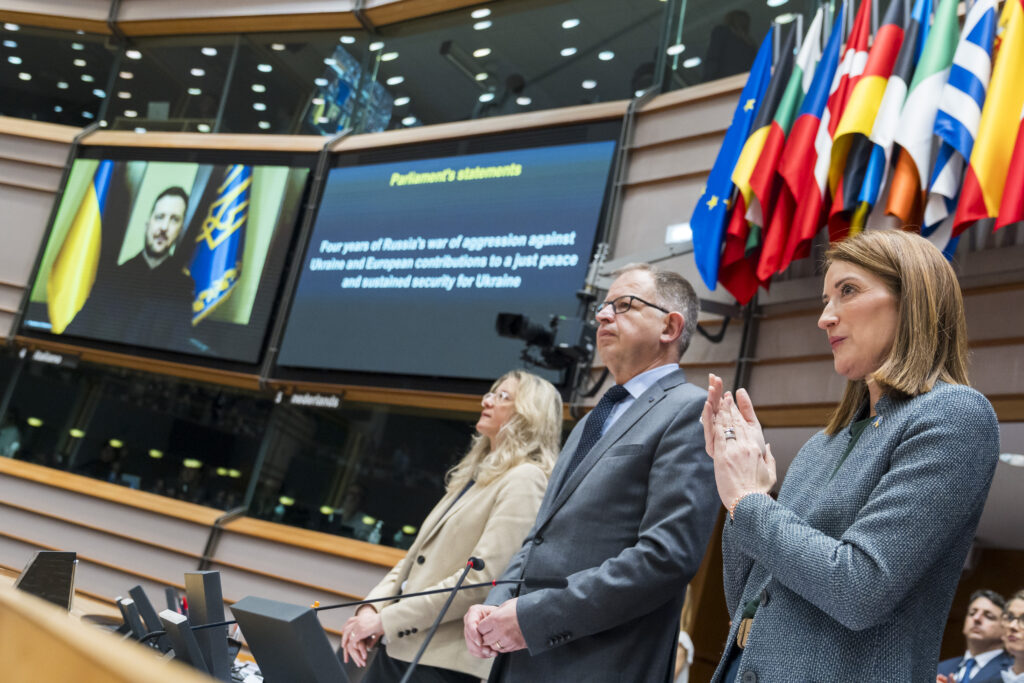
Four years after Russia launched its full-scale invasion of Ukraine — a war the Kremlin believed it could win within days — the European Parliament marked the anniversary with a formal sitting opened by President Roberta Metsola. Lawmakers heard by video link from President Volodymyr Zelenskyy, who received a standing ovation after his address. The debate that followed underscored strong European support for Ukraine, even as dissent surfaced at the political fringes.
President Metsola framed the anniversary not only as remembrance for Ukraine’s loss of lives and sacrifice, but also as a statement about what the war has come to represent for Europe itself. Resilience. “As tanks rolled across European borders and the war descended on our continent, Russia thought they could take Ukraine in days,” she told the chamber. She continued that Ukrainians had “proven them wrong,” enduring “through the depths of gruelling winters, even as drones fall indiscriminately and Russian missiles target women and children.”
What began as an invasion, she suggested, had become a test of Europe’s political resolve and identity and not solely an act of altruism. “We act because we know what is at stake for all of us,” she explained, linking Ukraine’s survival directly to Europe’s own: “Your security is Europe’s security. Your freedom is Europe’s freedom. And your future is in Europe.”
Zelenskyy: war part of a broader pattern
When President Zelenskyy appeared onscreen, all eyes in the chamber focused on him. His address blended gratitude with warning, placing Ukraine’s suffering within what he described as a longer pattern of Russian aggression. “We never chose this war. We didn’t start it and we did not provoke it and we do everything we can to stop it,” he said. He described Russia as fundamentally incompatible with European principles, warning that it “cannot accept that in Europe every life matters, human rights are important and nations can be protected whether they are big or small.” The war, he argued, was not an isolated rupture but part of a continuing trajectory:
“Putin’s Russia started with a war in Chechnya, then moved on to Georgia… Russian forces destroyed lives in Syria and in African countries… Russia supports the insane regime in Iran and ignores any number of killings. We cannot pretend this is not happening.”
You might be interested

Ukraine’s president repeatedly returned to the role of European solidarity, thanking lawmakers for their “constant attention, constant support,” and urged sustained economic pressure —“there must be no place in the free world for Russian oil… Russian tankers, Russian banks, Russian ships or for any Russian war criminals”— while pressing for political clarity on Ukraine’s future as a part of Europe and the EU.
He concluded with the words: “Slava Ukraini.” And received a sustained standing ovation from most on site.
Parliament aligned on support
When the chamber settled, speakers repeatedly returned to the themes set by President Metsola and President Zelenskyy: survival, security and the proposition that Ukraine’s defence has become inseparable from Europe’s own.
Ms Iratxe García Pérez (ESP), speaking for S&D, described Ukraine’s battle as “not just resistance, it’s dignity… a defence of Europe,” warning that “if Ukraine falls, then the European promise of freedom falls. If Ukraine resists, then Europe resists.”
From Renew Europe, Ms Valérie Hayer (FRA) said “the Ukrainian people are the first defenders of our values, our democracy” and insisted that “no peace agreement can be written without the Ukrainians and the EU at the table.”
A co-chair of the Greens called for accelerated measures, saying “the 90bn euros of support have to go to Ukraine” and urging the EU to “ban all imports of fossil fuels into the EU to stop financing Russia’s war.”
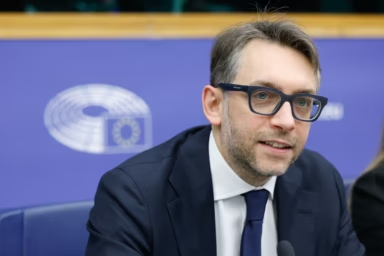
Across the pro-Ukraine majority, sanctions, defence assistance and EU integration were framed as interconnected elements of the same strategy. Mr Nicolás Pascual de la Parte (EPP/ESP) sharpened the message towards Moscow, asking, “Putin, where is your victory?” and adding that “the only language he knows is the language of strength.”
Dissent from the nationalist far-right
The debate also exposed dissent.
Jordan Bardella, leader of the PfE group (FRA), warned that support for Ukraine must not come at the expense of Europe’s own stability, saying “our duty is to continue supporting Ukraine without sapping our own nations,” and arguing that “there cannot be any way out of this conflict besides peace, peace that is negotiated to put down arms.”
A more forceful intervention from another sovereigntist lawmaker rejected further assistance outright, declaring: “We are against continuing supporting Ukraine. We do not want to send any more money, we do not want to send any more arms, and to listen to more propaganda,” and accusing Brussels of “pouring tens of billions of euros into one of the most corrupted regimes.”
Economic concerns raised during the debate reflected real domestic pressures, but the context remained central: lawmakers were marking a war widely described as brutal aggression, with Russia accused of systematic attacks on civilians. Against that backdrop, appeals centred primarily on internal costs landed uneasily in the chamber.
Several speakers responded sharply. One lawmaker accused figures such as Viktor Orbán and Robert Fico of aligning politically with Moscow, concluding: “The traitors are with Moscow. We are with you.”
Moscow signals no change
Elsewhere, Moscow gave no indication of a shift in its objectives. Russia will continue its campaign because its goals have “not been fully achieved yet,” Kremlin spokesperson Dmitry Peskov said, according to The Guardian.
Security analysts have for months questioned and indeed debunked news that Russia has taken any meaningful steps towards de-escalation, pointing instead to continued military operations and hardened public positions from senior officials.
There must be no place in the free world for Russian oil… Russian tankers, Russian banks, Russian ships or for any Russian war criminals. – Volodomyr Zelenskyy, president of Ukraine
Kyiv and beyond
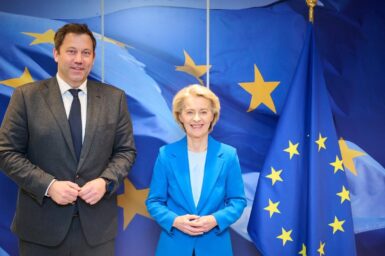
As lawmakers debated in Parliament, key European leaders gathered in Kyiv to mark the anniversary on the ground. European Commission President Ursula von der Leyen and European Council President António Costa joined Nordic, Baltic and Polish leaders in Kyiv to demonstrate continued political and military support.
The Guardian reported Nato Secretary-General Mark Rutte saying Ukraine needed “ammunition today and every day” alongside sustained backing, warning that “there cannot be true peace in Europe without real peace in Ukraine,” while UK Prime Minister Keir Starmer said the conflict would shape Europe’s future and rejected claims that Russia held the advantage, adding that it was Mr Putin who stood in the way of peace.
Ms von der Leyen and other leaders later took part in a Joint Ceremony for Honouring the Fallen Heroes at the People’s Memorial on Maidan Independence Square by President Volodymyr Zelenskyy and First Lady Olena Zelenska.
Nothing but contempt
President Zelenskyy urged Europe to remain resolute and warning that Moscow’s posture extended beyond Ukraine itself. As he said in his speech to parliament on Tuesday:
“In many ways, we can see how Russia shows contempt for Europe,” he said. “Russians must learn that Europe is a union of independent nations and millions of people who do not tolerate humiliation and will not accept violence.”
Four years on, the anniversary unfolded across multiple capitals at once — debate in Strasbourg, solidarity in Kyiv and hardened messaging from Moscow — underscoring a central reality: the war remains unresolved, and its outcome will shape Europe’s security order for years to come.