
European lawmakers have urged the ECB to bare its inflation models, policy assumptions and bond-selling plans to a sceptical, price-pinched public. The Strasbourg plenary, however, has blessed the bank’s 2025 report without much ado.
MEPs approved the European Central Bank’s 2025 annual report on 10 February, giving the text solid backing with 443 votes in favour, 71 against and 117 abstentions. The decision followed a spirited exchange the previous day between Christine Lagarde, the ECB’s president, and members of the European Parliament. MEPs endorsed the bank’s self-assessment yet tightened the screws on transparency and discipline.
The resolution opens by quoting Article 127 of the EU treaties, which makes price stability the ECB’s primary objective. It then “underlines that the statutory independence of the ECB … is a prerequisite” for achieving that aim. Lawmakers insist that the bank must take decisions “without political interference”, but they also remind Ms Lagarde that independence “does not mean isolation”. Accountability, they argue, must match autonomy.
Guarding the guard-dog
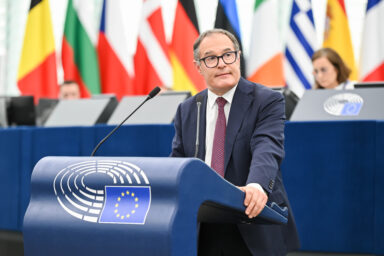
MEP Johan Van Overtveldt (ECR/BEL), the rapporteur set the tone in Monday’s debate. “The independence of the ECB is not a technical detail,” he warned. “History provides ample evidence that direct political intervention or interference with central bank independence invariably leads to inflation, financial instability and even nasty political turmoil.”
Parliament’s text echoes that admonition. It applauds an exchange-of-letters arrangement that structures contacts between the ECB and the chamber, calling such mechanisms vital for scrutiny. Ms Lagarde replied that “at a time when central bank independence is challenged in parts of the world, the European Parliament’s clear support of the principle sends an important signal to us”.
You might be interested

MEPs nonetheless push for plainer language from Frankfurt. They “invite the ECB to make efforts to enhance instruments that improve transparency, such as benchmarks [and] insights in its model-based assumptions”. By demystifying its models and publishing fuller Governing-Council assessments, the bank could shore up public trust—an asset as important as any policy tool.
Inflation’s aftershocks
The report also backs the ECB’s show of solidarity with America’s Federal Reserve, which recently faced threats to its independence. Europe, the text implies, must set a firmer example than the world’s reserve-currency issuer.
Parliament does not let Ms Lagarde off lightly for the price surge that followed the pandemic. It “expresses concern at the high levels of inflation … instigated by supply shocks” and argues that “a timely return to price stability … would have been warranted through ECB decisions”. Although inflation has eased since its 2022-23 peak, lawmakers caution that it could rise again and that any further rate cuts must be “prudent, data-driven and guided by price stability”.
The resolution cites the strain on households: in 2025 the average cost of a meal in the euro area was one-third higher than before covid-19, with low-income families hit hardest. It also flags risks from energy insecurity and disrupted trade routes—threats that could reignite price pressures faster than models predict.
Unwinding the arsenal
Monetary dominance requires fiscal help, legislators add. The text “highlights … the importance of sound and sustainable public finances in withstanding a high-interest-rate environment”. Bloated national budgets make it harder for the ECB to focus solely on inflation, they warn.
Reaffirming the ECB’s independence is even more important in the current global context. This threat to independence is especially pronounced in the US. — MEP Johan van Overtfeldt (ECR/BEL)
Parliament takes a sceptical view of unconventional policies. Asset-purchase programmes, the report says, “can distort price signals”, and the ECB’s balance sheet has shrunk only “very gradually”. MEPs urge the bank to keep winding down its government-bond purchases and to avoid paying commercial lenders deposit rates that exceed market levels, a practice deemed inimical to an open-market economy.
Since the financial crisis of 2008, the ECB’s short-term lending schemes have “largely displaced” private interbank markets. Lawmakers want obstacles to the revival of those markets removed and collateral standards kept high. They also back the inclusion of owner-occupied housing in euro-area price indices, provided statistical methods are watertight.
Digital questions
The chamber offers conditional support for a digital euro, calling it “essential to strengthening EU monetary sovereignty”. Yet cash, it argues, must remain widely accepted to prevent social exclusion. The text also presses the ECB to “intensify its monitoring of crypto-assets”, where private, often foreign, players dominate.
Mr van Overtveldt, summing up the mood, declared that “reaffirming the ECB’s independence is even more important in the current global context. This threat to independence is especially pronounced in the US. Monetary and financial stability are like water and electricity. Their importance is only recognised when they are absent.” Few colleagues dissented.
All in all, the parliament has endorsed Ms Lagarde’s mandate and defended the bank against political meddling. In return it expects quicker reflexes, slimmer asset holdings and clearer explanations. The bargain is simple: the ECB may enjoy its independence, but it must explain, in plain words, how every decision keeps prices stable for Europe’s beleaguered consumers.