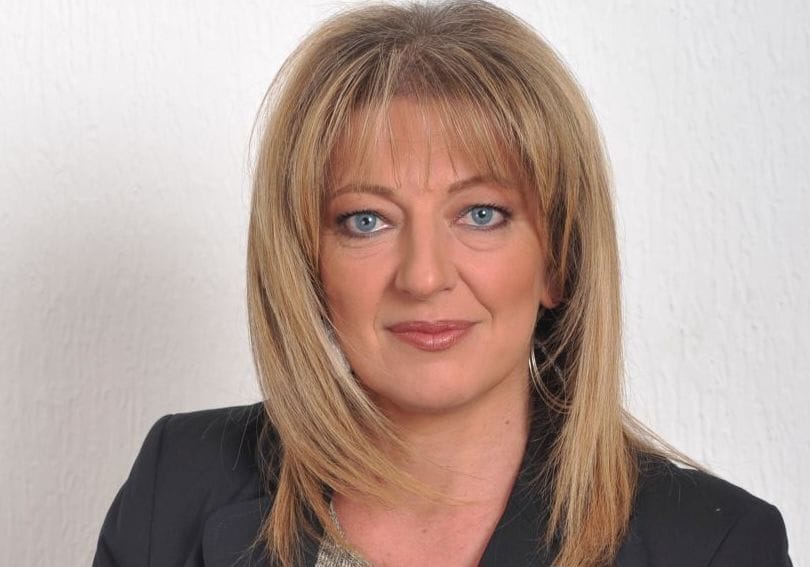

State capture, repression, and systemic corruption are reshaping Serbia’s political landscape in the wrong direction. Katarina Popović, professor at the Faculty of Philosophy in the University of Belgrade, tells EU Perspectives that Brussels lets her country’s leaders off the hook too lightly.
What are the implications of the European Union’s cautious stance toward a candidate country drifting away from the principles of rule of law and democratic accountability? “We were already living under an authoritarian regime. Now we are moving towards a dictatorship.” That’s the essence of what Ms Katarina Popović, Secretary General of the UN International Council for Adult Education tells Europe. Brussels’ muted response to Belgrade’s shenanigans draws criticism from the Serbian government’s opponents.
What is currently happening in Serbia after the Novi Sad tragedy?
Everything started on 1 November last year, when a canopy collapsed at the railway station in Novi Sad and killed 16 people. That tragedy triggered massive protests. During the first half of last year, hundreds of thousands of people took to the streets. In any democratic country, this would have been enough either for the government to resign or, at the very least, to call elections and say: “If you are unhappy with us, vote us out.”
Instead, what we have in Serbia is not a government but a mafia-like organised group. I am not using this term metaphorically. I mean it literally, and there is ample evidence for it. This group has effectively kidnapped the country and state institutions in order to engage in activities such as drug trafficking, weapons trafficking, and systematic corruption. It is reaching extreme levels, and it is precisely why the canopy in Novi Sad collapsed.
You might be interested

This is corruption that kills. It affects every aspect of life: you cannot get a job unless you are a party member and pay; you cannot access healthcare; you cannot open a business or function normally unless you are either paying bribes or are very close to the ruling party, and the second option is preferable.
Ample evidence is available of drugs and weapons trafficking. At the same time, by controlling money, the police, the army, and institutions, the regime has been able to bribe, blackmail, and intimidate people, and to systematically steal elections.
How popular is the government now?
All polls show that they no longer have majority support, but when you control the state apparatus, you can cling to power. We were already living under an authoritarian regime. Now we are moving towards a dictatorship.
The situation is deteriorating. They know their position is unstable and that people are rebelling. Throughout last year, protests, blockades, and demonstrations continued. As a result, the regime has started using violence. Students have sufferend violent attacks. Cars have driven into protest crowds. Journalists have disappeared. People have died under suspicious circumstances. This is not yet Russia-level repression, but it has become genuinely dangerous to oppose the regime. Professors and teachers are losing their jobs – hundreds of them – simply for supporting students. This is particularly visible in the education sector, which has been underpaid, marginalised, and systematically degraded for years.
The regime is targeting education workers. Do party supporters replace them, or is there simply a lack of personnel? What are the consequences?
Both, but mainly the former. The government has created so-called private universities, although it is almost shameful to call them universities. There is clear evidence that students can enroll in September and receive a degree by January, simply by paying a few thousand euros. Even master’s and doctoral degrees are for sale. Unlike in many countries where private education has a strong link to quality, in Serbia these institutions—especially those linked to the government—exist to sell diplomas.
Teachers and professors are being replaced by people who are barely literate. This is not an exaggeration. We have ministers who cannot read prepared speeches properly. These individuals now occupy key positions. This is a deliberate strategy. People with no qualifications are promoted to positions of power because they will defend the regime at all costs. If you were once repairing bathrooms or running a small bakery and suddenly become a minister, you will do anything to keep that position. That is how loyalty is bought.
How would you describe the current relationship between students and professors? What is the ultimate goal of the protests?
There have been moments of extreme tension, including last year when the government used a sound weapon during a massive protest. It caused panic, trauma, hearing loss, and neurological damage. It was terrifying. Despite provocations, students unanimously decided to remain peaceful. The regime repeatedly tries to infiltrate protests with provocateurs, but they are usually easy to identify.
After long discussions, students agreed on a clear demand: extraordinary parliamentary elections. Their message is simple – if the government claims it has support, it should prove it at the ballot box. Mass protests alone no longer work. President Vučić has openly said that even if five million people took to the streets, he would not care. Now the focus is on elections. Students are preparing candidate lists—without including themselves—selecting professors, activists, and public figures instead. Every faculty contributes candidates to what is known as the “students’ list”. Vučić knows he cannot win free elections, at least not without massive fraud. This time, people are preparing. I personally train students in election monitoring.
How do Serbs view the European Union’s role in the latest developments?
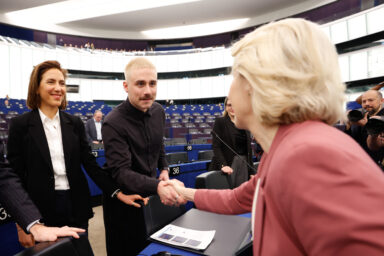
This is where our frustration with the European Union comes in. Support has been extremely weak. Serbian citizens expect much more. Figures like Ursula von der Leyen are deeply unpopular. When she visits and addresses Vučić as “dear Aleksandar” while praising Serbia’s progress, people are outraged. Media freedom is destroyed, violence is used against students, institutions are dismantled and yet EU leaders respond mildly.
Serbia is a candidate country. The EU has leverage. It could impose personal sanctions or pressure the government to clean up voter registers, which are full of deceased people and citizens living abroad. We are not asking for intervention, just for the EU to use the tools it already has.
Are professors and students always on the same side?
Students and professors are natural allies, and the vast majority of universities officially supported the student movement and suspended teaching. The academic year was effectively lost. However, tensions exist within the movement. Some students—especially from the radical left—see professors as part of the establishment. This ignores the reality that most professors are also being targeted by the regime. There are different currents within the movement, and the regime actively exploits these divisions by inserting provocateurs and amplifying tensions.
After more than a year of pressure, exhaustion is widespread. Some sociologists describe this situation as a ‘low-intensity war’: constant stress, uncertainty, surveillance, and fear. The government also uses advanced surveillance systems acquired from China. Cameras, data collection, and monitoring are openly used to intimidate and blackmail citizens. This is the reality we are living in.