
The official agenda of Monday’s Eurogroup meeting focused on economic sovereignty and global imbalances. But the session’s real impact comes from a new coordination initiative launched by France, Germany, Poland, Italy, Spain and the Netherlands, the so-called E6.
The Eurogroup’s leadership spent the day attempting to downplay the notion of a ‘two-speed Europe’ in connection to the E6 initiative. The term has enjoyed a renewed prominence since German Chancellor Friedrich Merz reintroduced it to the European discourse last week.
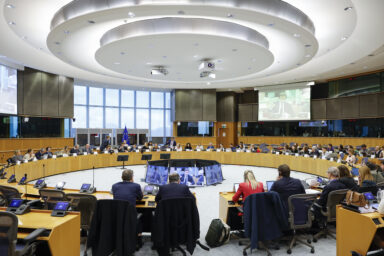
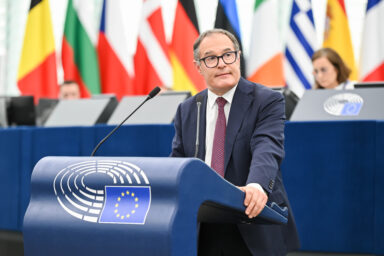
The euro area’s finance ministers gathered in Brussels on 16 February to address a burgeoning debate over the structural integrity of the union and the international role of its currency. Kyriakos Pierrakakis, Eurogroup chief, opened the proceedings by linking the meeting to the urgent priorities identified by EU heads of state.
Investment, energy, competitiveness
These include the savings and investment union, energy prices and competitiveness. He noted that the meeting established a common understanding on the draft Council recommendation for the economic policy of the euro area for 2026.
The document, according to Mr Pierrakakis, calls for member states to act decisively to safeguard fiscal sustainability. It also prioritises national budgets to accommodate increased defence spending over the medium-term.
You might be interested
The conversation turned inevitably to the E6. The initiative, spearheaded by the bloc’s six largest economies, is an informal and temporary format intended to facilitate convergence on key priorities. Critics worry that this caucus could threaten the Eurogroup as the primary body for economic discussion. Mr Pierrakakis was quick to push back against the suggestion that this format poses a danger to the body’s institutional standing.
The single word answer
“So let me start by saying that the single word answer to your question, is it the threat, is no,” Mr Pierrakakis said when asked if the E6 posed a danger to the body’s institutional standing. He explained that German Federal Minister of Finance Lars Klingbeil had provided a brief presentation on the rationale of the initiative. “It’s a temporary initiative, an informal initiative,” Mr Pierrakakis added. “It’s auxiliary to the European institutions.” He argued that any interaction between member states that facilitates convergence is potentially positive, provided it remains transparent.
Valdis Dombrovskis, EU economy commissioner, echoed this sentiment, suggesting that the E6 could be a positive force if it helps provide input to broader discussions. However, Mr Dombrovskis was more explicit regarding the possibility of moving forward without total consensus across all member states. “As European Commission, we always have a preference to act together at EU27,” he said. “However, if the progress at EU27 turns out to be evasive, then, if there are at least nine member states willing, we are open to engage on the enhanced cooperation and to move certain agenda points forward in this way.”
The global appeal of the euro in the world will first and foremost be determined by the strength and resilience of the European economy. — Valdis Dombrovskis, EU economy commissioner
This openness to “enhanced cooperation” touches on the possibility of a vanguard leading the union. On the specific question of the savings and investment union, Mr Dombrovskis noted that the Commission cannot prejudge which areas member states might choose for such a format. He emphasised that it is for the willing nations to determine their engagement. For the time being, the E6 serves as a format intended to create a gravitational pull that might pull along the rest of the union.
Currency as a shield
Beyond internal politics, the Eurogroup addressed the euro’s standing on the world stage. Mr Dombrovskis presented a strategy to strengthen the currency’s international role, a move seen as a cornerstone of the EU’s de-risking strategy.
He argued that a more dominant euro would boost competitiveness by lowering borrowing costs and shielding importers and exporters from exchange rate fluctuations. “The global appeal of the euro in the world will first and foremost be determined by the strength and resilience of the European economy,” Mr Dombrovskis said.
The strategy involves doubling down on the competitiveness agenda and deepening the single market. Mr Dombrovskis also highlighted the need for the EU’s retail payment system to become more autonomous. “There is a need to make EU retail payment system more autonomous, building around the digital euros infrastructure and wide acceptance network, and to enhance the issuance of Euro-denominated digital assets,” he told reporters. This push for autonomy is particularly relevant as the EU seeks to diversify its trade network and enhance its defence capabilities.
When asked if trade partners should be pushed to use the euro in specific sectors like energy, Mr Dombrovskis reported a broad agreement among ministers to explore such options. He acknowledged that a stronger international role for the currency carries implications for the exchange rate, a point of concern for countries that worry about export costs. However, he maintained that a stronger global role is not the only driver for exchange rate developments, and that many other factors remain at play.
Imbalances and allies
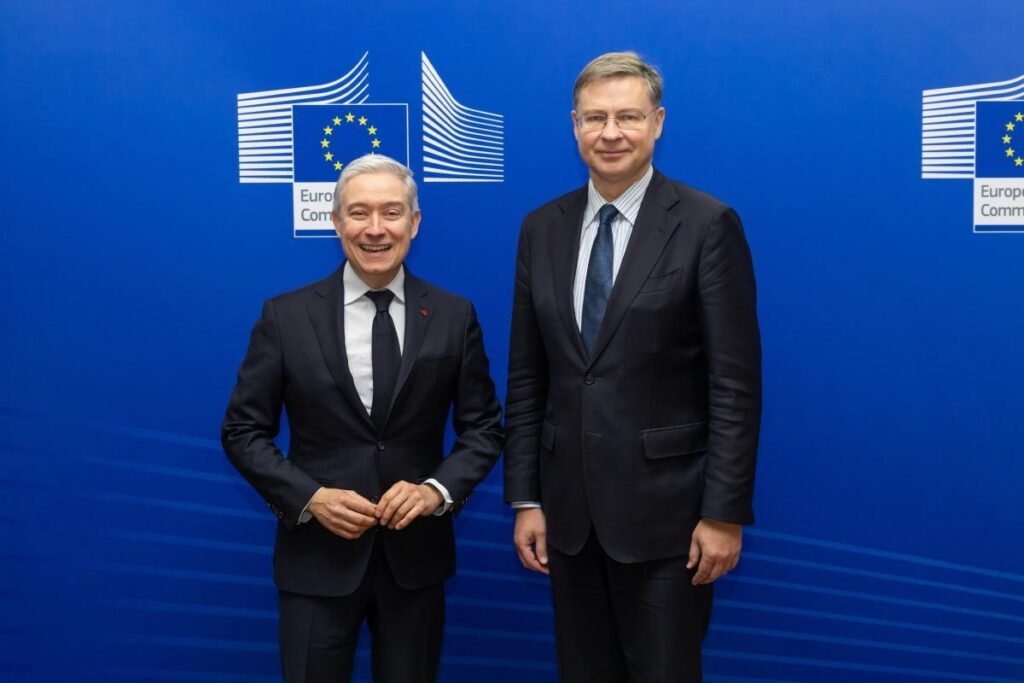
The final pillar of the meeting involved a discussion on global macroeconomic imbalances, featuring François-Philippe Champagne, Finance Minister of Canada, as a guest. The participation of Mr Champagne reflects efforts to coordinate approaches among international partners. Mr Pierrakakis described the goal as creating bridges rather than the opposite. Canada recently held the presidency of the G7, and France is set to hold it this year with a focus on these imbalances.
“I think everyone agreed with the Commission’s point that we need to look at global imbalances in a broad manner: they are not only about specific trade flows of goods between individual countries – they are about the whole financial and economic inter-relationships,” Mr Pierrakakis said. He argued that Europe is not part of the problem but certainly is part of the solution globally in this debate. The discussion was informed by Professor Hélène Rey, who is leading the G7’s academic group on global imbalances.
What we generally hope to do is to create bridges, not the opposite. — Kyriakos Pierrakakis, Eurogroup president
Mr Dombrovskis provided statistical context, noting that global macroeconomic imbalances reached four per cent of global GDP in 2024. “Current Chinese and US policies are the biggest contributors to the rise of imbalances, but the EU, however, has also work to do,” Mr Dombrovskis said. He noted a particular scope for an increase in investments, especially regarding private investments. The shared interest among G7 and G20 partners is to manage these risks in an orderly way to avoid further trade tensions.
Housekeeping and future paths
As the meeting concluded, the Eurogroup turned to internal matters. Tuomas Saarenheimo was appointed for a further term as President of the Euro Working Group. Mr Pierrakakis praised Mr Saarenheimo, stating that he “has been doing an excellent job for the past six years and we are happy we can count on his expertise for a fourth two-year term, starting 1 April.” This continuity provides a stable technical foundation as the Eurogroup navigates the political dynamics stirred by the E6.
The fundamental tension remains: can a smaller group of powerful nations accelerate European integration without fracturing the union? Mr Pierrakakis and Mr Dombrovskis have placed their emphasis on convergence and transparency. “What we generally hope to do is to create bridges, not the opposite,” Mr Pierrakakis insisted. Whether these bridges lead to a more unified Europe or simply provide a way for the biggest players to move ahead remains a defining question for the euro area.
The idea that coalitions of the willing must lead where the 27 cannot is no longer a theoretical proposal. It is now a matter of active coordination in Brussels. As the E6 prepares to meet on the sidelines of finance minister meetings, the rest of the bloc will be watching to see if this gravitational pull leads to broader unity. For now, the Eurogroup’s leadership is adamant that the institution remains the decisive body, even if the engines of change are increasingly concentrated in the hands of a narrower, bolder group.