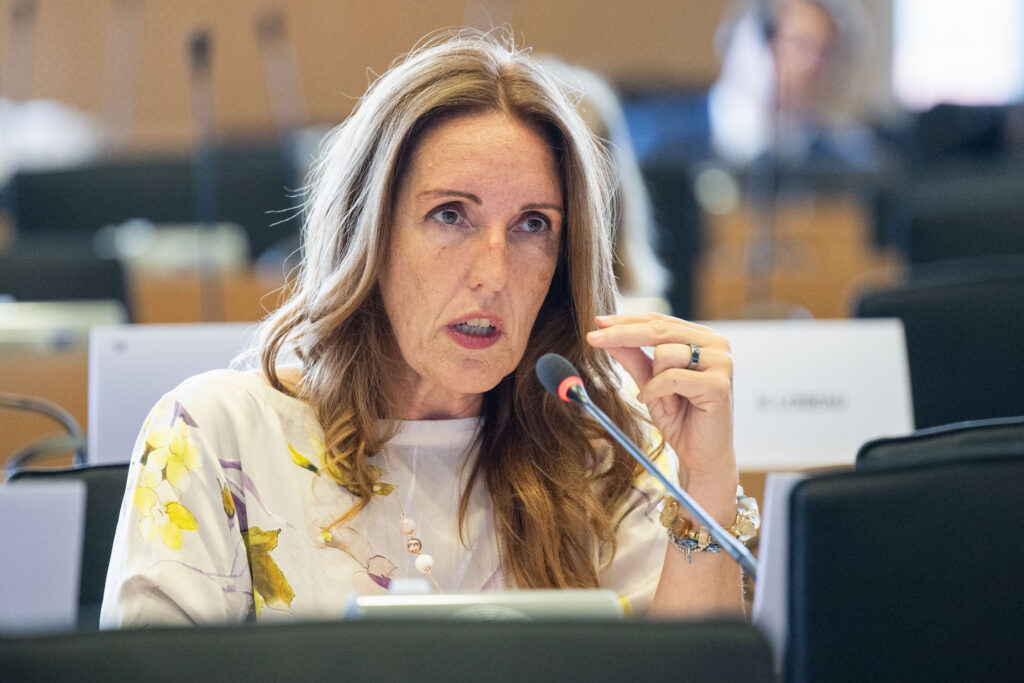

The EU Space Act is entering a decisive phase with key milestones set for March as the legislative process gathers momentum. In an interview with EU Perspectives, Italian MEP Elena Donazzan (ECR), rapporteur of the file in the European Parliament, confirmed that she will open the amendments phase on 26 March.
The proposed law is to shape the future of Europe’s rapidly expanding New Space Economy, as policymakers seek to foster innovation, reduce regulatory fragmentation and avoid excessive bureaucracy that could hinder private investment. At stake is the EU’s ability to remain competitive and strategically autonomous in a global space sector increasingly reliant on commercial actors alongside traditional powers such as the United States and emerging competitors including China.
The last few months were productive ones for meeting with many “Space” stakeholders. What is the state of play of the EU Space Act?
We’re almost there: my text is due on March 2nd, I’ll present it to the ITRE Committee on March 24th, and the deadline for amendments is March 26th. These have been months of intense work, initially involving numerous bilateral meetings, public hearings, reading and study, and subsequently analysis, writing, and ongoing discussion on specific topics. It’s a highly complex undertaking that requires great attention to detail.
What are the industries’ biggest concerns, and what are those of the ITRE Committee?
The industries’ biggest concern is that this text doesn’t turn into a bureaucratic millstone that would, in effect, nip the great rise of the “New Space Economy” in the bud. Companies are demanding simplification and less bureaucracy, and it is precisely on these issues that I want to focus my writing. My colleagues at ITRE see the Space Act as a means to increase European autonomy in space and to expand the single space market. These are issues I certainly agree with, but it requires a pragmatic approach without ideology.
How present are Russia and the US in the space sector? Are they threats to the EU today?
Russia and the United States are extremely present in space, but with several differences. Both are “historic” players, but in the United States, a public space policy has been accompanied by growing private initiative, now major players overseas. The progressive privatisation of space has led to security, research, and exploration missions being flanked by purely commercial ones. In Russia, however, space remains predominantly a public domain, with a focus on military and defense issues. This is why Russia represents a problem for us Europeans: in the context of hybrid warfare, the control of space can play a crucial role in the management of data and critical infrastructure. In this context, it’s important not to forget China: China is investing heavily in the space sector, both commercially and for security, and, to date, we don’t know the exact figures for this economic effort.
How can the EU become a leading player in the space sector?
I believe the EU must use all its moral suasion to foster responsible and shared use of space. The Space Act, in this context, must be seen as a tool to promote high levels of safety, resilience, and sustainability in the space sector. We have already made enormous progress with ESA; now, with this legislative instrument, it’s important that Europe not only self-regulates but also promotes best practices internationally for a “space for all”.
When will the next reports or progress reports on the Space Act be presented?
After the 26 March deadline for amendments, technical and political meetings will begin at parliamentary level to define the European Parliament’s position, which will be ready by early November. It is my intention to provide periodic updates on the progress of the text during this period and to continue a phase of dialogue with all the key stakeholders involved in this process.