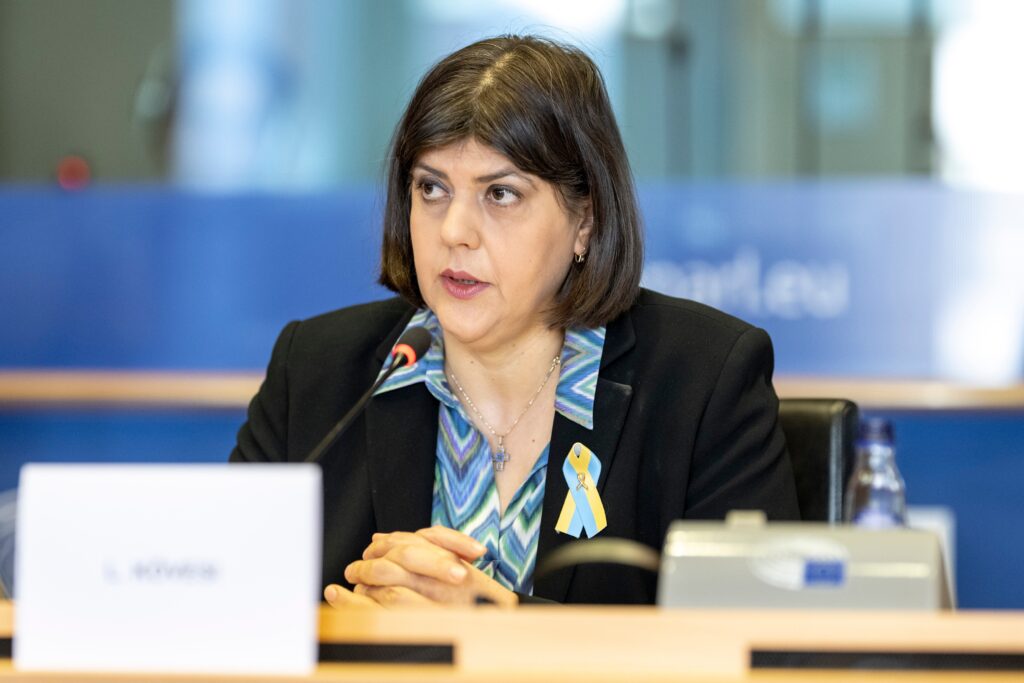

The European Union’s first Chief Prosecutor, Laura Codruța Kövesi turned the vague idea of fighting fraud into a €25bn crime-buster. She also made enemies. On Monday, MEPs anointed her unobtrusive German deputy Andrés Ritter as her successor. How does that play into the rivalry between their office and OLAF?
The European Parliament’s Civil Liberties, Justice and Home Affairs Committee (LIBE), voted on 23 February to place Andrés Ritter at the helm of the European Public Prosecutor’s Office. Fifty-two MEPs backed the German lawyer, ten opposed him and six abstained. The result surprised nobody: Parliament and the Council had already signalled their preference. Yet the vote marks a turning-point for the agency that hunts fraud against the EU budget.
Created only in 2017, the EPPO began work in mid-2021 under the formidable Laura Codruța Kövesi, a former Romanian anti-corruption czar. In five years she turned a line in the Official Journal into a force with 140 European delegated prosecutors spread across 24 member states. Her investigators opened more than 1,500 new cases in 2024 alone and froze assets worth €849m, 17 times the office’s original budget. Such figures made Ms Kövesi one of Brussels’s rare household names.
Two masters
By creating the EPPO, the European Union set to deploy two investigative hounds to guard its cashbox. The European Public Prosecutor’s Office (EPPO) conducts criminal inquiries and brings fraudsters to court. The European Anti-Fraud Office (OLAF) runs administrative probes and recommends the recovery of misspent money. Both chase the same quarry—crooks who plunder the EU budget—yet they answer to different masters and use different tools. That mix breeds rivalry as much as partnership.
EPPO is the upstart. A 2017 regulation armed it with powers to indict fraud, corruption and money-laundering that damage EU finances, especially cross-border VAT scams worth at least €10m. OLAF is older, born inside the European Commission in 1999. It cannot prosecute but may raid offices, seize documents and demand that Brussels claws money back. Its updated mandate in 2020 tried to mesh the two bodies, yet frictions persist.
You might be interested

The reform laid down tidy rules. OLAF must hand over any suspicion that falls under EPPO’s remit without delay. Once EPPO opens a case, OLAF must halt its own probe unless asked to run a complementary administrative check. Files that EPPO declines bounce back to OLAF for civil recovery. A 76-point working arrangement signed in July 2021 spells out how both sides swap case numbers and search each other’s databases. On paper the division looks neat.
Different badges, same villains
Reality bites harder. EPPO’s culture is prosecutorial, speed-driven and front-page-prone. OLAF’s is bureaucratic, meticulous and buried in Commission hierarchies. The numbers tell a tale: in 2024 fewer than one in a hundred crime reports that landed on EPPO’s desk came from OLAF. Most arrived from national police or whistle-blowers. EPPO’s chief prosecutor has grumbled that the anti-fraud office “withholds or filters” leads. OLAF officials counter that they need time to sift allegations before passing them on.
Turf wars erupt in high-profile files. In 2024 the press exposed a Brussels corruption scandal that OLAF had quietly examined without alerting EPPO; prosecutors jumped in after the leak, citing “disharmony” in cooperation. Earlier feuds flared over Spain’s pandemic mask contracts and Croatia’s medical-equipment tenders. Without an EU conflict-resolution board, national attorneys-general sometimes decide which body prevails. Each squabble fuels talk of duplication and delay, at best.
Yet coordination can work. In a Croatian case involving an EU regional-funded IT project, OLAF raised the alarm, EPPO opened a criminal file and both agencies ran parallel yet complementary tasks. Indictments followed and OLAF advised the Commission to recoup €1.4m. A 2025 joint strike against a €9.5m laundering network froze assets and drew praise for “excellent cooperation”. Success, it seems, depends less on rules than on mutual trust and the personalities steering each file.
Changing of the guard
Enter Mr Ritter as head of EPPO. For him, celebrity sits uncomfortably. His backers call him diligent, methodical and unflappable. His critics reach for another word: bland. The contrast with Ms Kövesi could hardly be sharper.
Ms Kövesi’s record explains why expectations run high. She chased carousel-tax cheats in Portugal, container rackets in Greece and a 16-country VAT scam dubbed ‘Admiral 2.0’. She named and shamed laggard capitals, clashed with national prosecutors and demanded stronger powers from the Commission. Supporters hailed her as the EU’s anti-fraud sheriff; detractors muttered about an abrasive temperament. Either way, she showed that the Union could prosecute serious economic crime without waiting for member states to do the job.
Her numbers impress. Crime reports almost doubled from 3,318 in 2022 to 6,547 in 2024. Active investigations tripled to 2,666, covering an estimated €24.8 bn in damages. More than half of that sum involves cross-border VAT fraud, the very reason the EPPO exists. Parliament’s budget hawks greeted each annual report with applause. National officials, wary of scrutiny, were less pleased.
Yet success brought strain. Ms Kövesi suspended a Bulgarian member of the College for ethical breaches, exposing tensions inside the still-young institution. OLAF, the Commission’s anti-fraud arm, referred surprisingly few cases, hinting at turf wars. Some governments accused her of grandstanding. All agree on one point: the next chief prosecutor inherits a powerful but delicate machine.
A blander hand
Mr Ritter has spent three decades inside Germany’s prosecution service. He ran a 130-strong office in Rostock that dealt with economic crime, cyber-offences and state security. In 2020 Ms Kövesi herself proposed him as one of her two deputies. Since then he has chaired chambers that filed a €93m VAT indictment in Düsseldorf and helped design the EPPO’s case-management system. Nobody doubts his technical chops.
His manner could not differ more from his boss’s. Colleagues describe him as polite, consensual and fond of spreadsheets. During December’s confirmation hearing he promised operational continuity and spoke of better workload distribution among the College. MEPs liked what they heard: he topped the LIBE preference ballot after a single round of voting. Council diplomats detect ‘no revolution’, only steady consolidation.
That suits many in Brussels. The EPPO has outgrown its start-up phase; it now needs stable routines, not fireworks. Mr Ritter wants to double the number of delegated prosecutors, invest in AI tools to spot VAT rings earlier and tweak Article 38 of the EPPO regulation so that more stolen money flows back into the EU budget. Such ambitions require calm persuasion in Council working parties rather than public spats.
Continuity over fireworks
Ms Kövesi rarely bit her tongue when governments dragged their feet. She warned Slovenia for failing to nominate prosecutors and attacked Romania for political meddling. Mr Ritter prefers quiet nudges. His German federal background prizes collegial decision-making; he intends to let permanent chambers steer individual files while he minds strategy and resources. That does not mean he will go soft. He has specialised in subsidy fraud and digital evidence. These are areas where the EPPO caseload grows fastest.
Parliament’s endorsement means the Council is unlikely to waver. The plenary vote, scheduled for March, should confirm Mr Ritter with a comfortable margin. Once appointed, he will serve a single seven-year term starting on November 1st 2026. Ms Kövesi will remain in charge until then, handing over a docket that includes investigations into Covid-19 vaccine contracts and suspect spending from the €807 bn recovery fund.
The incoming chief inherits another debate: whether to widen the EPPO’s remit to cover sanctions-evasion and environmental crime. Ms Kövesi argued that her office has proved its worth; member states now trust its procedures. Mr Ritter agrees in principle but urges budget realism. Expanding offences while case numbers rise by 30 per cent a year could overwhelm prosecutors unless Brussels boosts staffing and IT.
A test of the office
Success will hinge on more than leadership style. The EPPO’s asset freezes already outstrip its annual budget by seven to seventeen times. That strengthens the case for reinvesting a slice of recovered money to finance extra detectives and software. But finance ministries resist earmarking, and some capitals fear a precedent for self-funding EU agencies.
Finally, the EPPO’s reputation rides on court results, not press releases. Ms Kövesi filed 205 indictments last year; judges have yet to decide most of them. Convictions will silence sceptics who claim that the agency chases headlines. Acquittals could embolden those who see supranational prosecution as institutional overreach. Mr Ritter must shepherd complex, cross-border files through crowded national courts. That is no small feat for a man known more for patience than charisma.
The LIBE vote therefore matters beyond personnel. It signals Parliament’s determination to anchor the EPPO as a permanent feature of the Union’s legal landscape. Ms Kövesi built the house and lit it brightly. Mr Ritter must keep the lights on, fix the wiring and add new rooms without setting off alarms. His success will tell whether the EU can move from heroic start-ups to durable institutions.