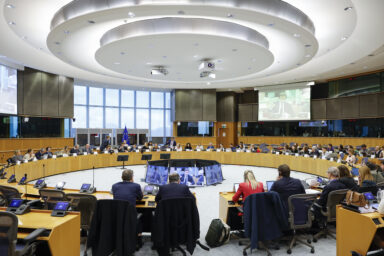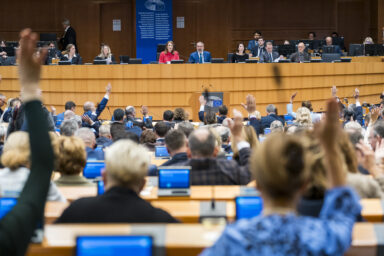

Monday’s Foreign Affairs Council ended with a result that many EU leaders had feared. Hungary carried out its threat and vetoed further sanctions against Russia for its ongoing war in Ukraine. Budapest is also blocking the approval of a critical €90bn loan to Ukraine.
“Tomorrow, we will mark 4th anniversary of the Russia’s brutal war in Ukraine. Unfortunately, today we did not reach agreement on the 20th package of sanctions. This is a setback, a message we did not want to send.” These were the key words spoken by a visibly annoyed Kaja Kallas, High Representative of the EU for Foreign Affairs and Security Policy, at a press conference following the Foreign Affairs Council meeting.
The 20th package of sanctions against Russia has been vetoed by Budapest (and also by Slovakia). Hungarian Prime Minister Viktor Orbán had announced his opposition to the package ahead of the foreign ministers’ meeting. Hungary is reportedly blocking the new sanctions package because Ukraine allegedly refuses to transport Russian oil to Hungary via the Druzhba pipeline for political reasons. The pipeline was damaged by Russian troops on Ukrainian territory at the end of January.
Hungary is also blocking the approval of a €90bn loan to Ukraine, which EU presidents and prime ministers agreed on at the EU summit in December 2025.
You might be interested
Russia an obstacle to peace, not Ukraine
Asked by a journalist what she thought about the actual state of the Druzhba pipeline, which normally transports oil to Hungary and Slovakia, Ms Kallas did not give a direct answer. However, she clearly stated that Russia was responsible for the whole situation. “It is not Ukraine who is the obstacle to peace; Russia is,” Ms Kallas said.
We have seen this scenario earlier, the work with our Hungarian and Slovakian colleagues continues. – Kaja Kallas, High Representative of the EU for Foreign Affairs and Security Policy
High Representative labelled the Hungarian position towards sanctions ’regrettable’ and said that EU leaders will definitely raise this question again with Prime Minister Orbán. “We have seen this scenario earlier, the work with our Hungarian and Slovakian colleagues continues,” Kaja Kallas added.
Diplomacy is preferable, but…
Foreign Council also discussed disinformation campaigns conducted by Russia. “Wars are not only fought with tanks and drones, but also with lies and disinformation. Russia will spend billions on influence campaigns only this year. These operations are being more and more sophisticated, we must not loose this battle,” Ms Kallas said.
High Representative noted that diplomacy is always preferable, but in the case of Ukraine war not much has been achieved so far. “After a year of negotiations, we still do not have even a ceasefire,” Ms Kallas said in a frustrated tone. She added that it has beeen decided to limit the Russia’s diplomatic missions in EU member states to 40 people at maximum. “We will not tolerate abuse of diplomatic power,” Kaja Kallas stressed.