
All eyes were on competitiveness last week. “This is the moment for unity and for urgency,” said Commission President Ursula von der Leyen in front of the European Parliament. Parallel to European leaders gathering at Alden Biesen Castle to discuss how to turn the Draghi report into action, MEPs held their own debate on the urgency of reviving EU competitiveness. Discussions revealed again a broad sense of alarm and sharp political fault lines over the cure.
From market integration to massive public investment, from deregulation to social safeguards, MEPs made clear there is no shortage of diagnoses. But they disagree on the correct prescription.
The Draghi report’s headline figure—up to €800 billion in additional annual investment—loomed. Without a financial framework that matches this ambition, several MEPs warned, the debate risks becoming rhetorical.
’Anti-Trump agreement’
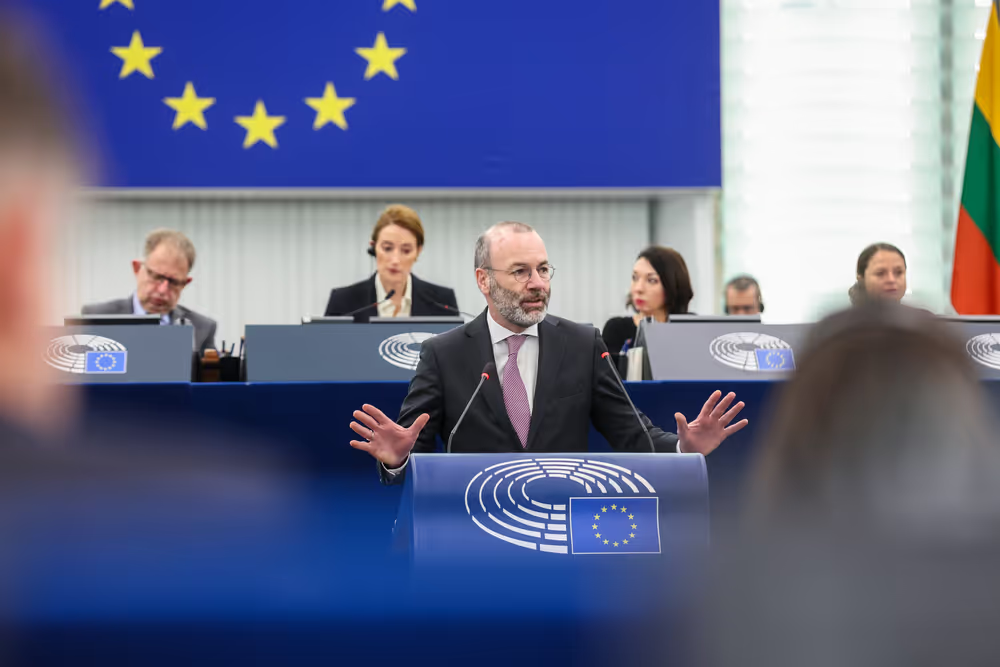
Manfred Weber (EPP/DEU), speaking for the EPP Group, framed the situation in stark terms: “The European economy is on fire,” Mr Weber said. He pointed to the widening gap with the United States in market capitalisation and artificial intelligence investment, warning of deindustrialisation across the Union.
The prominent MEP welcomed the Commission’s omnibus simplification packages and called for technological neutrality in the automotive sector. At the same time, he pushed for concrete milestones, faster action in the Council and a more assertive trade policy . The latter include support for the Mercosur agreement, which he called an ’anti-Trump agreement’.
You might be interested

Harmonisation rather than deregulation
From the Socialists & Democrats (S&D) benches, competitiveness was framed less as a race against the United States and more as a question of fairness at home. With over 8 per cent of workers at risk of poverty and housing prices rising sharply in recent years, MEP Iratxe García Pérez (S&D/ESP) warned: “A Europe that suffers is not a competitive Europe.”
For S&D MEPs, competitiveness must not mean lower wages or weaker rights, as they underlined that Europe will not compete by cutting salaries or undermining social protections.. Instead, they argued, the path forward lies in quality jobs, continuous training, strong public services and a clean industrial strategy that reduces energy costs while strengthening sovereignty.
We need simplification through harmonisation, rather than deregulation. – MEP Marc Angel (S&D/LUX)
MEP Marc Angel (S&D/LUX) also warned against the increasing focus on deregulation. “We need simplification through harmonisation, rather than deregulation,” he insisted. European rules, in his view, should replace today’s patchwork of national legislation. Angel pointed to 2028 as a political deadline to complete the Single Market—not by lowering standards, but by aligning them.
Does overregulation harm innovation?
On the right, criticism focused largely on regulatory burden and the Green Deal. Jordan Bardella (PfE/FRA) accused the EU of organising its own industrial decline through excessive climate ambition and bureaucracy. Suspending parts of the Green Deal and prioritising economic patriotism, he argued, would be necessary to restore sovereignty.
Nicola Procaccini (ECR/ITA) similarly warned that overregulation has stifled innovation, calling for technological neutrality and relief from what he described as self-imposed energy costs.
Investment gap widening
Liberals in Renew took a different angle. MEP Valérie Hayer (Renew/FRA) acknowledged the need for simplification but cautioned against making it the centrepiece. “We are too slow. We must do more,” she said, noting that implementation of the Draghi recommendations remains limited. Each year, she pointed out, around €300bn in European savings flows abroad. Mobilising that capital through a genuine Savings and Investment Union, alongside massive investment in AI, cloud and quantum technologies, is essential if Europe wants to remain competitive, Ms Hayer means.
The real issue is not overregulation but underinvestment. – MEP Bas Eickhout (Greens/NLD)
MEP Bas Eickhout (Greens/NLD) echoed that. He argued that the real issue is not overregulation but underinvestment. With the investment gap potentially exceeding €1tn annually, savings from simplification measures represent only a fraction of what is required. For the Greens, joint European borrowing and a large-scale clean industrial strategy are indispensable to secure strategic autonomy and long-term competitiveness.
“It’s necessary if we want a Europe that is independent of autocrats, with a strong green industry that can compete with China and the United States. It is necessary if we want a Europe that protects its people and its workers, and can stand up for its values when they are under threat,” Mr Eickhout said.
Urgency felt across factions
Despite the ideological divides, a common thread ran through the debate: urgency. Whether through deeper market integration, social investment, deregulation, trade expansion or green industrial policy, most political groups agreed that Europe cannot afford stagnation in an increasingly hostile geopolitical climate.