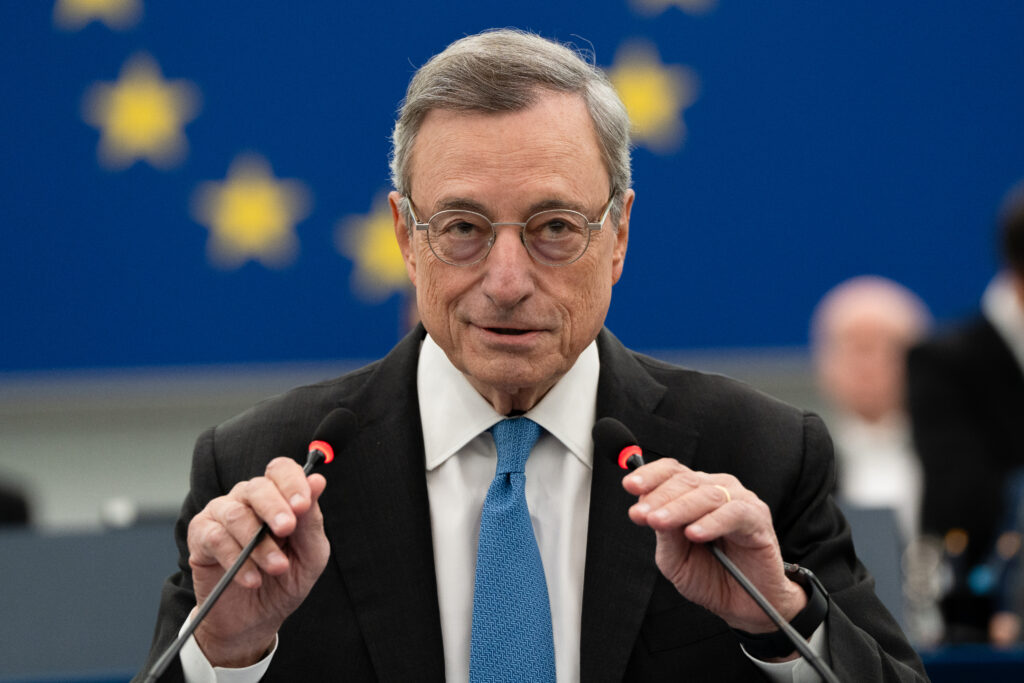

Mario Draghi, the former European Central Bank president and crisis manager whose 2012 vow to do “whatever it takes” helped save the euro, has delivered one of his starkest warnings yet to the European Union, declaring that “the current world order is dead” and cautioning that Europe risks becoming “divided, dependent and deindustrialised” unless it abandons political inertia and moves towards deeper integration.
Speaking at KU Leuven in Belgium, where the former official was awarded an honorary doctorate on Monday, Mr Draghi argued that the EU’s institutional model — designed for a cooperative, US-led world — is no longer fit for an era defined by geopolitical rivalry, industrial competition and economic coercion. Shielded for decades by American power and globalised trade, Europe could at one time afford slow decisions and fragmented authority; in a harsher global environment, that luxury is long gone.
Why Europe’s confderal model is breaking down
Mr Draghi urged the bloc to evolve into what he called a “genuine federation”, capable of acting decisively on defence, industrial policy and foreign affairs. Where Europe already pools sovereignty, he said, it “is respected and negotiates as one”. Where it does not, he suggested, it is sidelined, divided and vulnerable to pressure from other powers.
The urgency of Mr Draghi’s intervention reflects a convergence of shocks that have dismantled the assumptions underpinning Europe’s post-Cold War prosperity. The continuing unpredictability of Donald Trump’s second presidency—including his insistence on wielding tariffs as a cudgel and his renewed push to acquire Greenland—has underscored just how exposed Europe becomes when the old Atlanticist approach falls away.
Since returning to office, Mr Trump has moved towards highly transactional relationships that treat allies as competitors as much as partners — or worse.
You might be interested
How China turned economics into power
China’s state-backed industrial expansion has further fused economics with geopolitics, turning trade, technology and supply chains into instruments of power. Russia’s war against Ukraine meanwhile exposed Europe’s previous over-dependence on imported energy and external defence production, as well as the limits of a decision-making system that critics say struggles to act quickly precisely when speed is required.
Overlaying these pressures is a deteriorating economic picture, marked by weak productivity growth, capital flowing to the United States and chronic underinvestment in critical industries.
The Draghi effect
Although no longer in elected office, Mr Draghi’s words still carry a great amount of authority. He has become a central figure in the EU’s strategic rethink after being asked by Ursula von der Leyen to produce a landmark report on Europe’s competitiveness and long-term economic strength. That initial report helped frame the bloc’s current approach to competitiveness, arguing that Europe’s problem is not a lack of ambition but an inability to translate scale into power.
Mr Draghi’s relationship with von der Leyen is institutional rather than partisan, but strategically significant. His analysis has provided economic and intellectual ballast for the European Commission’s push towards a more assertive industrial policy and greater strategic autonomy, reinforcing the case for faster collective action and far higher levels of coordinated investment.
Borrowed time
The core warning is that Europe has been living on borrowed time. For years, it substituted regulation for power and consensus for strategy, assuming stability was permanent. Now Mr Trump has repeatedly upended trade and diplomatic norms, leaving Europe scrambling for coherence — most recently in the dispute over Greenland. Europe has adjusted even as leaders attempt to push forward efforts to secure a just and lasting peace in Ukraine, with the fourth anniversary of Russia’s invasion approaching.