
Exclude repayments on the EU’s pandemic-era borrowing? How much should Ukraine get? What price cohesion? Each of the disputes threatens to unpick the entire seven-year Multiannual Financial Framework, worth almost €2tn, which will dictate EU policies between 2028 and 2034.
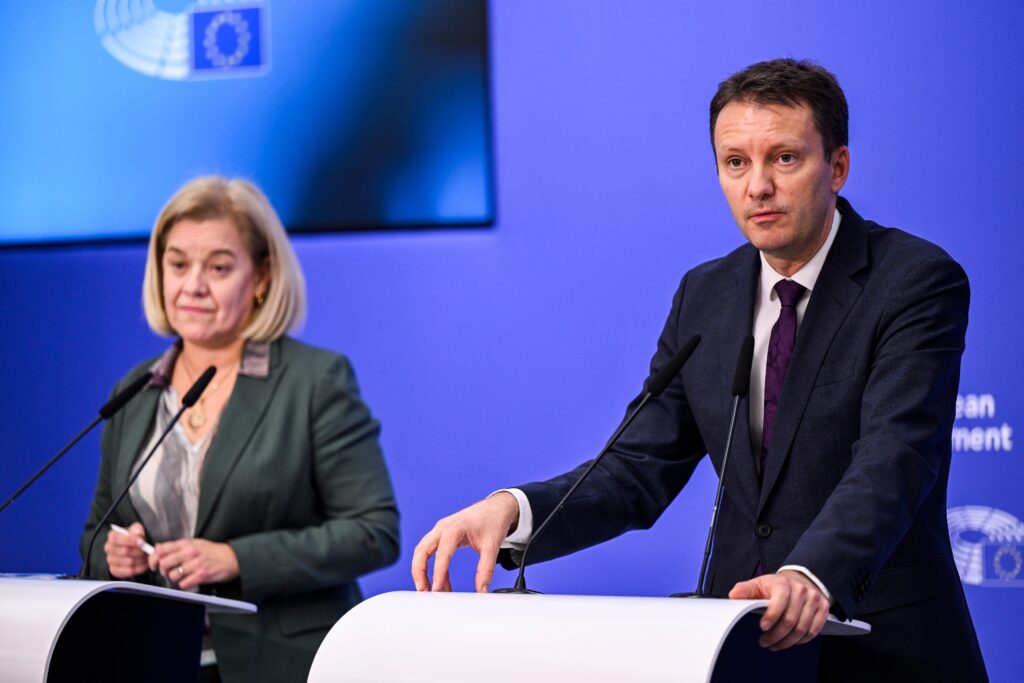
The European Parliament’s big brawl over the Union’s next long-term budget has begun. The budget committee session on Thursday, 5 February brought a taste of what is to come.
Rapporteur for the file, MEP Siegfried Muresan (EPP/ROU) laid down the gauntlet at the outset. “Once adopted, this will constitute the Parliament’s official mandate for the upcoming negotiations with the Council and the Commission on the MFF,” he told colleagues. He warned that over 1 000 amendments to the committee’s interim report had been tabled and pressed MEPs to declare their priorities before a 9 April vote.
Tug-of-war over the ceiling
Opponents argue that allowing debt-service costs to count as spending would squeeze out new programmes. With the Union preparing to repay its €800 bn of NextGenerationEU (NGEU) debt, every euro devoted to interest could displace money for farmers, researchers or regional aid.
MEP Carla Tavares (S&D/PRT) made her red line unmistakable. “For Parliament, it is not acceptable for the NGEU reimbursements to be included in the total amount of the MFF,” she declared in Portuguese. She reminded members that opinion committees have until 5 March to refine their input.
You might be interested

Excluding debt service would free roughly ten percent of the current envelope—about €200 bn—for fresh lines or top-ups. Fiscal hawks retort that the headline ceiling already hovers near 1.26 percent of the EU’s gross national income (GNI). Northern ‘frugal’ governments, they note, view anything above one percent as heresy.
Guarding the treaty pillars
MEP Isabel Benjumea (EPP/ESP) delivered the committee’s first group response. “Cohesion and agriculture remain treaty-based pillars of the European project and must not be undermined by a structural redesign of the MFF,” she warned, invoking Heading 1 (Investing in people, member states and regions). She backed the ten-percent lift to Headings 1-3 but insisted that core transfers stay intact.
She criticised the Commission’s idea of leaving 20 percent of each National and Regional Partnership Plan (NRPP) unallocated, labelling it “excessively high” and proposing five percent instead. Disaster-response capacity would still rise, she said, but “five percent flexibility combined with the European Union’s crisis facility guarantee should be sufficient.”
For Parliament, it is not acceptable for the NGEU reimbursements to be included in the total amount of the MFF. — MEP Carla Tavares (S&D/PRT), MFF co-rapporteur
Ms Benjumea championed research and defence, too. “We specifically want a substantial increase in Horizon Europe, raising its budget to $200 billion in current prices,” she said, alongside €5 bn boosts for Erasmus+ and the Connecting Europe Facility, plus €2 bn for civil protection.
Competing wish-lists
MEP Jean-Marc Germain (S&D/FRA) countered with a bigger number: 1.4 percent of GNI, or 1.8 percent if off-budget tools count. “We think, of course, that we hope to be more in line with the European priorities that we have to face and that are increasing every day,” he argued. His group would reroute €90 bn to restore the common agricultural policy (CAP) and cohesion funds to today’s levels.
He pressed for a dramatic uplift to the European Social Fund Plus (ESF+). “We are asking for ESF+ funds of 125 billion,” he said, up from €97 bn. The Socialists want separate budget lines for CAP, the European Regional Development Fund (ERDF), the Cohesion Fund and ESF+ so that national plans cannot shuffle cash unseen.
That call for ring-fencing jars with the centre-right’s emphasis on flexibility. It also re-opens the argument over the proposed “Multi-Fund”, which would merge five programmes—including CAP and fisheries—into one envelope per member state.
A war budget, or prudent security?
MEP Angéline Furet (PfE/FRA) fired the day’s sharpest volley. She branded the Commission proposal “a proposed war budget” that “takes money from farmers, regions and businesses and, in fact, provides it to Ukraine”. “We systematically reject any European decision to prolong the war in Ukraine and to finance this massacre,” she thundered, calling instead for EU cash to build walls as part of border surveillance.
We specifically want a substantial increase in Horizon Europe, raising its budget to $200 billion in current prices. — MEP Isabel Benjumea (EPP/ESP)
The European Conservatives and Reformists offered a cooler critique. Reading for Roberts Zīle (ECR/LAT), the speaker warned that national plans risk “fragmentation of the single market” and demanded more funds for cross-border transport, defence and migration control, plus greater room to respond to floods and fires.
MEP Fabienne Keller (Renew/FRA) shifted the spotlight from spending to income. “A strong, ambitious EU budget means having own resources and a long-term perspective,” she said. She urged colleagues to lean on the Council to approve a carbon border adjustment mechanism (CBAM) and a digital levy. Without fresh income, she argued, the MFF will buckle under national resistance.
Counting the cash
From the Greens, MEP Rasmus Nordqvist (Greens-EFA/DNK) pitched an even higher ceiling—1.5 percent of GNI including NGEU payments—and stressed the need for “flexibility in the budget to be able to respond to the challenges we are facing”. He lamented the threatened demise of LIFE, the nature fund. “We need biodiversity if we want agricultural production and a beautiful Europe to live in,” he said.
MEP Sandra Gómez-López (S&D/ESP) then reminded members that ambition demands revenue. “There must be enough MFF to implement new priorities without forgetting our old traditional priorities,” she said. She called the Commission’s initial own-resources package “a bare minimum” and floated a digital tax among other ideas.
MEP Thomas Geisel (NI/DEU) echoed the warning. “Without a strong own resources package, we would not have been able to achieve Parliament’s priorities on the expenditure side,” he insisted, urging colleagues to devise alternatives if Council baulks at Brussels’s proposals.
Balancing act
Mr Mureșan summed up the dilemma. “We can’t say we want to spend a lot, we don’t have the revenue, so it’s better to generate it,” he said, promising “a clear, predictable and strong fund for the common agricultural policy and regional policy” while remaining “innovative and forward-looking” on research. He ended with a warning that “whoever receives European funds needs to respect European values.”
We systematically reject any European decision to prolong the war in Ukraine and to finance this massacre. — MEP Angéline Furet (PfE/FRA)
Ms Tavares closed with a culinary metaphor. “You can’t make an omelette without breaking some eggs, so it will be some work to increase the MFF,” she said, urging colleagues to pick what matters most to citizens.
The session exposed deep splits over size, scope and structure. Members disagree on shielding farmers versus funding Ukraine, on ring-fencing versus flexibility and on whether debt service belongs inside the ceiling. Yet unanimity among 27 governments, plus Parliament’s consent, is needed before the current framework expires in 2027.
The battleground ahead
Russia’s war, climate disasters and tech rivalry with China all press for more money. A €100bn Ukraine Reserve already sits under so-called Heading 3 (covering external action, while Heading 1 shelters CAP and cohesion, and Heading 2 bundles research, defence and industry). Defence and migration lines crowd traditional programmes. Green groups fear the 35 percent climate-spending target will be met only on paper; trade unions fret that a merged Multi-Fund will erode job-training guarantees.
Next steps are tight. Opinion committees file views by 5 March; shadow negotiators haggle through spring; a first committee vote is set for 8-9 April. Diplomats in capitals already pore over numbers, aware that failure could force a rollover of the current MFF—freezing old priorities just as new crises bite.
If Parliament insists on excluding debt repayments, the Council may demand a lower ceiling. Should member states refuse new levies, MEPs must trim programmes. If neither side budges, Europe risks entering 2028 without a fresh budget, hamstringing efforts to fund climate action, social justice and Ukraine’s survival. The opening debate shows appetite both for austerity and ambition. Whether that appetite yields compromise or stalemate will determine how Europe spends—and what Europe does—from 2028 to 2034.