
Brussels wants young Europeans to spend less time worrying about malicious messages and more time learning. On February 10th the European Commission released ‘Safer online, stronger together‘, a 30-page action plan that tackles cyber-harassment of children.
The Commission argues that the internet’s gains—unrestricted knowledge, instant camaraderie—are now matched by threats, from grooming to addictive algorithms. One in six pupils aged 11-15 reports being bullied online; one in eight confesses to having done the bullying. Such numbers, says the paper, demand a united continental response.
The strategy rests on three pillars. First comes protection. Brussels will reinforce existing statutes, notably the Digital Services Act, the Audiovisual Media Services Directive and the forthcoming Artificial Intelligence Act. Each will acquire child-safety add-ons. Guidance under the Digital Services Act will speed up removals of posts that target minors. The review of the Audiovisual Media Services Directive will extend safeguards to video-sharing and livestream platforms. Meanwhile the AI Act will oblige providers to label synthetic content and curb recommendation engines that fuel pile-ons.
Better data will stiffen enforcement. The Commission wants national authorities to adopt a single definition of cyberbullying, producing statistics that can be compared across borders. New rules for “trusted flaggers”, a guild of accredited watchdogs, will demand swift takedowns. Officials believe that consistent numbers and common vocabulary will allow cross-border cases to be handled as easily as domestic ones.
You might be interested

Continental classroom
A second pillar is prevention and awareness. Digital education will start early and touch everyone. Teacher guidelines will be freshened; critical-thinking modules on disinformation will slot into school timetables. Erasmus+ funds will bankroll exchanges of lesson plans, while Safer Internet Centres will coach parents and pupils. Brussels will roll out what it calls an EU “citizenship competence” framework, so that the next generation recognises a smear campaign as readily as a misspelt noun.
Children are not merely targets of instruction; they are partners. The plan insists that youngsters help design the very tools meant to shield them. Annual events such as Safer Internet Day, already a fixture in many schools, will give them the podium. Platforms, NGOs and public bodies will publish transparency dashboards, letting teenagers judge whether promises have been kept.
Money follows words. The Commission expects a trickle of grants from 2026 to 2029, channelled through Horizon Europe and other pots. Officials reckon that aligning dozens of national curricula will cost less than repairing the mental-health damage wrought by tormentors armed with smartphones.
Panic-tap politics
The third pillar covers swift reporting and wrap-around support. Brussels will commission a model smartphone application, co-designed with victims’ groups and helplines. The software allows users to capture evidence, block abusers and summon counsellors. Member states must localise the app yet keep it interoperable, so aid follows children on school trips across borders.
We need big tech companies to take the responsibility of what happens online on their platforms. — MEP Alex Agius Saliba (S&D/MLT)
Victim services dovetail with broader reforms. The EU victims’-rights strategy will be updated to recognise online harassment as a distinct harm. Data-protection rules for minors will tighten. Firms that fail to throttle hateful content could face stiffer fines under the Digital Services Act. A senior official mutters that Brussels has grown tired of “voluntary” pledges that last only until the next earnings call.
Deadlines abound. Guidance under the Digital Services Act should appear within months. By 2027 every school ought to teach the new literacy modules. The support app must be live in all member states by 2028; a full review of progress is pencilled in for 2029.
Strasbourg speaks
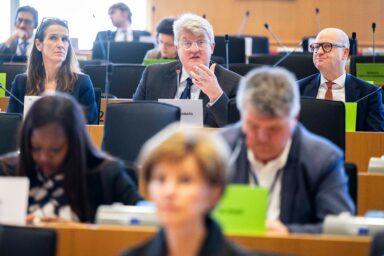
Commission plans rarely travel unscathed through Parliament. Yet Ms Henna Virkkunen, executive vice-president for a digital Europe, strolled into the Strasbourg chamber in confident mood. “This day highlights the importance of making the internet a better place for everybody, especially our children and young people,” she told MEPs. She boasted of Europe’s global lead: “In Europe, we can be proud of our unique framework to protect minors online, at its core is the Digital Services Act, requiring that all platforms accessible to minors ensure a very high level of privacy, safety and security.”
Ms Virkkunen sketched recent enforcement. TikTok had been warned for “addictive design features”. Snapchat, YouTube and both app stores had received information requests. X faced new scrutiny over an AI model known as Grok. “The guidelines serve as a very powerful addition for enforcing our online safety rulebook,” she said, before concluding: “I look very much forward to hearing your views on this important topic, and I count on your support in protecting and empowering our children and youth online.”
Support came first from MEP Ewa Kopacz (EPP/POL). “For a child experiencing violence, be it in the real world or online, every day lived in fear, shame and a sense of loneliness is one day too many,” she began. Ms Kopacz, a former Polish prime minister, likes law’s sharp edge. “Platforms and social media must finally treat the safety of the youngest internet users as a priority, and they should stop getting rich at the expense of their mental health,” she declared. She praised the common definition of cyberbullying but warned that criminal codes must still be rewritten. “Let us remember the role of adults is not only to protect, but also to wisely accompany children in their digital journey.”
Politics of pain
The Socialist benches heard an echo of private dread. MEP Alex Agius Saliba (S&D/MLT) invoked a local tragedy. “There is nothing worse for a parent than seeing your child suffering,” he said, recalling the suicide of a 15-year-old tormented about his looks. Mr Saliba applauded the Digital Services Act—“a key achievement of our socialist group”—and stiffened the message: “We need big tech companies to take the responsibility of what happens online on their platforms.” Enforcement, he added, required properly financed trusted flaggers. Still, he ended on a hopeful note. “I am hopeful that we can make a positive change as lawmakers and reverse this trend.”
National pride surfaced next. MEP Annamária Vicsek (PfE/HUN) pitched Hungary’s home-grown answer. “The digital welfare program under the Fidesz government has put forward a new strategy to protect children, to make the online world child-friendly,” she said. Brussels should learn, not lecture. “If the EU wants to give a really good answer to this problem, we don’t need general censorship, but we should build on already well-functioning member state examples.”
The mental health of our young people is not for sale and will not be determined by algorithms focusing only on the profits of their owners. — MEP Veronika Cifrová Ostrihoňová (Renew/SVK)
On the Eurosceptic right, MEP Lara Magoni (ECR/ITA) framed the fight in moral terms. “Cyber bullies can have a profound effect on life itself,” she warned. Ms Magoni, a former downhill skier, urged investment in school gyms as well as firewalls. “We must invest in education,” she said, adding that young people need the values conveyed by team sport. “Defending our young people online is a political, moral and human duty.”
Liberal angst, green fury
Renew Europe looked east. MEP Veronika Cifrová Ostrihoňová (Renew/SK) attacked Slovakia’s constitution for limiting sexual education. “We need to create healthy communities, healthy relationships, safe environments,” she insisted. Silicon Valley’s allure left her cold. “The mental health of our young people is not for sale and will not be determined by algorithms focusing only on the profits of their owners.”
MEP Anna Strolenberg (Greens-EFA/NLD) said gender coloured every byte. “The online world is not safe for young people,” she began, noting that 99 per cent of deepfakes target women. Ms Strolenberg tore into Elon Musk, whom she called “pornographer-in-chief“: “They have proved time and time again that they will not change a single line of code if it costs them a single euro of profit.” She backed a petition to ban ‘nudify‘ apps and closed with a reminder: “Online abuse is abuse.”
From the hard left came louder thunder. MEP Isabel Serra Sánchez (The Left/ESP) linked the web’s bile to parliamentary language. “Violence starts here, violence is made legitimate here, and then it multiplies and spreads online,” she said, accusing social networks of serving “friends of Trump, friends of Epstein”. Her prescription was sweeping: “The only real way forward is to get social networks out of the hands of private powers and into the hands of the people.”
Civil-liberties alarm
Not everyone sought tougher law. MEP Christine Anderson (ESN/DEU) argued that Brussels hides mass surveillance behind child-protection rhetoric. “Governments pretend to care about children to propose the most intrusive measures,” she said, dubbing the proposed scanning of private messages “a ruse”. Cyberbullying, she concluded, should be policed by “parents, school, and local communities,” not by a continental ‘Ministry of Truth‘.
If the EU wants to give a really good answer to this problem, we don’t need general censorship, but we should build on already well-functioning member state examples. — MEP Annamária Vicsek (PfE/HUN)
Ms Virkkunen retorted that the plan preserves privacy by limiting scans to flagged content and by keeping artificial-intelligence tools outside the phone unless and until harm is suspected. Critics remained sceptical, but the majority applauded. Parliament will vote on a non-binding resolution next month; formal legislation, where needed, will follow later in the year.
Europe’s quarrel is less about ends than means. Few dispute that children deserve a childhood free from digital torment. The question is whether the Commission’s blend of statute, software and citizenship will work. Some MEPs fear foot-dragging by national governments; others mistrust Brussels’s appetite for rules. The tech industry, scenting tighter oversight, complains of red tape.