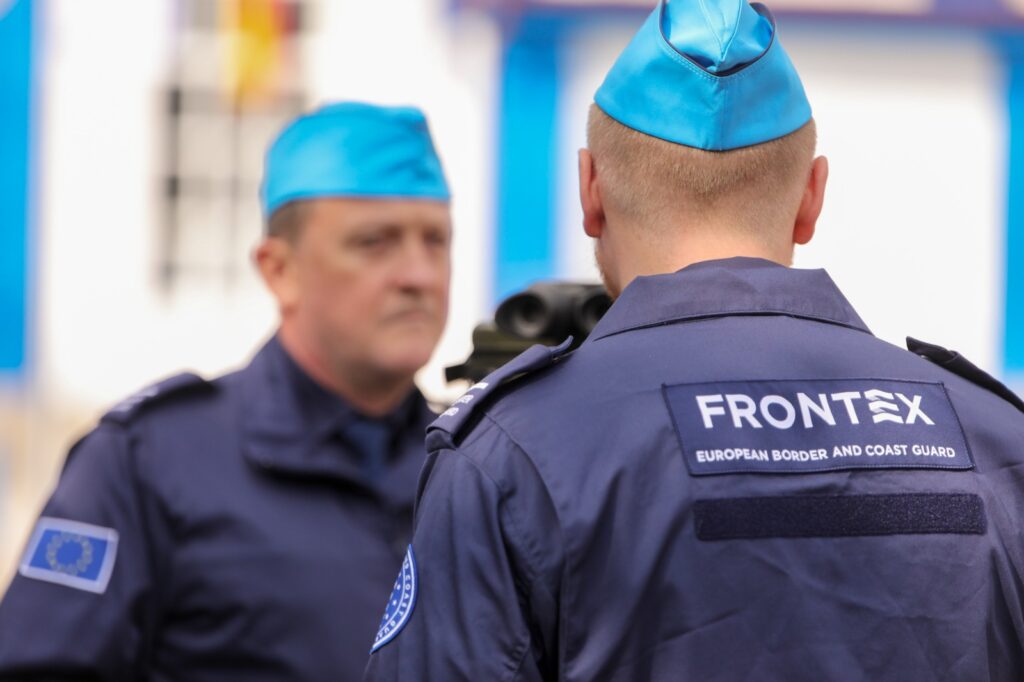

The European Border and Coast Guard Agency (Frontex) is set to receive a reform proposal from the European Commission by summer 2026. Some watchdogs and MEPs—like Statewatch and the member of the LIBE Committee Cecilia Strada—are trying to figure out how the new Frontex could be.
“Ever since Frontex was set up, one of our main concerns has been the granting of powers—including executive powers, for example to carry out border checks, carry and use weapons, and so on—to an unaccountable agency”, said Chris Jones, Director of Statewatch, to EU Perspectives.
MEP Cecilia Strada (S&D/ITA) claimed that if Frontex is to be reformed, “it must be for the better, with clear and certain rules of engagement, and a total guarantee of respect for the rights of people, of all people”.
Long story short
As the Magnus Brunner, Commissioner for Home Affairs and Migration, said in September 2025, Frontex had 1,239 of its own staff, 880 officers seconded long-term by member states, and 4,946 seconded short-term. The planned target for 2025 was slightly higher: 2,000, 1,000, and 5,000 respectively. The European Commission will present a proposal in 2026 to revise the rules, after consulting the public, in June or July.
However, more than a decade ago, the Commission funded a report that set out options for Frontex’s development. “The planned end state was a unified border agency controlled by a faceless committee in Brussels—making Europe’s violent and deadly border policies even-less accountable to the general public. We are not at that point yet, and we may never get there, but we are certainly much further down that road than we were just six years ago”, Director Jones explained.
You might be interested
Returns and return hubs
On returns, “we’ll have to wait and see what happens—if Council proposes to expand Frontex’s mandate, allowing the agency to send teams to non-EU countries to coordinate repatriations from one country to another, we will strongly oppose it”, said Ms Strada to EU Perspectives. “It would be yet another step toward the outsourcing of border management that the European right-wing parties, and especially the Italian right-wing government, so favor. The problem is that we have already seen very clearly, with the failed Albanian model, what this means: unspeakable suffering for the most vulnerable and the erosion of the protection of the rights on which the EU is founded”, she concluded.
If Council proposes to expand Frontex’s mandate, allowing the agency to send teams to non-EU countries to coordinate repatriations from one country to another, we will strongly oppose it. – MEP Cecilia Strada (S&D/ITA)
According to Statewatch, Frontex may well get the power to conduct ’pre-departure checks’ on people travelling from Western Balkans states—a lot of return hubs are planned to be settled there with the new EU’s Pact for Migration and Asylum upcoming in summer. “It is important to note that many member states already have officials deployed in foreign states to carry out controls on people, before they have even left the country”, explained Mr Jones. Moreover, by the end of 2026, Frontex will be responsible for carrying out digital pre-departure checks on many millions of people, once the European Travel Information and Authorisation System (ETIAS) comes into operation. It will host the Central Unit, where people’s ’travel authorisation’ applications will be screened by algorithms.
Drones and counter-drones
Regarding the specific possibility of Frontex taking in ’counter-drone’ work, “this appears to be another opportunity for the EU’s most expensive agency to swallow vast quantities more of public funding as it seeks to further develop Fortress Europe—albeit with the enemy this time being foreign governments, rather than people seeking safety and opportunity”, added Director Jones. For Statewatch, this mingling of military and immigration policy objectives is already dangerous and giving Frontex new powers in this area would do nothing to resolve that.
From returns to drones, the same applies to the potential green light. “The European far-right knows well that hybrid threats cannot be addressed by giving Frontex the power to use drones to push people back into the Mediterranean. It’s merely an excuse to build an increasingly coercive and liberticidal Europe”, MEP Strada said.
So far no specific legal reforms have been proposed. It is neither possible to say what the precise consequences are, nor what Frontex may be allowed to control or not. Unofficial documents from the member states, however, give a good indication of what they are after in the planned reform.