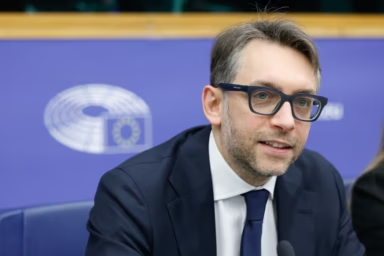

The EU has long profited from the World Trade Organisation’s rules-based trading system. At a time of growing protectionism, geopolitical rivalry and rising trade distortions, it is in Europe’s direct strategic interest to lead efforts to reform the organisation and ensure it remains effective and fair. That is what a (soon-to-be-published) study, presented in Parliament this week, concludes.
The study, written by Professor Stephen Woolcock, Tobias Stoll, Jan Hagemejer, Zaker Ahmad and Oskar Chmi, points to a specific pillar of World Trade Organisation (WTO) which is closely intertwined with the EU’s prosperity: the so-called Most-Favoured-Nation (MFN) principle. It requires countries to treat all WTO trading partners equally; if one country grants a lower tariff to one member, it must extend the same tariff to all others.
This rule guarantees predictability and non-discrimination. Small and medium-sized enterprises rely heavily on that principle, as it ensures stable export conditions and avoids having to navigate complex bilateral arrangements.
In 2024, 79.4 per cent of total EU imports were subject to MFN tariffs, offering certainty for supply chains. Although the share of extra-EU exports benefiting from MFN treatment has declined over the past decade, it still accounted for 47.6 per cent of EU exports in 2024, and makes the MFN crucial for the EU’s wealth.
You might be interested
System under pressure
Yet, in a world of latent trade wars and proliferating bilateral agreements, MFN is increasingly under fire.
The EU itself has proposed giving WTO members more flexibility to adjust tariffs, an attempt by Brussels to deal with a weakening multilateral system. Faced with US tariffs and what it sees as market distortions from China, the EU argues that the current balance of rights and obligations no longer reflects economic realities.
We must rethink how the ‘most favoured nation’ principle functions and whether the current balance of rights and obligations remains fit for purpose. – Maroš Šefčovič, Commissioner for Trade and Economic Security
“We must rethink how the ‘most favoured nation’ principle functions and whether the current balance of rights and obligations remains fit for purpose,” Maroš Šefčovič, Commissioner for Trade and Economic Security, recently wrote in an opinion piece in Financial Times.
But those remarks, in combination with the study that was presented in Parliament earlier this week, caused confusion among MEPs. Karin Karlsbro (Renew/SWE) and Catarina Vieira (Greens/NLD), for example, questioned how the EU can simultaneously defend the multilateral order and propose changes to one of its foundational principles.
Bernd Lange (S&D/DEU), Chair of the European Parliament’s Trade Committee, warned that the EU must defend MFN on tariffs but acknowledged that plurilateral initiatives—agreements among subsets of WTO members—may “by definition challenge MFN” while allowing progress where full consensus is impossible.
Jörgen Warborn (EPP/SWE) underlined the need for the EU to take a leadership role, arguing that Europe cannot afford to remain passive while the system weakens.
Middle powers to act together
A key question pointed out by Professor Woolcock is whether the United States can be counted on—of course a crucial partner for the survival of the WTO—and to what extent it remains serious about the organisation’s principles.
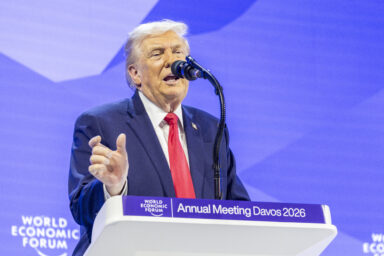
In that regard, Mr Woolcock also referred to Canadian Prime Minister Mark Carney’s speech at the World Economic Forum, in which he said: “The middle powers must act together, because if we’re not at the table, we’re on the menu.”
If the United States is not fully engaged in the WTO, it needs the middle powers to make progress. – Professor Stephen Woolcock
That advice, Mr Woolcock argued, is highly relevant in this context. “If the United States is not fully engaged [in the WTO], it needs the middle powers to make progress.”
Workarounds
Several MEPs referred to so-called plurilateral agreements as an example of those middle powers taking matters into their own hands. Plurilateral agreements are deals among willing subsets of WTO members—which are being considered to advance reform where full consensus, required for WTO decisions, is impossible.
Mr Lange noted that “the growing reliance on plurilaterals suggests the principle is evolving in practice,” offering a pragmatic route for progress without abandoning core WTO norms.
Developing countries. Really?
Beyond trade wars, another sensitive issue for the EU concerns ’developing country’ status within the WTO. Some countries have now become large economies but continue to benefit from flexibilities that allow them to avoid certain commitments under WTO rules.
China, for example, retains developing country status despite accounting for a significant share of global trade. For some European policymakers, this creates structural imbalances. Ms Karlsbro also pointed to fierce competition in sectors such as pharmaceuticals from countries like Thailand, which also benefit from developing country status within the WTO.
An important milestone will be the WTO Ministerial Conference in Cameroon in March. But the outcome will depend heavily on the agenda—itself subject to consensus among members.