
The European Union can no longer wait for its slowest members. When the German Chancellor says this, you know a seismic shift is underway. Effectiveness is the name of the new game; unanimity, legal purity—and, in the eyes of some, democracy itself—take the back seat.
Europe’s leaders once dismissed talk of an ‘EU army‘ as dinner-table fantasy. Now they are busy sketching troop numbers. Friedrich Merz, German Bundeskanzler declared that the union must be able to field “between 100,000 and 300,000 soldiers”, and soon.
The pledge is still aspirational. Today the EU can mobilise only a 5,000-strong Rapid Deployment Capacity (RDC). Yet the political ground is shifting. Mrs von der Leyen urges Europeans to “bring Article 42.7 to life”. Capitals that long hid behind NATO now confront a receding United States, a protracted war in Ukraine and veto-wielding populists at home. The result is an unsentimental drive for mass that would once have seemed un-European.
No more waiting
The effort now rests on improvisation. The RDC, mandated by the 2022 Strategic Compass, will not reach full readiness before the end of next year and is two orders of magnitude below Mr Merz’s target. Funding tools remain modest: the European Defence Fund stands at €7.3bn for 2021-27; the off-budget European Peace Facility holds €17bn; the entire EU line for defence in 2025 is a paltry €1.8bn. Article 42 of the Treaty on European Union (TEU) allows national forces to be made available for joint missions, but every large combat deployment so far—France in the Sahel, Poland on NATO’s eastern flank—has been organised nationally or through the alliance, not by Brussels.
Mr Merz thinks procedure, not fire-power, is the real brake. “It can’t be that it’s always the last one that sets the pace.” He has also told the Bundestag: “I could have imagined that everyone would agree, but if that’s not possible, a decision must be taken by qualified majority.”
You might be interested
Those remarks framed the EU’s approval, by 24 member states, of a €90bn interest-free loan to Kyiv and, in January, the passage of the Mercosur trade deal against France’s objections. Both acts used enhanced co-operation under Article 20 TEU—a legal escape hatch that requires unanimous authorisation once and thereafter lets nine or more willing states forge ahead. The message is clear: effectiveness, not universality, will drive the next phase of integration.
Leaving slowcoaches behind
The triggers for this impatience lie outside Brussels. Brexit proved that membership is reversible; Russia’s full-scale invasion of Ukraine shattered illusions of perpetual peace; US President Donald Trump’s threats to “take” Greenland reminded Europeans that Article 5 of the North Atlantic Treaty may not always shelter them.
Meanwhile Viktor Orbán in Hungary and Robert Fico in Slovakia exploit the unanimity rule to stall sanctions or migration reform. The Franco-German axis no longer guarantees momentum. Berlin alone has budgeted €11.5bn in military aid for Ukraine this year while Paris quibbles about fighter projects; doubt over who will occupy the Elysée after 2027 adds urgency.
I could have imagined that everyone would agree, but if that’s not possible, a decision must be taken by qualified majority. — Friedrich Merz, the German Bundeskanzler
Hence the proliferation of mini-clubs. German Foreign Minister Johann Wadephul convenes an E5 (Germany, France, Britain, Poland, Italy) and “Weimar plus” (France, Germany, Poland, Italy, and High Representative Kaja Kallas). Mr Merz, Mr Macron and British Prime Minister Keir Starmer huddle as an E3, arguing that “given the absence of the US, at least the three militarily and economically strongest European countries must adopt a common line”. Similarly, German Finance Minister Lars Klingbeil has launched an E6—adding Spain and the Netherlands—to bulldoze a capital-markets union. Critics decry fragmentation, but the habit of waiting for 27 signatures is dying.
Too much flexibility?
Europe’s legal bedrock does not, for now, match the ambition. Article 42.7 TEU, the mutual-assistance clause, is flexible and fast: any victim of “armed aggression” may invoke it unilaterally; partners then decide what “all the means in their power” entails. It has been activated only once, by France after the 2015 Paris attacks. By contrast, NATO’s Article 5—invoked only after 9/11—rests on integrated commands, pre-planned forces and, crucially, the American nuclear umbrella.
Article 42.7 offers none of that. It reads: “If a Member State is the victim of armed aggression on its territory, the other Member States shall have towards it an obligation of aid and assistance by all the means in their power, in accordance with Article 51 of the United Nations Charter.” The clause further states: “This shall not prejudice the specific character of the security and defence policy of certain Member States.”
Finally, it insists: “Commitments and cooperation in this area shall be consistent with commitments under the North Atlantic Treaty Organisation, which, for those States which are members of it, remains the foundation of their collective defence and the forum for its implementation.”
Loose bolts in the legal chassis
Article 42.7’s promise evaporates without troops and cash. The Franco-German expert group that reported in September 2023 concluded that a 100 000-plus standing force would require rewriting Maastricht’s Article J.4, scrapping references to the moribund Western European Union and replacing the phrase “might in time lead” with a binding commitment.
If a Member State is the victim of armed aggression on its territory, the other Member States shall have towards it an obligation of aid and assistance by all the means in their power, in accordance with Article 51 of the United Nations Charter. — Article 42.7, Treaty on European Union
Unanimity, now obligatory for all defence decisions under Article 42(4) TEU, would have to yield to qualified-majority voting (QMV). A permanent corps would need its own budget line inside the Multi-annual Financial Framework, not ad-hoc raids on the Peace Facility. Neutrality clauses protecting Austria, Ireland and Malta would need opt-outs or rewording; otherwise constitutional courts will pounce.
Treaty change, though, is tortuous. All 27 parliaments must ratify, some after referendums. Mr Merz therefore touts a “two-speed Europe”. Six states—Germany, France, Italy, Spain, Poland, Netherlands—would fold deeper defence planning into Permanent Structured Co-operation (PESCO); others could join later. Enhanced co-operation under Article 20 would let the core adopt binding acts.
Freer hands
A treaty-outside-the-treaty, modelled on the fiscal compact, could give the group freedom to use QMV internally while enjoying Commission expertise. CEPS, a think-tank, notes that none of these paths “would require amending the Treaties provided the group is willing to pool procurement budgets and accept QMV for internal decisions”.
A harder legal nut is the exclusion of measures “having military or defence implications” from the passerelle clauses—short-cuts that otherwise allow leaders to shift unanimity files to QMV without national ratification. The Franco-German report proposes to skirt the ban by re-labelling defence-industrial subsidies as internal-market measures, a trick already used for the 2023 SAFE Act.
Smaller states call this sleight of hand. Hungary rails against a “war-economy logic” imposed by Brussels. Legal scholars warn that operational deployments still fall under Article 42(4) TEU and therefore require unanimity even if procurement does not. That grey zone could land in the European Court of Justice.
From words to brigades
Yet numbers matter. Only eight EU countries now field armies larger than 40,000. A pooled force of 200 000 soldiers would cost €30–40bn a year—equal to the bloc’s entire agricultural budget. The Readiness 2030 plan asks member states to pump €800bn into defence this decade; but EU-level money remains minuscule. Industrial giants—Dassault, Airbus, Leonardo—support integration because it disciplines procurement cycles; small suppliers fear crowd-out. Northern “frugals” balk at another shared pot when they already spend over two per cent of GDP on defence.
Two further obstacles loom. First, the absent nuclear guarantee. France alone holds the bomb. President Emmanuel Macron has offered only a “strategic dialogue”. Whether a National Rally government after 2027 would extend deterrence to Warsaw or Tallinn is guesswork.
This shall not prejudice the specific character of the security and defence policy of certain Member States. — Article 42.7, Treaty on European Union
Second, capability gaps. Europe still depends on American strategic air-lift, missile defence and satellite intelligence. The RDC’s 5 000 troops cannot plug those holes. Nor does the EU yet own an equivalent to NATO’s Supreme Allied Commander Europe. Without such command-and-control the biggest army in history would resemble a militia.
A map of the legal minefield
1) Article 20 TEU: enhanced co-operation: one unanimous authorisation, thereafter nine or more states may act.
2) Article 31 TEU: CFSP decision routes:
– 31(1) constructive abstention lets a dissenter stand aside without blocking action.
– 31(2) referral allows the Council, by QMV, to bump a file to leaders if one state cites “vital reasons”.
– 31(3) passerelle can shift non-military foreign-policy areas to QMV, but defence issues stay protected.
3) Franco-German fixes: raise QMV to 60 per cent of states representing 60 per cent of the population; introduce “unanimity-minus-one” for sovereignty-sensitive matters; permit opt-outs where QMV is extended.
Neutral, Atlanticist, fiscally hawkish
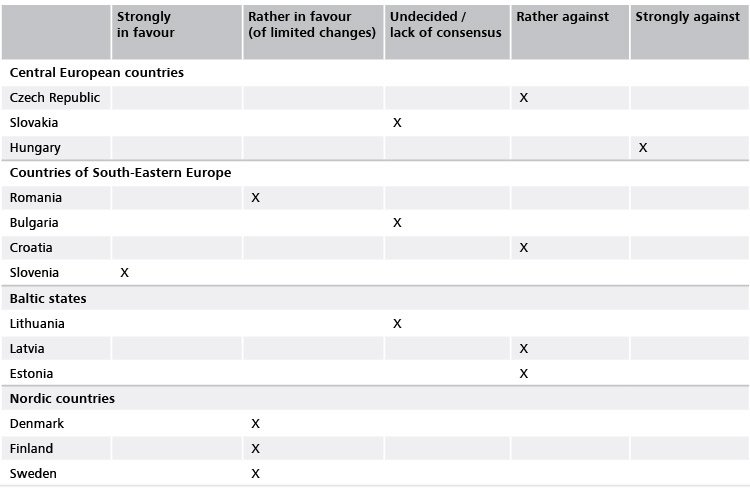
Politics may yet scupper technical ingenuity. Austria’s latest poll shows 78 per cent still back neutrality; only 22 per cent would join an alliance. Ireland and Malta echo that ambivalence. Denmark, the Netherlands and the Baltic states fret about NATO duplication. Fiscal hawks in Sweden and Finland dislike a new EU budget line when they already meet their own spending pledges. The European Parliament, bullish on QMV for defence funding, has no formal say over troop deployments—but national parliaments, especially the Bundestag and Italy’s Camera, do, and they guard war powers jealously.
Populists sense an opening. Marine Le Pen calls the aforementioned Mercosur vote “undemocratic” and will hammer it in 2027. Mr Orbán frames QMV as an existential threat to sovereignty. Left-wing critics warn that a German-led core entrenches an imperial hierarchy. Even supporters admit risks. A “permanent inner circle” could hard-wire first- and second-class membership. Late-joiners may face higher thresholds; candidate countries worry that complex concentric circles will slow their accession.
The Parties agree that an armed attack against one or more of them in Europe or North America shall be considered an attack against them all and consequently they agree that … they will assist the Party or Parties so attacked by taking forthwith … such action as it deems necessary, including the use of armed force. — Article 5, North Atlantic Treaty
Still, the alternative looks worse. Between 2016 and 2023 the Franco-German working group counted 48 CFSP acts blocked because one capital threatened a veto. Hybrid attacks on undersea cables, Russian sabotage in Germany and Chinese pressure on Lithuania show that threats now move faster than Brussels can decide. The European Peace Facility, designed to reimburse lethal aid, took nine months and 27 signatures to refund ammunition sent to Ukraine. A high-tempo crisis—Greenland, Kaliningrad or Kosovo—would expose the gap between ambition and capacity.
Article 5 versus Article 42.7
The logic of a European force rests on closing that gap. NATO’s Article 5 runs: “The Parties agree that an armed attack against one or more of them in Europe or North America shall be considered an attack against them all and consequently they agree that … they will assist the Party or Parties so attacked by taking forthwith … such action as it deems necessary, including the use of armed force.”
That single, breathless sentence is backed by pre-positioned American armour and a nuclear umbrella. Europe’s equivalent so far is paper. The cost of inaction is high. If Ukraine joins the EU before NATO and Russia tests Article 42.7, a limp response would prove EU solidarity hollow; a robust one could drag 26 capitals into a war still reliant on Washington’s assets.
First, plug-and-play planning. The Strategic Compass promised scenarios; it must deliver detailed orders of battle and supply chains. Second, funding. Scaling the Peace Facility, or creating a dedicated line of €30bn a year, would give teeth to procurement pledges. Third, ink an EU-UK defence accord so that Britain, Europe’s other heavyweight, can “dock” forces when NATO chokes. Fourth, settle the nuclear question. Dual-key arrangements or a European nuclear planning cell would reassure allies and warn foes. Fifth, speak with one voice. Mixed signals—Paris suggesting troops in Ukraine, Berlin denying it—sap deterrence.
Towards the mid-2030s
Even if politics co-operates, a 200,000-strong EU force will not form overnight. Negotiating a treaty revision, passing 27 ratifications and building units could stretch to the mid-2030s. Without a treaty, a core six could start sooner inside PESCO, but they would still lack legal certainty for automatic mutual defence. Neutral members would sit outside; fiscal hawks could balk at sharing costs; industrial squabbles over fighters and tanks would persist.
It can’t be that it’s always the last one that sets the pace. — Friedrich Merz
Yet the direction of travel is unmistakable. Enhanced co-operation is likely to get Ukraine its €90bn loan; QMV sent Mercosur over France’s objections; mini-clubs are multiplying. Mr Merz’s dictum—effectiveness before unity—has become conventional wisdom in Brussels. Treaties matter, but so does momentum. Europe has discovered that, in security as in trade, size counts.
If the project succeeds, the Union will gain strategic autonomy, mend the credibility of Article 42.7 and share burdens with the United States on more equal terms. Failure would signal to Moscow, Beijing or a hostile Washington that Europe cannot defend its own frontiers. The choice is stark, and the clock is ticking. A decade ago the idea of 200,000 European soldiers sounded fanciful. Today it sounds merely difficult. In Brussels that passes for a revolution.