
After weeks of back and forth over the ‘Made in EU’ requirements—and 44 last-minute changes to the draft text—the European Commission adopted the Industrial Accelerator Act (IAA) on 4 March. The talks culminated in a cabinet chiefs’ meeting that ran from Monday into Tuesday.
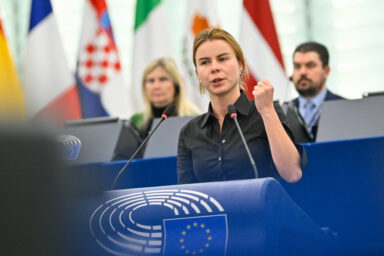
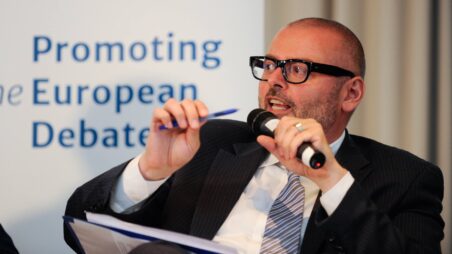
“If we want to strengthen Europe’s competitiveness, we need urgent, practical measures that make it easier to invest, innovate and produce in Europe. This means cutting unnecessary complexity, mobilising private capital, and ensuring that Europe remains a reliable and attractive place to manufacture,“ said MEP Raúl De La Hoz Quintano (EPP/ESP) in an EPP statement, after the European Commission presented the IAA today.
The IAA, over a year in the making, uses public procurement and public incentives to boost demand for low-carbon, European-made products and net-zero technologies. The goal it puts forward: raise manufacturing’s share of EU GDP from 14.3 to 20 per cent by 2035. The Commission frames it explicitly as putting the Draghi competitiveness report into action. It is to amount to an ‘insurance policy’ for strategic economic independence.
A potential job creator
According to the Commission, the IAA will “create or preserve” 150,000 jobs. The ‘preserved’ figure, however, is a modelled counterfactual and will be impossible to verify in practice. This creation or preservation centers on battery projects (85,000) and solar manufacturing (58,000). The commission also states that it aims to safeguard existing jobs in steel, aluminium, and cement through the transition.
By 2030, the Commission projects it will add €10.5bn across the automotive value chain and over €600m in added value for steel, aluminium, and cement. All while saving 30.58m tonnes of CO₂ in energy-intensive industries.
You might be interested
The IAA covers energy-intensive industries and net-zero technologies ranging from batteries and solar PV to heat pumps, wind, electrolysers, and nuclear. Together these sectors account for 22.5 per cent of total EU greenhouse gas emissions — underscoring why the Commission has chosen industrial policy, rather than carbon pricing alone, as its primary lever for decarbonisation.
The nuts and bolts
At the heart of this Act is the ‘Made in EU’ preference in green public procurement. The extent to which it is made in the EU is still yet to be determined, with a six-month delay to decide on if certain third countries like the UK or Switzerland should be allowed to qualify.
The Act also sets conditions on major foreign investments, targeting companies from countries that control more than 40 per cent of global production in electric vehicles, batteries, solar, and critical raw materials. The threshold aims squarely at China. Any investment above €100m will have to meet conditions including European majority shareholding, technology transfer, and local job creation.
If the policy goal is to make sure that your industry is not being destroyed by China, I think we have better instruments. — Niclas Poitiers, Bruegel
For European businesses, the Act promises to cut through one of the most persistent complaints about doing business in the EU: bureaucratic delay. Permitting for industrial projects will be fully digital, with maximum timelines of 18 months for certain projects and a single ‘one project, one submission’ procedure accessible through the European Business Wallet. The Commission projects this will save manufacturers up to €240m in administrative costs.
Made in Europe? Or…made with Europe?
The Commission will also designate Industrial Acceleration Areas, clusters designed to attract investment by bundling faster permitting with better access to infrastructure, financing, and skills. The Act is to complement the Automotive Package adopted in December 2025, extending ‘Made in EU’ conditions into the CO₂ standards framework for cars and vans. This ties industrial origin requirements directly to the EU’s emissions regulation architecture for the first time.
The most politically charged element of the Act which delayed it three times, is its ‘Made in EU’ procurement preference. The disagreement split the Commission itself, with DG Trade pushing to extend ‘Made in EU’ status to all Free Trade Agreement partners, while Industry Commissioner Stéphane Séjourné reportedly favoured stricter criteria.
Industry itself displayed divisions. Downstream users in the automotive sector raised concerns about disproportionate costs when buying steel, while the European Chemical Industry Council argued that ‘Made in EU’ criteria would only work if applied across entire value chains, not just end products. Steelmakers broadly supported the strengthening of domestic production, as did the clean technology sector, albeit with reservations.
Another layer of regulation?
Among member states, France championed the approach while Germany warned it could deter investment and raise prices—coining the softer ‘Made with Europe’ as a compromise. A bloc of northern and Baltic states joined by the Netherlands warned it risked adding yet another layer of regulation. Sweden’s defence minister Pål Jonson put it bluntly to Bloomberg: “We think it’s good to have an open EU.”
Third countries have also lobbied hard to be included. UK Finance Minister Rachel Reeves called on Brussels to extend equivalent status to Britain, Norway, and Canada, while the Japan Business Council in Europe made a similar appeal. It reflects broader unease among close trading partners about being locked out of European public procurement.
We think it’s good to have an open EU. — Pål Jonson, Sweden’s defence minister
“If the policy goal is to make sure that your industry is not being destroyed by China, I think we have better instruments,” Niclas Poitiers, an international trade specialist at the Bruegel think-tank told AFP. He pointed instead to the EU’s existing toolkit for investigating and penalising unfair foreign subsidies as a more targeted response.
Battles ahead
Bruegel, the Brussels-based economics think-tank, has argued the framing should shift from ‘Made in Europe’ to ‘Made with Europe’ on the basis of reciprocity. In particular, this concerns cases covered by World Trade Organisation procurement agreements or EU free trade agreements.
It is a distinction that will define the political battles ahead in Parliament and Council, where the act must now be negotiated before entering into force. The central question is whether the IAA becomes a genuine industrial strategy, or protectionism dressed in green.