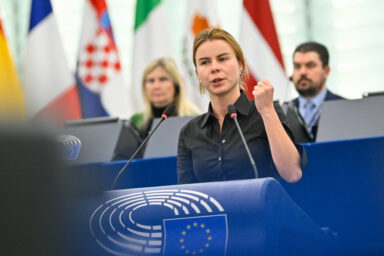

The European Commission used its weekly College meeting on Tuesday to adopt a new energy package centred on consumer protection, clean-energy investment and the development of small modular nuclear reactors. The proposals were also presented to the European Parliament the same day, where lawmakers debated their potential impact on energy prices and Europe’s competitiveness.
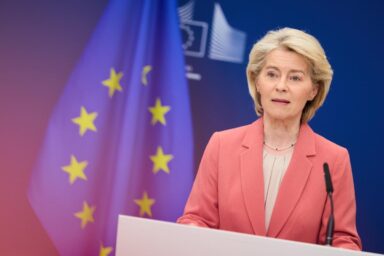
Executive Vice-President Teresa Ribera and Energy Commissioner Dan Jørgensen outlined the package during a press briefing after the meeting, describing it as part of the Commission’s longer-term approach to strengthening Europe’s energy system.
“I think that it is quite important to underline that today we have dedicated a college meeting to come up with a relevant package on energy,” Ms Ribera said.
“A political debate on energy that for a very long while… has been mainly focused on industrial competitiveness, but in fact it covers different aspects and it is always shaken by geopolitics.”
You might be interested
Energy costs and fossil fuel volatility
Taking questions following the briefing, Ms Ribera said the discussion also reflected ongoing concern about the impact of energy prices on households across the EU.
“For many houses, energy bills already represent a significant share of their monthly budget… and especially the global fossil fuel markets means that we suffer the consequences of volatility.”
In her view, reducing dependence on imported fossil fuels remains central to addressing both affordability and security concerns.
“This is why homegrown clean energy is the only long-term lasting solution for our competitiveness but also for the affordability of our families.”
Citizens and energy affordability
A key element of the package focuses on consumers and measures aimed at helping households deal with energy costs while expanding opportunities for local energy production.
“This is why the citizens energy package puts people first and comes up with different proposals,” the executive vice-president said.
She also pointed to existing state-aid tools that can already be used to support energy efficiency improvements. Certain aid for building renovations, she noted, can be granted without prior notification to the Commission under the general block exemption regulation.
Mobilising investment
Another pillar of the package centres on investment in Europe’s energy infrastructure and clean technologies.
Commissioner Jørgensen said the Commission intends to combine EU financial instruments with private capital to accelerate investment across the energy system.
“The EIB will be contributing with over 75bn euros in financing in the years to come,” he explained.
“This is a huge amount and it will make a real difference.”
The funding is expected to support grid development, efficiency projects and other infrastructure needed as the EU’s energy system continues to evolve.
Strategy for small modular reactors
The Commission also presented what it described as the EU’s first strategy dedicated to small modular nuclear reactors (SMRs), aimed at supporting member states that choose to develop nuclear power as part of their energy mix.
“It’s very clear that the potential for small modular reactors… is very big,” Jørgensen said.
“We’re very happy that we are able to today present the first ever small modular reactor strategy from the European Union.”
Alongside regulatory cooperation and research support, the initiative includes additional EU funding for innovation.
“The EU invests a top up of 200 million euros until 2028,” he added.
Questions on crisis response
During the briefing, journalists also asked about possible emergency measures should geopolitical developments push energy prices higher.
Mr Jørgensen said the Commission is monitoring the situation but stressed that any intervention would need to remain limited in scope.
“If we indeed end up in a situation where we have a crisis… it needs to be temporary and targeted measures,” he said.
“So we are not talking about changing fundamentally the structure of price setting, for instance carbon pricing.”
He added that discussions with international partners are under way, including through the International Energy Agency (IEA).
“What we are discussing… with our partners in the IEA is the potential to release some of the oil stocks.”
Carbon pricing debate
Ms Ribera also addressed suggestions that the EU could weaken climate policies in response to rising energy costs.
“I don’t think that killing the carbon price is going to send any positive message to anyone,” she said.
“It would derail the efforts… and it would prevent our community.”
Next steps
With the package now adopted by the College, the Commission has begun presenting the proposals to the European Parliament and to member states as the legislative process moves forward.
The discussion in Parliament earlier on Tuesday highlighted that while there is broad agreement on the need to strengthen Europe’s energy system, divisions remain over how the transition should proceed and which technologies should play the biggest role.