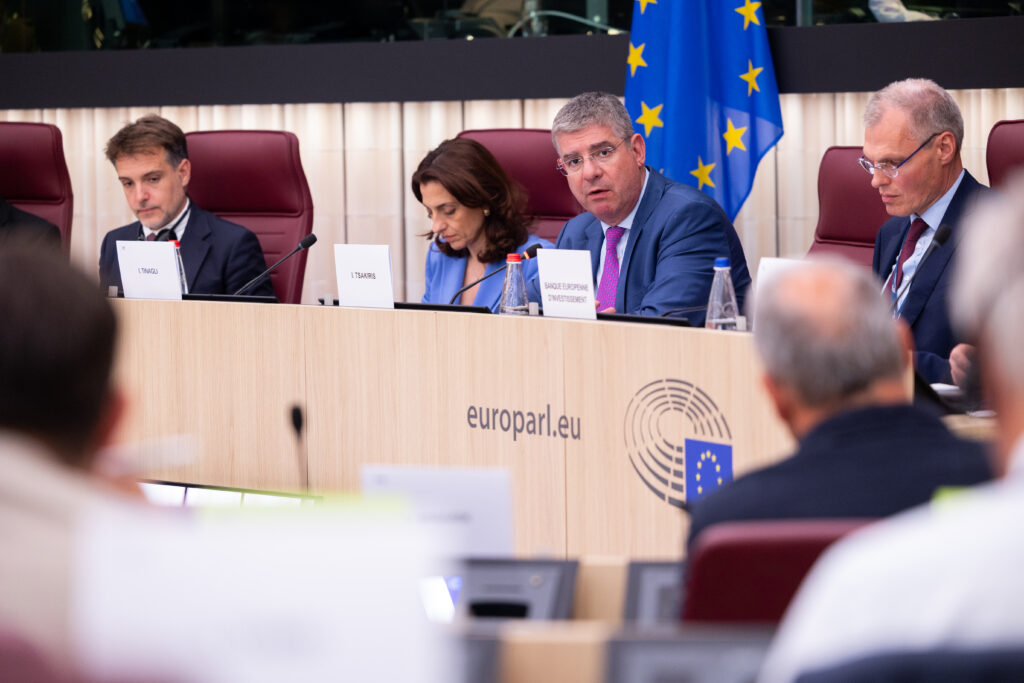

The European Parliament’s HOUS Committee signalled a shift from diagnosis to delivery in Europe’s housing debate on Monday, convening an exchange specifically to hear from European Investment Bank (EIB) Vice-President Ionannis Tsakiris. He described progress implementing the Affordable and Sustainable Housing Plan and how EU-level financing is being mobilised to address what members repeatedly described as a major crisis.
The session followed the committee’s adoption of amendments prioritising “renovation and new buildings with a focus on promoting modern construction techniques, accelerating energy efficient upgrades and building new sustainable and affordable housing.” The objective, as the Chair put it, was “to gain firsthand information… about the EIB’s housing-related work over the past months, including the progresses made in implementing the Affordable and Sustainable Housing Plan, as well as the bank’s plans and priorities for the months ahead.”
View from the EIB
Mr Tsakiris opened by congratulating the committee on the “strong majority” backing its report, calling it “a powerful message” that Europe “recognises the scale of the housing challenge and is ready to act.” He framed the issue in unequivocal terms: “Europe’s housing crisis is real, it is structural, it is urgent,” requiring coordinated action across all levels of governance while respecting member state competences.
The macroeconomic case was equally direct. According to the EIB’s latest investment report, “addressing housing shortages could increase EU GDP by 1.7 per cent, and in some member states by up to 7.3 per cent.” Housing, he stressed, “is not only a social issue, it’s an economic issue, it’s a competitiveness issue, it’s a demographic issue, it’s a climate issue.”
Closely aligned
That framing aligns closely with the Commission’s Affordable Housing Plan, under which the EIB has been given what Nicolina Brnjac (EPP/HRV) described as “the central role… especially under Pillar 2, on mobilising investments.” Ms Brnjac pressed for clarity on the forthcoming European investment platform for affordable and sustainable housing, asking how it would function in practice and whether it would operate primarily through InvestEU and blended finance or through its own instruments. She also underscored the scale of the renovation challenge, noting that “85 per cent of the buildings… were built… before year 2000” and that “70 per cent… are low energy efficiency.”
Mr Tsakiris responded that the platform would act as “a mechanism of pooling resources,” enabling funds to be channelled through the most appropriate financial instruments on a case-by-case basis. Given “significant fragmentation throughout the European Union” in housing conditions and regulatory frameworks, aggregation at European level combined with tailored national approaches was presented as essential to scale.
You might be interested

Numbers game
The emphasis on implementation was reinforced by financial figures. “Since then, we have moved decisively from strategy to implementation,” Mr Tsakiris said, noting that in 2025 the Bank reached “a record of 5.2 billion… which is a 50 per cent increase compared to the previous year.” Over five years, the EIB has provided “18 billion euros for affordable and sustainable housing across Europe,” with a 2026 target of “6 billion in housing support.”
Andreas Schieder (S&D/AUT) broadened the debate further, arguing that housing’s significance extends well beyond social policy. “Housing is not only a social issue, but it’s much more. It has a strong economic impact,” MEP Schieder said, suggesting that affordable, well-located housing could reduce congestion and inefficiencies. At the same time, he questioned whether governance models could be made “quicker… less bureaucratic” in order to respond to the scale of demand.
Envelope pitch
Mr Tsakiris acknowledged the concern, describing efforts to reduce “the time to market” through pre-approved lending envelopes that allow projects meeting defined criteria to move on a “fast track for approval,” while maintaining post-project evaluation to ensure cohesion and impact objectives are met.
National examples underscored both progress and urgency. Ciarán Mullooly (Renew/IRE) welcomed EIB support in Flanders and Ireland, highlighting the 40-year fixed-rate financing model designed to stabilise rents. But he pointed to continued price increases and rising homelessness, noting that figures in Ireland have “surpassed 17,000” with “5,300 children… homeless.” The affordability situation, he made clear, has worsened.
Time is of the essence
Mr Tsakiris acknowledged that “it takes time” for financial instruments to translate into market effects, emphasising the need for promoters to request both financial and advisory support. However, he reported “an increased demand for operation,” suggesting growing awareness of available EU-level instruments.
Gordan Bosanac (Greens/HRV) added another layer to the discussion, asking whether cohesion funds and the next Multiannual Financial Framework could more directly finance public housing construction and raising concerns about “financialisation of the housing market.” Mr Sakiris drew a distinction between speculative short-term returns and longer-term, lower-yield models compatible with public objectives. “The first one is speculation,” he said. “The second one can work… low return but guaranteed for a long period.”
Half empty or half full?
Nearly half of current EIB resources are directed towards renovation, described as “a quick win.” Meanwhile, the Housing Tech EU Pact — backed by a €400m lending envelope — aims to modernise construction processes and improve productivity. “Doing more of the same will not resolve Europe’s housing shortage,” Mr Tsakiris said.
The exchange ultimately revealed an emerging institutional alignment. The Commission has embedded affordable housing within cohesion policy and the forthcoming MFF. The HOUS Committee has delivered cross-party backing. The EIB has scaled up volumes and introduced governance reforms to accelerate delivery.
As Mr Tsakiris concluded, while the crisis remains acute, it also presents an opportunity “to modernise our construction sector, accelerate the green transition, strengthen competitiveness, and reinforce social cohesion.”