
Foreign Ministers of the Gulf Cooperation Council and the European Union stressed the need to fully respect the international law and called on Iran to cease its attacks at an extraordinary online meeting on Thursday, 5 March. The joint statement does not include a single mention neither of Israel nor of the United States whose unprovoked attack on Iran triggerred the current crisis.
The joint statement on recent developments in the Middle East focuses on ’escalation in the Middle East’ and ’Iran’s inexcusable attacks against the Gulf Cooperation Council (GCC) countries’. Ministers reiterated their commitment to regional stability and called for protection of civilians and full respect of international law, international humanitarian law and the obligation to abide by the principles of the United Nations Charter.
When diplomacy fails…
Ministers highlighted the extensive diplomatic efforts by the European Union and its member states and the GCC member states prior to the attacks. The document also mentions the GCC’s commitment that their territories would not be used to launch attacks against Iran.
Ministers also reaffirmed their commitment to dialogue and diplomacy as means to resolve the crisis, commending the constructive role of Oman in this regard. The online meeting highlighted the need to restore regional stability and security.
Israeli and American air forces and missiles attacked Iran at a time when another round of indirect negotiations between the US and Iran was expected. It was supposed to focus primarily on Iran’s nuclear program.
You might be interested
Air space, maritime routes in danger
Ministers reaffirmed the importance of safeguarding regional air space, maritime routes, and freedom of navigation. That includes the Strait of Hormuz and Bab-el-Mandeb, as well as the safety and security of supply chains and the stability of global energy markets.
The document stresses that the security and stability of the Gulf region are fundamental pillars of the stability of the global economy, intrinsically linked to European and global security.
Death toll surpasses 1,000
The current war in the Middle East began on Saturday, February 28, with coordinated air strikes by Israel and the United States on Iran. Since then, the Islamic Republic has been defending itself, among other things, with missile and drone strikes on US military bases in neighboring countries and on infrastructure related to oil and natural gas extraction.
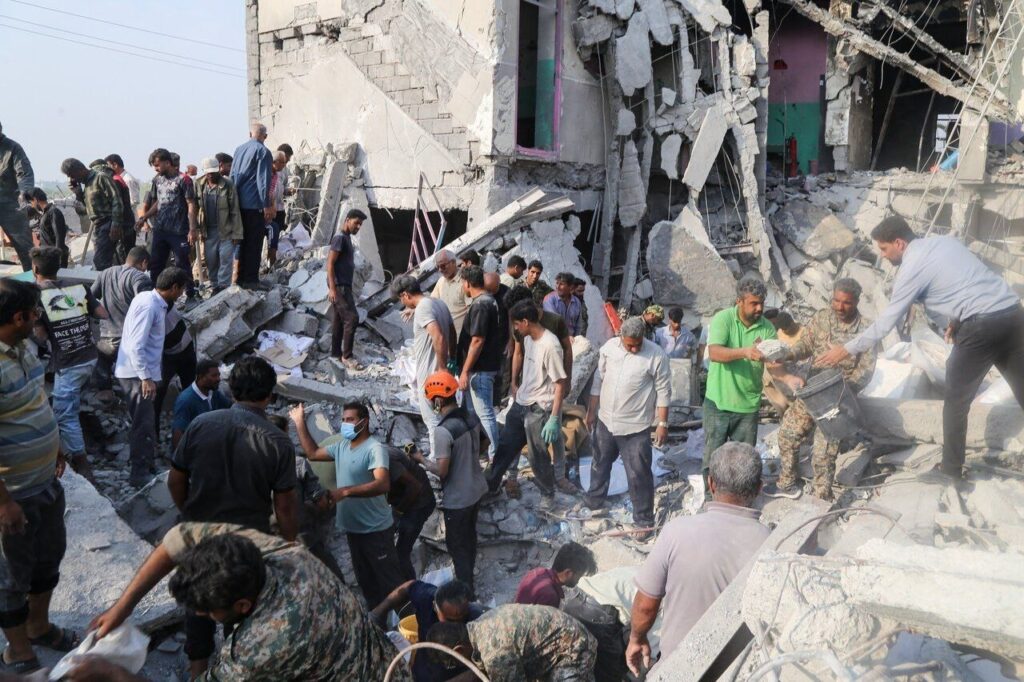
According to local authorities, more than 1,000 people, mostly civilians, have been killed on the Iranian side as a result of the US-Israeli attacks. Six American soldiers lost their lives through Iranian counterattack. Israel reports 11 deaths so far.