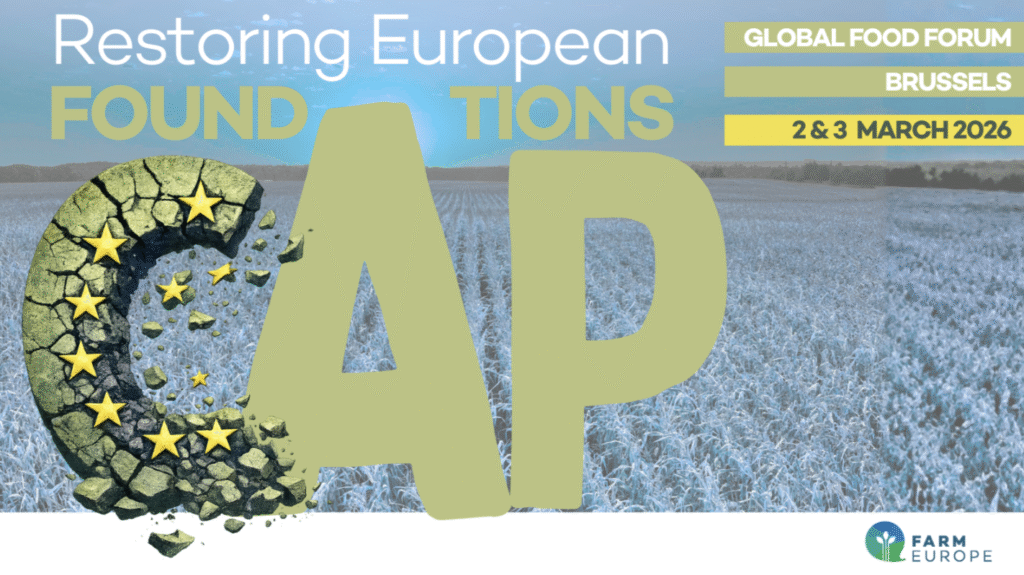
The European Union requires a political vision and an agricultural strategy for the long term, ministers tThe European Union requires a political vision and an agricultural strategy for the long term, ministers told a top-level forum on the future of the Common Agricultural Policy. They said food security can no longer be treated as a peripheral matter in today’s turbulent geopolitical climate. Ahead of budget negotiations, the farm policy is viewed as a benchmark for Europe’s geopolitical seriousness.
The current crises triggered by the pandemic and Russia’s invasion of Ukraine have highlighted the EU’s structural weaknesses, said Yves Madre, President of Farm Europe. “More than the Covid crisis, it was Russia’s war in Ukraine and the sudden shift of our historic American partner that triggered a brutal wake-up call,” he said.
The EU is suffering from “a crisis of political visibility”, he continued, stressing that it was failing to identify medium and long-term priorities, and from a loss of connection with its citizens. Brussels has coped with one crisis after another, but has failed to present a coherent political project that could serve as a basis for sound budgetary and regulatory decisions. In recent years, Mr Madre suggested, trade deals have come to be seen as “almost the only way for the EU to exist geopolitically”, even at a cost to its domestic standing.
“No European country on its own will remain among the top 10 global economic powers in ten years,” Madre stressed “The farmer is the core reactor of the European Union’s strategic autonomy. Investing in agriculture cannot be optional.”
You might be interested
A watershed moment for the CAP
The discussion is taking place ahead of EU negotiations for the next multiannual budget and a reformed CAP after 2028. The proposals now under discussion in Brussels would, however, reform the policy at a fundamental level, including shifting its focus towards income and allowing greater flexibility for member states.
Annie Genevard, France’s Minister for Agriculture and Food Sovereignty, hailed the current moment as “a watershed moment in European history”, not just for the upcoming CAP negotiations but for the pace of geopolitical change.
The CAP is a historic foundation of the European Union, it is not a policy of the past. It is a policy for the future. – Annie Genevard, French Minister for Agriculture and Food Sovereignty.
Food sovereignty needs to be treated with the same gravity as military sovereignty, she said. “Securing our essential security need — ensuring that we can feed ourselves — is a necessity,” she noted adding that any effort to reduce the common nature of the CAP or its budget would entail “a profound alteration” of the policy. “The CAP is a historic foundation of the European Union, it is not a policy of the past. It is a policy for the future.”
Strategic food sovereignty in realistic terms
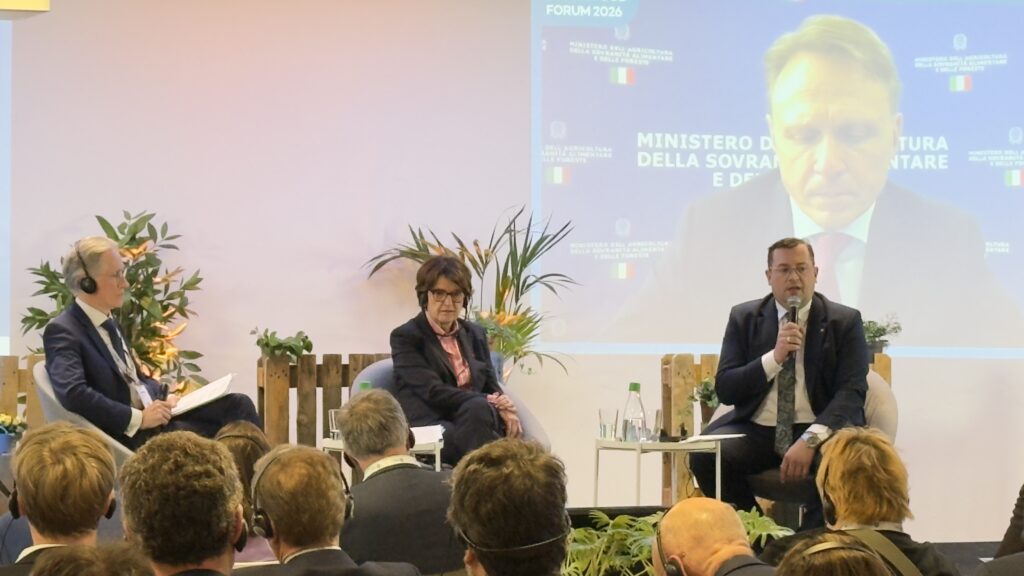
Francesco Lollobrigida, Italy’s Minister of Agriculture, Food Sovereignty and Forests, framed the discussion in geopolitical terms. “Food security and integrity of territory are pillars of economic prosperity. The primary sector may no longer be the largest in economic terms, but it is the driver of the European Union.”
The pandemic was “a wake-up call”, he said, and food sovereignty is now connected with the idea of strategic autonomy. “Food is the main source of energy,” he remarked. What Europe needs now is not new ideologies but policies “adapted to today’s reality rather than a reflection of utopian dreams of yesterday”.
“We have worked together to set aside certain ideological positions,” he added, referring at least in part to discussions around the Green Deal. “Europe should not erase its differences. But together we will be more powerful.”
Income stability
Stefan Krajewski, Poland’s Minister for Agriculture and Rural Development, focused on the social and economic bases of the CAP. “We cannot forget how the Common Agricultural Policy was created,” he commented. “Consumers must be able to afford food, and farmers must have sufficient income for their efforts.” He rejected any attempt to reduce the CAP to military terms. “In times of peace we may think we can import everything, but in times of war supply chains can be disrupted,” Mr Krajewski said.
He called for realistic regulatory standards. This has been illustrated by recent farmer protests. “Farmers were protesting not against environmental goals as such, but because some standards were impossible to implement,” he stated . And highlighted tensions between requirements for internal production and meat imports. “On one hand we impose restrictions on our producers; on the other hand we have meat from Brazil on our tables,” Krajewski argued.
Budgetary choices
At stake in the negotiations is the extent to which the EU budget will be stretched to meet higher demands for financing for agriculture while still making sure that spending in other areas respects its environmental and reform commitments. Annie Genevard warned that if Europe fails to secure its agricultural income, the next generation of farmers will disappear, and so will production and rural economies.
For Yves Madre, it is not just a question of how much the budget should be increased. “We are at a crossroads,” he said. “It is now up to the European Parliament and, above all, the Council to lay the foundations of our common future for the period beyond 2028. This is not routine budget work. It is fundamental.”
The negotiations are being increasingly framed in the context of a wider debate about Europe’s economic model, its place in a multipolar world, and what sovereignty means in a more fractured global arena.