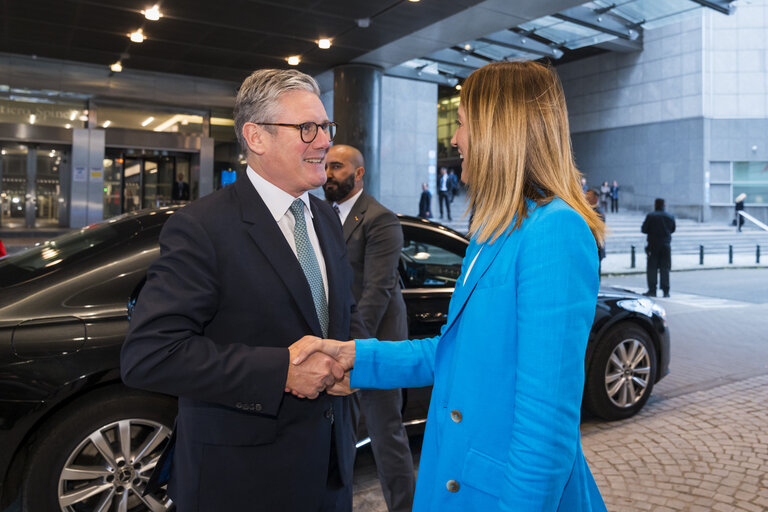

As relations between Europe and the United States grow more uncertain, the European Union is increasingly looking closer to home for reliable partners. In its sights is an old friend: the United Kingdom. Approaching the 10th anniversary of the Brexit referendum, however, the envisioned EU–UK “reset” is still struggling to gain momentum.
The Labour government of Keir Starmer, which came to power in July 2024, promised to “reset” relations with the EU after years of post-Brexit friction. The first EU–UK Summit in May 2025, held at Lancaster House in London, appeared to signal a renewed spirit of cooperation between the two sides.
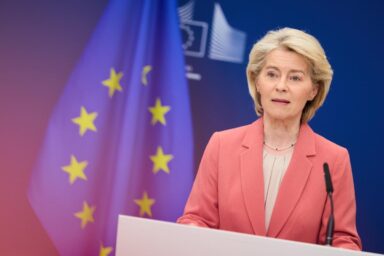
Warm exchanges between Starmer and the European Commission President Ursula von der Leyen suggested a deliberate effort to turn the page on the acrimonious disputes that had long dominated the post-Brexit relationship. “It is good to meet a friend again and to be here with you. We are friends, and we are Europeans, we are very like-minded,” von der Leyen stated.
A turned page?
But has the “page been turned” in this relationship as Ms von der Leyen suggested during that summit?
A true reset still seems far away, with the main constraint coming from the UK itself. The Starmer government has set firm red lines: no return to the EU’s single market, no rejoining the customs union and no restoration of freedom of movement.
You might be interested
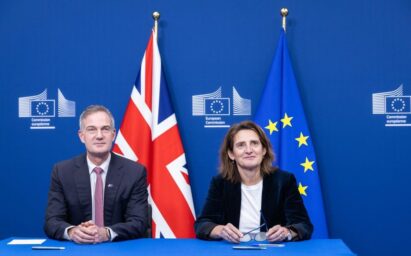
With Nigel Farage’s Reform UK breathing down its neck and accusing Labour of drifting too close to Brussels, the government has been careful to emphasise sovereignty. As a result, the red lines it has drawn inevitably restrict the scope of the relationship Brussels and London can rebuild.
Selective cooperation
Progress has predominantly followed in the form of targeted initiatives since. The UK has begun rejoining the Erasmus+ programme for educational exchanges, restoring one of the most tangible “people-to-people” links lost after Brexit.
It is time for the UK Government to recognise that the EU is Britain’s closest ally and its strongest partner for sustainable economic growth in this new world order. – MEP Sandro Gozi (Renew/IT)
Negotiations have also been launched to ease trade frictions in specific sectors. In November 2025, EU member states authorised talks on a common sanitary area for agri-food products and on linking emissions trading systems – measures that could help reduce barriers affecting businesses on both sides.
In December 2025, the EU and the UK agreed fishing opportunities for 95 jointly managed fish stocks under the EU–UK Trade and Cooperation Agreement, ensuring stability for fishers operating in the Atlantic and the North Sea in 2026.
Financial disagreements
Meanwhile, discussions have taken place about greater coordination in defence procurement through the EU’s Security Action for Europe (SAFE) initiative, a €150 billion instrument designed to strengthen Europe’s defence industrial base.
The UK had explored joining the programme. That would have allowed British defence companies to participate more fully in EU-funded procurement. However, negotiations collapsed in November after the two sides failed to agree on the financial contribution required for British participation.
Other disagreements have emerged in specific policy areas. Discussions about integrating the UK into the EU electricity market, for example, have been complicated by the EU’s demand that the UK contribute financially to its cohesion policy, which supports economic development in poorer regions of the Union. London has resisted such contributions, wary of appearing to re-enter the EU’s financial structures.
The reset isn’t resetting
All in all, despite growing geopolitical stakes, the EU–UK reset does not seem to really be resetting the way the EU would like to see it. As MEP Sandro Gozi (Renew/IT) put it: “Brexit meant Brexit, but ten years is a long time in politics and the geopolitical landscape has changed beyond recognition. It is time for the UK Government to recognise that the EU is Britain’s closest ally and its strongest partner for sustainable economic growth in this new world order. Progress has been too slow. The EU–UK reset must now be supercharged. Engagement, based on respect of the Union’s principles, should be broadened and accelerated ahead of this summer’s EU–UK Summit.”