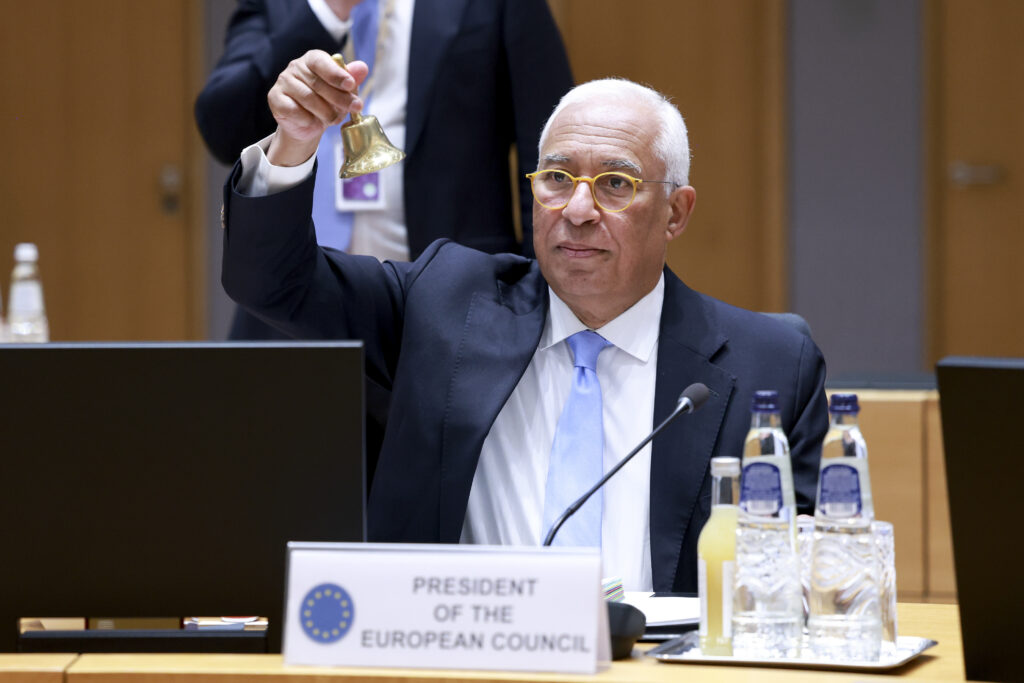

EU leaders entered the March edition of the European Council facing a growing list of crises: a deadlock over Ukraine, rising energy concerns linked to the Iran war, and renewed fears of immigration. What was originally to have focussed on competitiveness largely shifted towards geopolitics.
The shadow of a prolonged conflict in Iran and the stalemate over Ukraine loom large over European leaders’ discussions. The dossier on Kyiv-related issues remains blocked by vetoes from Hungary and Slovakia.
Energy costs and the future of the EU’s emissions trading system (ETS) have become a central point of tension among member states. The ETS, the European “cap-and-trade” mechanism, imposes a cap CO₂ emissions and assigns tradable allowances to companies. Those who emit less can sell excess permits, while those exceeding the limit must buy them: an incentive to reduce emissions, considered essential for decarbonization.
According to diplomatic sources, the remaining conclusions on competitiveness have, in effect, reached finalisation. However, disagreements on short-term solutions to address rising energy prices are holding them up.
You might be interested
A group of countries—including Italy, Austria, Croatia, Greece, Romania, Bulgaria, the Czech Republic, Hungary, Poland and Slovakia—have joined forces in the matter. In a letter sent to Commission President Ursula von der Leyen and European Council President António Costa, they call for a more radical revision of the ETS.
The 2027 roadmap
EU leaders have also outlined a broader roadmap for strengthening the single market by 2027, including steps such as the e-declaration, a review of the ETS, and proposals linked to capital markets, digital finance and industrial policy.
EU leaders have also agreed on a roadmap to complete the single market by the end of 2027. Key milestones include approval of the e-declaration by June 2026, a review of the ETS by July, and a report on the competitiveness of the banking sector this summer. Approval of the proposal on the mutual recognition of professional qualifications is likely in the fall.
The most important measures expect approval by the end of this year. These include the 28th regime, the European Business Wallet, harmonised rules for placing products on the market, simplification packages, mapping of strategic dependencies, the Networks Package, the digital euro, the Capital Union proposals regarding securitisation, supplementary pensions, and market integration and supervision, and the Industrial Accelerator Act.
The Hormuz Strait crisis
Tensions around the Strait of Hormuz are adding to concerns over energy prices, although the impact varies across the EU. Countries with a diversified energy mix, including nuclear with a high share of renewables, have faced almost no price increases as a result of the blockade of gas and crude oil flows through the Strait. The opposite is true for Italy, Germany, and Belgium, who are pushing for rapid measures to contain the surge.
EU leaders do not want to enter a conflict triggered by the US and Israel, but they would like to help find a way out. In parallel, a ‘coalition of the willing’ has emerged, initiated by Italy, the United Kingdom, France, Germany, the Netherlands and Japan.
The group has expressed its readiness to “contribute to the efforts needed to ensure safe passage through the Strait”, according to the joint statement.
The countries clarified that this is not a response to requests made by US President Donald Trump but rather an operation likely to kick off only after the conflict. “We call on Iran to immediately cease its threats, mine-laying, drone and missile attacks, and other attempts to block the Strait from commercial shipping, and to comply with United Nations Security Council Resolution 2817.”
Flashback of 2015 migration crisis
The conflict in the Middle East, which has already displaced around one million people in Lebanon, is raising concerns about potential migration flows towards Europe.
Italian Prime Minister Giorgia Meloni, together with Danish Prime Minister Mette Frederiksen and Dutch Prime Minister Rob Jetten, hosted a new meeting with the 16 states most interested in taking a firm stance on migration. The focus was on strengthening returns and preventing a scenario similar to the 2015 migration crisis triggered by the war in Syria.
Furthermore, Italy and Denmark have also sent a letter to EU leaders regarding the potential risks to migration flows arising from recent developments in the Middle East. “We cannot risk a repeat of the refugee and migrant flows towards the EU we witnessed in 2015–2016,” the letter reads. “This would not only be a humanitarian catastrophe for those directly affected, but would also risk impacting the security and cohesion of our Union.”
Security first
They also argued that assistance should primarily be provided in regions of origin, alongside stronger protection of the EU’s external borders to ensure full control over migration flows.
In this vein, the conclusions on the Middle East adopted by the European Council, in the chapter dedicated to the impact of the Iranian crisis on migration, mention the 2015 crisis. “Building on the lessons learned from the 2015 migration crisis and to avoid a similar situation, the EU stands ready to fully mobilise its diplomatic, legal, operational, and financial tools to prevent uncontrolled migratory movements towards the EU and preserve security in Europe,” it says.
The previous draft version only referred to the impact of recent developments for the EU in terms of energy security and prices, supply chains, and migration, and to propose appropriate measures and coordination at EU level, including regarding the possible impact on internal security.
A Union pulled in multiple directions
The March European Council highlights how the EU is being pulled in several directions at once — from geopolitical tensions in the Middle East to internal divisions over energy and Ukraine.
Competitiveness, originally the main dossier, has been pushed into the background following discussions that emerged during Alden Biesen’s retreat on 12 February. The discussion on the next Multiannual Financial Framework (MFF), originally scheduled over dinner, has reportedly been postponed “until the next meeting”.