
Europe finds itself facing a complex geopolitical dilemma. The turbulence on the international stage driven by the policies of US President Donald Trump—ranging from tariff disputes to growing energy security concerns—is forcing European leaders to reassess long-standing strategies towards China. Beijing has seen a steady stream of high-level visitors.
Transatlantic trade tensions have intensified in recent months, with 15–50 per cent tariffs affecting EU export to the US in key sectors such as steel and automotive. At the same time, volatility in energy markets linked to US policy decisions has added to the sense of uncertainty. Some European officials are beginning to see China as a potentially more reliable partner — despite the economic risks.
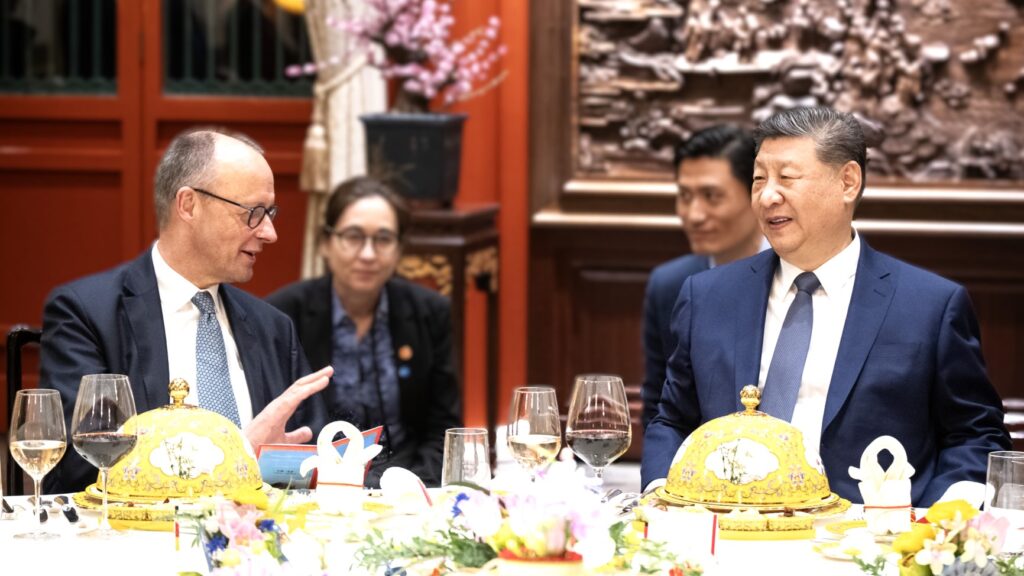
Over the past months heads of state and government from countries including Germany, France, Finland, and Ireland have traveled to Beijing. German Chancellor Friedrich Merz led a sizeable business delegation to China at the end of February and was received by president Xi Jinping himself.
The aim is not only to deepen trade and technological ties, but also to secure access to expertise where Europe lags behind — particularly in areas such as battery supply chains, rare earth processing, and parts of digital infrastructure.
You might be interested
“We want to strengthen our comprehensive strategic partnership. The Chinese and Germans are aware that our economic exchange contributes significantly to the prosperity of both countries,” Merz said. Bilateral trade between Germany and China reached €251.8 billion in 2025, making China surpass the US as Germany’s largest trading partner.
EU keeps its stance
“European leaders are traveling to China with the hope of hedging political bets vis-à-vis the United States,” Agatha Kratz, a partner at advisory firm Rhodium Group, told Bloomberg. This hedging strategy reflects a broader shift: while the United States remains Europe’s primary security partner through NATO, economic considerations are increasingly pushing policymakers to diversify partnerships and reduce exposure to unilateral policy changes in Washington.
Italy, by contrast, has remained somewhat on the sidelines. Prime Minister Giorgia Meloni’s government has sought to avoid excessive dependence on Beijing, following its decision to withdraw from China’s Belt and Road Initiative in 2023. Even so, companies such as Stellantis are reportedly exploring potential cooperation with Chinese manufacturers.
The European Union’s official stance, however, remains largely unchanged. The bloc continues to pursue cooperation with China on global issues such as climate change. China accounts for over 30 per cent of global CO2 emissions and is indispensable to any mitigation effort.
At the same time, Brussels has adopted a more defensive economic posture. The EU continues to warn against the risks of unfair competition and calls for more balanced and reciprocal economic relations, citing persistent market access barriers for European firms operating in China. Strategic risk also remains the growing dependence of Europe on Chinese critical minerals. “I don’t think the EU is pivoting because the harm to the EU economy is huge from China’s exports,” said Alicia Garcia Herrero from the Brussels-based Bruegel think tank.
Brussels has also become increasingly vocal on geopolitical and security concerns, urging China not to support Russia in its war against Ukraine. The EU has criticized human rights violations and restrictions on fundamental freedoms. The bloc maintains its ‘one-China’ policy, while cautioning against escalating tensions over Taiwan.
Unity at risk
Bilateral visits by individual member states may, however, undermine a unified European strategy. Some countries are pursuing their own paths, giving China room to employ a ‘divide and conquer’ approach. Germany’s evolving stance could also complicate agreement on the use of trade defense instruments—such as the Anti-Coercion Instrument—in future disputes with Beijing, Bloomberg noted.
The economic and political incentives behind these engagements are clear. Stability and commercial opportunities with China may, in the short term, help offset the uncertainty stemming from US policy, especially given that EU–US trade still exceeds EU–China trade.
Yet European leaders are aware that this approach carries risks. China has previously demonstrated a willingness to use economic leverage for political purposes, targeting Lithuania with trade restrictions after Taiwan opened a representative office in Vilnius .
Overreliance on China, particularly in critical sectors such as raw materials, batteries, and pharmaceuticals, could expose Europe to similar vulnerabilities. At the same time, fragmentation within the EU could weaken the bloc’s negotiating position against both Beijing and Washington, complicating its ability to act as a coherent geopolitical actor.