
As Russia menaces and US reliability wobbles, Europe’s bid to forge a credible nuclear deterrent hinges on treaty rewrites, a Franco-British umbrella and public consent. The toughest hurdles? Non-proliferation limits and EU sovereignty issues.
Once the preserve of think-tank panels and retired generals, Europe’s nuclear debate has burst into official corridors. Hardware is not the chief obstacle. The missing pieces are legal, political and strategic. To forge a credible European deterrent, governments must rewrite treaties, craft fresh institutions and reassure publics that atomic guardianship can be both collective and restrained.
Russia’s war on Ukraine drags on; Washington’s commitment looks contingent; and Moscow is layering new A-235 and S-500 interceptors around its capital. If the United States one day withholds “extended deterrence”, Europe will need a shield of its own.
Three tests
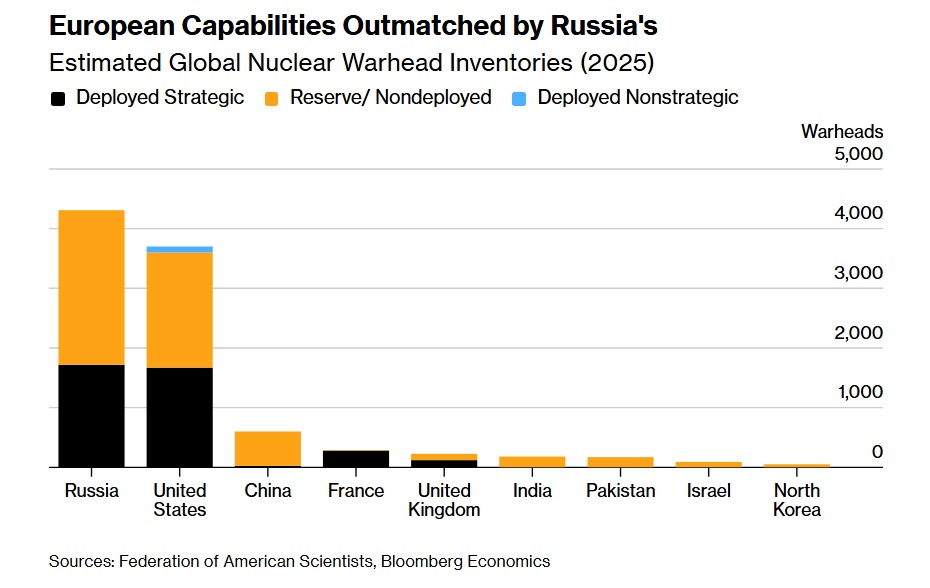
France and Britain, the only European nuclear powers, field roughly 515 warheads and four ballistic-missile submarines apiece. In isolation, the numbers may look impressive. In comparison to Russia’s nuke arsenal, they are less so.
Three tests now frame the discussion. First, can an enlarged Franco-British umbrella satisfy frontline states without breaching the Nuclear Non-Proliferation Treaty (NPT)? Second, will the EU’s creaking constitutional machinery admit a competence so tightly bound to national sovereignty?
You might be interested
Third, can a new arrangement coexist with NATO, or would it provoke an American backlash that leaves Europe more exposed? Each question sends diplomats scurrying through legal texts and historical footnotes in search of precedent. The answers will decide whether Europe’s deterrent remains rhetorical or becomes real.
Russian doctrine openly contemplates limited nuclear first use. Intelligence briefings to the EU Political and Security Committee warn that Moscow keeps about 1,900 non-strategic warheads “available for rapid deployment” (and about twice as much in reserves).
Shifting strategic sands
Since late 2025, Iskander-M brigades have rotated through Belarus and Kaliningrad, rehearsing 500 km strikes against Baltic ports. In one modelled scenario the Kremlin detonates a 20-kiloton device on an uninhabited Ukrainian training area. The EU response—dispersal of French Rafales to Poland, plus the surfacing of extra submarines—deters escalation only if Vladimir Putin believes Paris and London would actually press the button.
A study by the British Royal United Services Institute, meanwhile, warns that by the early 2030s “an increasingly robust ballistic-missile-defence system around Moscow may emerge”. With an intercept rate of 90 per cent—the level Israel achieved in 2024—Russia might neutralise a small Anglo-French salvo.
Analysts therefore demand larger stockpiles or new manoeuvring warheads. Yet quantity and technology are moot unless Europe can decide, collectively and quickly, how to threaten retaliation.
Quotes and cracks
What is in the way of any coherent nuclear defence is the European mindset. At a recent Stimson Center round-table a European ex-defence minister proved the case in point. “He questioned the need for such a discussion and pointed out that it would take Europe at least a decade to develop such a capability,” the meeting record notes.
An increasingly robust ballistic-missile-defence system around Moscow may emerge by the early 2030s. — Royal United Services Institute, UK
The think-tank added, with equal bluntness, that “the shared transatlantic goals and structures created after World War II, including a credible US nuclear umbrella over Europe, can no longer be considered as givens.” Even if the next American president reins in isolationism, Europe must insure against wild mood swings in Washington.
President Emmanuel Macron sees an opening, speaking about plans to “guarantee Europe’s security more widely”. The idea may win over allies. European governments—particularly in Berlin and Warsaw—are increasingly warming to the idea that Paris could use Western Europe’s largest atomic arsenal to play a bigger role in safeguarding the continent’s security, The Economist notes. A widely quoted quip by a French officer, however, encapsulates the sovereignty dilemma: “At the end of the day, who would be able to push the button? Only France.”
Existing treaty straight-jackets
The Treaty on European Union (TEU) devotes a single article—42(7)—to mutual defence. It pledges that member states shall give aid “by all the means in their power”. Yet nuclear forces sit outside EU competence; Article 4(2) safeguards national security as the “sole responsibility of each member state”. Any attempt to cede even partial launch authority to Brussels therefore needs new wording, not creative reinterpretation.
The Lisbon ‘passerelle‘ clauses, which permit unanimous Council decisions to shift selected policies to qualified majority voting, cannot stretch to nuclear employment without shredding political legitimacy. An inter-governmental conference under Article 48 is thus unavoidable.
A recent Memorandum on a European Defence Union proposes a dedicated treaty chapter creating an ‘European Defence System‘ with a strategic-deterrence component. Lawyers in Berlin and Madrid argue that such a protocol could be signed only by willing states, using enhanced co-operation, while others opt out.
NPT constraints
The NPT blocks any “transfer of control” from a nuclear-weapon state to a non-nuclear one. France and Britain are recognised NWS under Article IX(3). They may consult allies, share costs and even station delivery aircraft abroad; yet the warheads must stay under national custody until launch. NATO gets around this by keeping American B61 bombs padlocked until war. Critics call the practice hypocritical but, over five decades, no NPT review conference has broken it.
Analysts foresee harder choices. “Given the potential existential nature of the security threat Europe may face, treaty abrogation may need to be eventually placed on the table,” reads a Stimson essay. Abrogation would undermine every Western argument against Iranian or North-Korean ambitions.
The shared transatlantic goals and structures created after World War II, including a credible US nuclear umbrella over Europe, can no longer be considered as givens. ― Stimson Center, US
European diplomats therefore hunt for a middle path: national custody plus collective authorisation, dubbed ‘dual-key-plus‘. Paris retains physical control; a new European Nuclear Council grants political legitimacy. The arrangement resembles Nato’s Nuclear Planning Group yet admits only willing EU states, keeping neutrals untainted.
Designing fresh architecture
Blueprints circulate in Brussels. The European Nuclear Council (ENC) would gather participating heads of government, the High Representative and the Commission president. Decisions on posture and employment would require a ‘reinforced qualified majority‘; say, 72 per cent of states representing 80 per cent of their population. That is too high for routine business, but high enough for credibility. A Nuclear Executive Committee, chaired by the HR/VP, would handle planning and exercises.
Parliamentary oversight is trickier. One draft suggests a Defence Sub-Chamber within the European Parliament holding closed hearings and issuing non-binding resolutions. Critics note that democracies rarely entrust mere advisory bodies with Armageddon. Supporters reply that NATO offers no elected oversight whatsoever; any increase, however modest, counts as progress.
Legal drafting must soothe neutral nerves. Austria, Ireland, and Malta—all cherishing their neutrality—might refuse to join but could still block EU budget lines that finance deterrence. Treaty drafters therefore envisage a parallel pact, outside the EU treaties, funded by a ‘Euro-Nuclear Fund‘ into which only participants pay. That would mirror the 2025 Northwood Declaration, signed by London and Paris outside EU law, yet feeding policy co-ordination back into Brussels.
Numbers, budgets, timetables
Compatibility with NATO raises further clauses. The ENC could pledge that its deliberations do not prejudice commitments undertaken in the North Atlantic Treaty. Mark Rutte, NATO secretary-general, warns that any duplication must be “kept lean” to avoid resource drains. Washington, for its part, could accept a Franco-British umbrella that complements US forces, relieving American taxpayers, but would bridle at an autonomous EU bomb that sidelines NATO.
National security is the sole responsibility of each member state. — The Treaty on European Union (TEU), Article 4(2)
France earmarks about €6bn a year for its deterrent; Britain spends roughly €5bn. Extending cover to Poland, Finland and the Baltic trio would involve more training flights, forward stockpiles of ASMP-A missiles and perhaps a fifth Dreadnought-class submarine. Estimates presented to the European Council last December put the incremental cost at €2.8bn annually. The figure appears negigible next to EU agriculture subsidies, yet is political dynamite in pacifist countries.
Civil protection budgets pale by comparison. EU scenario planners reckon a single 100-kiloton air-burst over Manchester would kill 80,000 on day one and injure over 200,000. Radiation-burn beds across Britain number fewer than 1,000. The European Civil Protection Mechanism wants €1bn for antidote stockpiles and mobile decontamination labs. Without such spending, any notion of deterrence is mere bluff.
National attitudes and red lines
Poland leads the enthusiasts. Polls show 55 per cent of citizens back hosting French nuclear assets. The Baltic states echo that sentiment; Latvia’s prime minister sees “new opportunities”.
Germany straddles the fence. The liberal FDP favours an EU umbrella; the Greens demur. Chancellor Friedrich Merz insists no tiered security zones may emerge. Spain, Italy and Belgium want tight parliamentary scrutiny and cost ceilings.
Austria threatens to litigate any EU budget transfer to nuclear projects before the European Court of Justice. Finland quietly buys Arrow-3 interceptors but keeps its legal powder dry. Sweden, fresh into NATO, nods politely yet counts on the American bomb. Britain, now outside the EU, has an associate status of sorts: shared patrol schedules but no vote inside Brussels.
Russian and global reactions
Moscow brands every proposal escalation. Its foreign ministry warns that extending French forces eastward would “destroy strategic stability”. Yet the Kremlin also fears proliferation. A visible Franco-British umbrella that keeps Warsaw non-nuclear may suit Russian interests better than a Polish bomb.
Wishing these challenges away will not make them disappear. ― Center for Strategic and International Studies, US
China accuses Europe of double standards, complicating EU climate diplomacy in the global south. The United States withholds judgement; Congress whispers about export-control leverage over Britain’s submarine warhead design, derived from American data.
Timeline matters. Mr Macron leaves his Élysée office in mid-2027. Marine Le Pen’s National Rally, leading in polls, vows to keep nuclear sovereignty “purely French”. An irreversible move would therefore have to occur within 14 months: station Rafales on Polish soil, integrate German officers into Poker exercises or sign a treaty that requires a two-thirds parliamentary majority to repeal. A paper by the US-based Center for Strategic and Internatioal Studies cautions against haste but adds, pointedly, “Wishing these challenges away will not make them disappear.”
Beyond sovereignty
If the Franco-British route proves politically impossible, two starker options remain. First, a Euro-deterrent pooling fissile stocks under a single EU command. Studies by the European Security Negotiation Group price this at €100bn up-front and twenty years of R&D. Second, national break-outs by Germany or Poland; this would be swift, illegal and shattering for the NPT. Few serious policymakers favour either. The umbrella approach, for all its knots, is the least disruptive.
Still, legal tweaks alone will not fill submarines with warheads. The United Kingdom debates ordering a fifth Dreadnought boat to guarantee two hulls at sea; France mulls a modest increase in stockpile size and an extra Rafale squadron.
Think-tank modelling suggests each country needs one more SSBN, plus tankers, SEAD kits and satellite early-warning sensors, to ensure that half its weapons survive a Russian first strike and pierce missile defences. Without those, declaratory policy risks ridicule.
Policy recommendations
The following is a list of policy recommendations compiled from Stimson Center, Royal United Services Institute, Center for Strategic and International Studies, Chatham House, Bloomberg, Scientists for Global Responsibility, Financial Times, and The Economist.
• Convene an inter-governmental conference under Article 48 to draft a Strategic Deterrence Protocol, permitting enhanced co-operation among willing states and explicit opt-outs.
• Establish a European Nuclear Council with dual-key-plus authority, guaranteeing national custody yet collective political assent.
• Create a Euro-Nuclear Fund outside the EU budget, financed by participating members at a pro-rated GDP share, to avoid vetoes from neutral states.
• Publish a legal white paper demonstrating NPT compliance by retaining French and British physical control.
• Expand the European Civil Protection Mechanism with €1bn for radiation medicine, mobile shelters and decontamination units.
• Accelerate the Franco-German early-warning satellite constellation and a European fire-control radar, closing dependence on US sensors by 2030.
• Draft a joint strategic-communication plan clarifying that the European umbrella supplements NATO, preserving the American guarantee and deterring Russian miscalculation.
Europe has the fissile material, the submarines and, in theory, the will. What it lacks is a treaty web tight enough to bind 27 diverse democracies yet elastic enough to let two sovereign nuclear powers act when minutes matter.
The legal carpentry will be arduous. But the alternative—trusting a fickle Washington or fearing a brazen Moscow—may prove costlier still. Credible deterrence begins with credible governance. If Europe can write the right rules, the warheads will remain silent. If not, the final guarantor of the continent’s peace may lie in an American election or a Russian whim. In such a world Europe would be, once again, an object of strategy, not a maker of it.