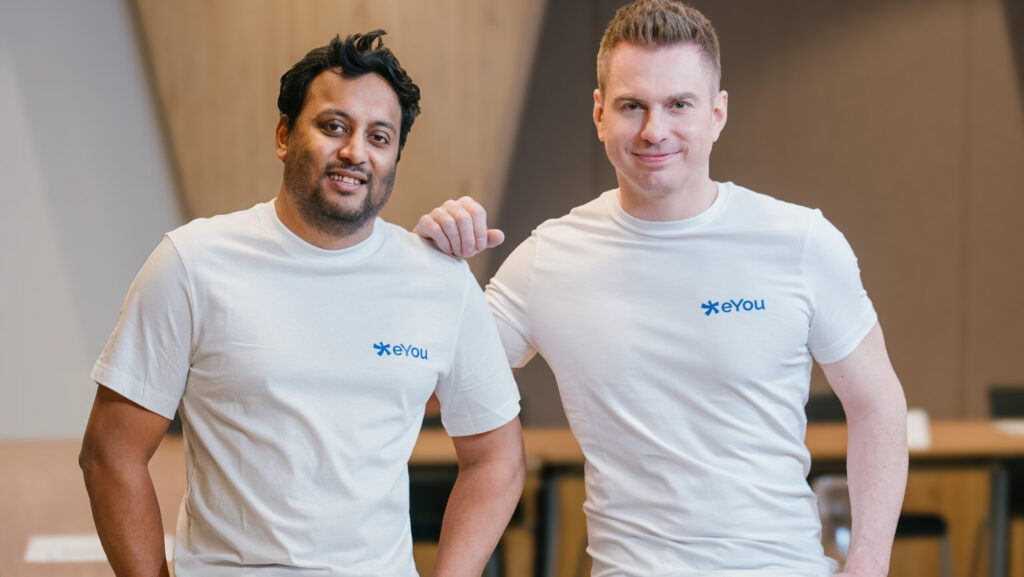

As disillusionment with social media grows, two European entrepreneurs are launching a new platform designed to challenge Big Tech. The startup eYou, founded by Grégoire Vigroux and Jasseem Allybokus, has raised €300k in pre-seed funding to build a European social media platform that fact-checks posts in real time.
The nascent eYou platform says it aims to offer a European alternative to Big Tech giants like X and Facebook. It will integrate real-time fact checking (or “fast checking”, as Mr Vigroux prefers it) on posts. Clicking on a post opens an AI-generated pop-up assessment based on credible and neutral sources that summarise the accuracy of each claim.
The platform also plans a transparency feature that will allow users to see and edit the profile the algorithm governing the app builds about them. “Rather than operating as a hidden ‘black box’ as other platforms do, the recommendation system allows users to modify the signals that shape their feed — giving them the option to broaden their content exposure to a wider diversity of viewpoints and step outside algorithm-driven echo chambers,” explained founder Grégoire Vigroux, a Romania-based French entrepreneur.
Impartial and independent
The founders respond to increasing demand. More than a third of EU citizens are regularly exposed to disinformation online. This represents an increase of eight per cent since 2022. In January MEPs across Europe called on the European Commission to offer more support to European-owned alternative platforms. And on 4 March, an official European Citizens’ Initiative (ECI), entitled European Public Social Network, was registered by the Commission.
The ECI calls for a legislative act to create “a public social media platform at the European level” that “would form an alternative to the current platforms and work as a service for the society, be funded by the society and be under its oversight”. The initiative says such a platform “could stay impartial and independent from political pressures while also guaranteeing rights of all people without distinction”.
You might be interested

The organisers of the ECI say social media platforms are increasingly used to spread disinformation and propaganda. “Non-transparent algorithms are locking users in information bubbles. Billions of fake accounts are spreading disinformation, propaganda, or hatred,” they said. Private data is often shared with third parties. Both children and the elderly are targeted by malicious groups or individuals online.
The funding comes from Fil Rouge Capital, a venture capital fund investing in early-stage European technology companies. “The founders are tackling one of the most important challenges facing digital platforms today: trust,” said Matei Dumitrescu, partner at Fil Rouge Capital. The public launch is planned for May 2026, but a waitlist is already open.
Meanwhile, the organisers of the ECI have six months to secure at least one million statements of support. These must come from at least seven member states. If they succeed, the Commission is required to react and decide what, if any, action it will take.
Grégoire Vigroux: CEOs have too much power
So I guess my first question is, why this and why now?
That’s the best question to start with. I’m going to share a little bit of the genesis of this project. It was last year, and I decided to go on X because I was an early adopter of Twitter back in the day. And on my feed, it was all Elon Musk posts. But I never even followed the guy, and I said, we have a problem here. It came as a revelation for me. How come a social media platform that was supposed to connect people ends up being in the hands of the owner and CEO?
The week after, it was the second round of the presidential elections of Romania. On the very morning I was on Telegram and I received—along with all Telegram users in Romania—a message from Pavel Durov, the founder and the CEO of Telegram. This message was openly accusing France of interference in the Romanian elections. The very morning before people were going to vote! So I said, this isn’t right that a CEO has so much power over a social channel to influence populations.
I believe my role in society as an entrepreneur is to see problems, to identify problems and to build solutions. And it came at a time when everybody was talking about technological and digital sovereignty in Europe. So I said, I’m going to build a European network!
VCs and fellow entrepreneurs told me it’s going to be a super challenging project, but if you can find the right angle to differentiate your European social media from X, from Facebook, from Instagram, from TikTok and the others, then you might be onto something.
So I started working with Jasseem Allybokus, an old friend, to build a social media app with a European mindset. One that stands for data privacy, openness and, most importantly, fact checking, which is the number one thing on our mobile app.
But if you’re another founder, what’s to stop you becoming like Elon Musk?
If you look at tech startups and tech scaleups you have to look at who’s behind them, right? And if you look at my profile, my previous companies, one of my most successful companies is a mobile application fighting food waste. I also have a company that sells refurbished smartphones because manufacturing new smartphones is a catastrophe for the environment.
So I have a track record of trying to have an impact. Trying to do business, but also always with a positive mindset, in a way that has a positive impact on people, the environment and society.
Secondly, the DNA of eYou is to put people back in the centre of everything when it comes to the way the platform works. Fake news on Instagram spreads six times faster than real news. Why? Because the algorithm keeps pushing the content that is a bit controversial, etc.
So in order to avoid that, which we believe is the main pitfall with social media today, we have integrated a “fast checking system”. It’s in the middle of your screen when you are using the app. Every time you see a post, you click on fast checking. And basically we make several LLMs (large language model AIs) compete in real time. That way we can provide the most accurate answer.
We’ve seen other social media alternatives, like Bluesky, which, although US-based, is decentralised. We’ve seen Mastodon, and neither of them have really taken off. Do you think there’s something to learn from those other efforts to compete with the big social networks?
I think that the most important lesson is that you need to have a very, very strong differentiator. It’s not enough to have a European social media app. You have to have something that is completely new and innovative.
We believe that our fast checking system is exactly what people are looking for. We did a survey last year with 400 respondents, and 98 per cent of them declared that they feel manipulated by social media today, and 92 per cent of people said that they would really appreciate a fast-checking system built in the mobile application.
Founders over EU institutions
Just last week, a European Citizens’ Initiative called for the establishment of a public European social media platform that would be a not for profit in order to address almost identical issues to the ones you raise. They believe it must be funded by society in order to stay impartial and independent from political pressures. Do you think there are inherent issues with something that’s publicly managed versus something that’s privately managed?
I salute and welcome this kind of announcement, it is great. But as an ADHD startup entrepreneur, I’m full of energy and an entrepreneur at core. Maybe I’m being a bit too extreme here, but I believe that the only chance of success of a very strong European social media platform needs to come from tech founders with a very strong digital project, rather than an institutional initiative. I have lots of respect for the European institutions, but I believe this is extremely entrepreneurial. Now if the European institutions could support us in one way or another, that would be great.
I think that will resonate with a lot of people, especially in Brussels. So finally, then next steps, when are we going to see something?
We are actually addressing lots of online marketing channels. That includes TikTok ads, Facebook ads, and Instagram. We are going to promote heavily online on our future competitors… until they block us! We are even going to promote our app on Donald Trump’s Truth Social!