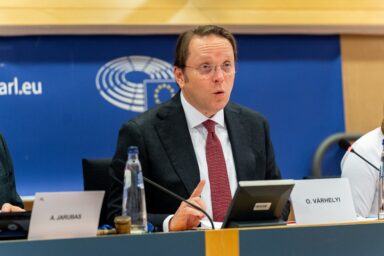

Commissioner Christophe Hansen had a mountain to climb on Thursday. He tried hard to convince members of the Parliament’s agriculture committee that the Mercosur deal and other Commission policies will shield farmers — all while bolstering competitiveness, food security and resilience. He scored something of a mixed success.
Controversy surrounding the Mercosur deal overshadowed wider discussion about the future of EU agricultural policy in the European Parliament’s agriculture committee (AGRI) debate on 19 March. It was to have covered CAP reform, rural development and food security. In fact, much of it boiled down to Commissioner Christophe Hansen defending the Mercosur agreement.
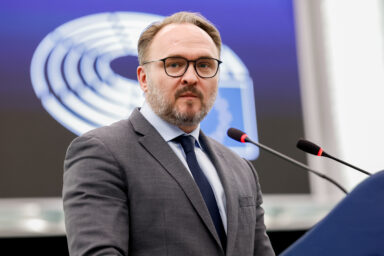
MEP Csaba Dömötör (EPP/HUN) took up European farmers’ cause vis-à-vis the deal: “Some days ago, the Commission announced that it would implement the Mercosur agreement as an interim agreement. The decision was made despite the fact that there were many rounds of farmers demonstrations here in Brussels and also in Strasbourg.”
Commissioner rebuts accusations
The Hungarian member also found fault with the political process. “Not a single plenary debate took place in this house (…) on an issue that affects the lives of hundreds of thousands of farmers,” Mr Dömötör pointed out. He implied what amounts to a Commission power grab.
Mr Hansen rejected such claims, saying that Parliament and the Council still have roles to play. In his reply to Mr Dömötör, he argued that “If there is a majority against this agreement, why didn’t you take this chance on the consent vote?” (The Parliament had agreed to accept the Mercosur agreement as is, on a provisional basis — before taking it to court.)
You might be interested
The commissioner further pointed to the political support that member states had given to the issue. “There was a large majority as well in the Council that gave the Commission the mandate,” he said. The implication was that the political disagreement should be resolved within the existing institutional framework, rather than through quibbles with procedural issues.
The discussion went on with the commissioner speaking about the next Common Agricultural Policy (CAP), food security, and farm incomes. Mr Hansen’s introduction was, again, a broad defence of the Commission’s farm policy, driven by the need for a competitive, resilient and trusted EU farm model in the face of geopolitical friction, climate change and economic competition.
Details of the next CAP
In particular, the next CAP would also include targeted support in the form of lump-sums and coupled support for some of the smaller farms whilst also continuing with common rules and level playing field across the EU, he said.
It also wants to shift support to areas with a big rural population, which Hansen said are 75 per cent of EU territory, and build resilience by focusing spending on food security, fertilisers and risk management.
If there is a majority against this agreement, why didn’t you take this chance on the consent vote? — Christophe Hansen, EU agriculture commisisoner
The debate centred on how the EU reconciles all these planned issues of market access with its own calculated autonomy and its mandates to provide farm subsidies in a turbulent geopolitical and economic environment. The Commission wants to present a package of simplification, targeted income support and resilience measures.
Balancing access and autonomy
More generally, the exchange showed the nature of the interrelation between trade policy and other developments for the farm sector. MEPs took up the links between the trade pact and rising prices, declining farm incomes, and feelings among farmers that they have to work under more demanding circumstances.
Mr Hansen pointed to the importance of the fertiliser, diesel and food security pressures coming from the Middle East. He announced that the Commission would be convening the EU’s food security crisis mechanism and be preparing a fertiliser action plan in the first half of 2026.
However, it did not appear to convince most MEPs that these provisions addressed the immediate political issue of Mercosur. The cardinal question to them was whether the EU is doing enough to protect its own agricultural producers while opening its market to outside competition.
To many, it was the response to the deal what framed the debate about more general challenges related to unbalanced competition, democratic scrutiny and the future of European agriculture. Many signalled that any Commission package will be judged against a simpler test: whether farmers believe Europe is defending their interests.