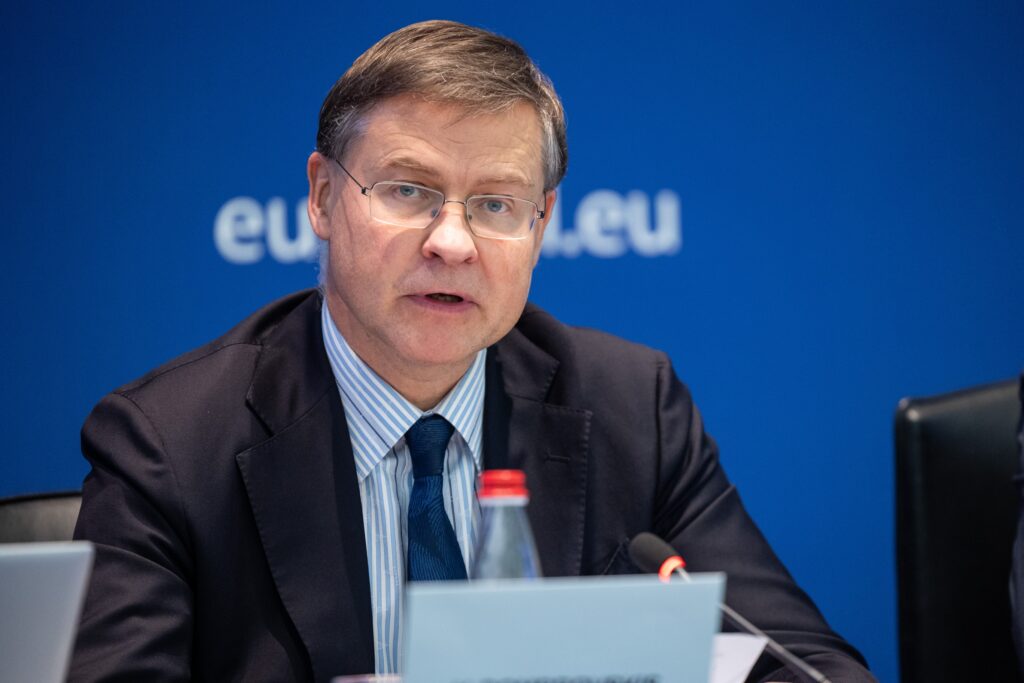

Tuesday’s ECOFIN meeting ended with a thinly veiled warning to Hungary and Slovakia over the funding of Ukraine. Commission VP Valdis Dambrovskis indicated there is a price to pay for throwing spanners in the European works.
Mr Dombrovskis emerged from the 10 March meeting of EU finance ministers intent on unblocking a stalled lifeline for Kyiv. “Let me begin with our regular update on Ukraine. We remain as determined as ever to support Ukraine and exert maximum pressure on Russia,” he told reporters.
Two legal pillars of the long-delayed Ukraine Support Loan—worth €90 bn over 2026-2027—have now entered the statute book. “Since our last meeting, two pieces of the Ukraine Support Loan legislative package have entered into force, namely the Ukraine Support Loan Regulation and the amendment to the Ukraine Facility Regulation,” he said.
Orbán’s baton
Yet the money still sits in Brussels. Budapest and Bratislava, the two capitals sharing Hungarian legacy, refuse to give the unanimous thumbs-up needed for disbursement. Hungary links its veto to the damaged Druzhba oil pipeline. Slovakia threatens to “take up the baton” if Prime Minister Viktor Orbán relents.
Mr Dombrovskis avoided naming names, but his barbs were aimed squarely eastward. “There was broad agreement among member states on the urgent need to move forward with the Ukraine Support Loan, and we expect all leaders to honour their commitments,” he warned.
You might be interested
The message was unmistakable. Should the two refuseniks persist, they risk isolation just as the EU edges towards jointly issued debt to fund the fight for Ukraine’s survival. The Balt in charge of the euro’s guardianship offered no concessions. He simply reminded capitals that the ground rules are in place and that the next move is theirs.
A high-stakes pot of cash
The package matters. Of the €90bn, €60bn will finance weaponry and equipment. The other €30bn keeps Kyiv’s budget afloat, paying teachers, medics and pensioners while bombs keep falling. The EU will raise the funds on capital markets, spreading the servicing cost—about €1bn in 2027, rising to €3bn annually from 2028—across the bloc’s budget. That edges the union further into Eurobond territory, a step unthinkable a decade ago.
All money comes with strings. Ukraine must uphold the rule of law and advance reforms outlined in a forthcoming Memorandum of Understanding. “We are working with the Ukrainian authorities to finalise its financial strategy and the Memorandum of Understanding setting out the conditions for Ukraine to receive the loan,” said Mr Dombrovskis.
Crucially, the Commission insists Ukraine will repay the principal once war reparations flow from Moscow. The political symbolism, however, outweighs the accounting niceties: Europe will not let Russia bleed its neighbour dry.
Pressure and incentives
Budapest’s veto threatens to derail that resolve. Mr Orbán demands the immediate restoration of Russian crude via Druzhba, claiming Kyiv blocks repairs. Slovak Prime Minister Robert Fico, eager to court Moscow-friendly voters, vows to maintain the blockade if Hungary steps aside. Their stance would deny Ukraine two-thirds of its external financing needs for 2026–2027. Mr Dombrovskis chose understatement, but the hint of sanctions on cohesion cash hovers in the background.
We are working with the Ukrainian authorities to finalise its financial strategy and the Memorandum of Understanding setting out the conditions for Ukraine to receive the loan. — Valdis Dombrovskis, European Commission Vice-President
Time is tight. Ukraine could run short of foreign currency by mid-2026. The International Monetary Fund has stepped in with a new programme. “We will work together with the IMF on Ukraine’s reform agenda, combining our efforts to help build a more resilient economy and integrate it into our single market,” said Mr Dombrovskis. Private investors may draw comfort from that alignment, yet only the EU’s cheque can plug the looming gap.
Meanwhile Brussels keeps an eye on oil-price gyrations caused by Middle-East turbulence, anxious that higher Russian revenues might embolden the Kremlin. “Ukraine’s international partners still have a crucial role to play, given that the EU’s financial support covers around two thirds of the country’s urgent financing needs,” Mr Dombrovskis reminded colleagues. He will carry that plea to the IMF and World Bank spring meetings.
The political cost
If Hungary and Slovakia remain recalcitrant, the Commission could explore ways to neutralise their vetoes — perhaps by docking funds elsewhere or pressing other member states to compensate. For now, Mr Dombrovskis leans on moral suasion.
The legal groundwork is laid, the money is ready, and the geopolitical stakes grow by the week. The veiled threat issued on March 10th leaves Budapest and Bratislava with a choice: fall into line, or face the political cost of starving Ukraine when Europe has already signed the cheque.