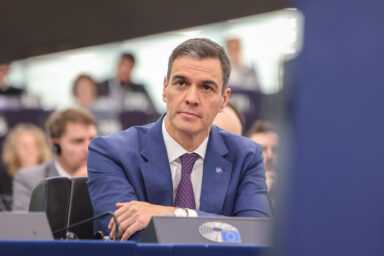

Europe must widen its circle of legally bound partners, choke off revenue that fuels aggression and help regional actors police their waters before rogue states do it for them, Kaja Kallas, the Union’s top diplomat told the European Parliament on Tuesday.
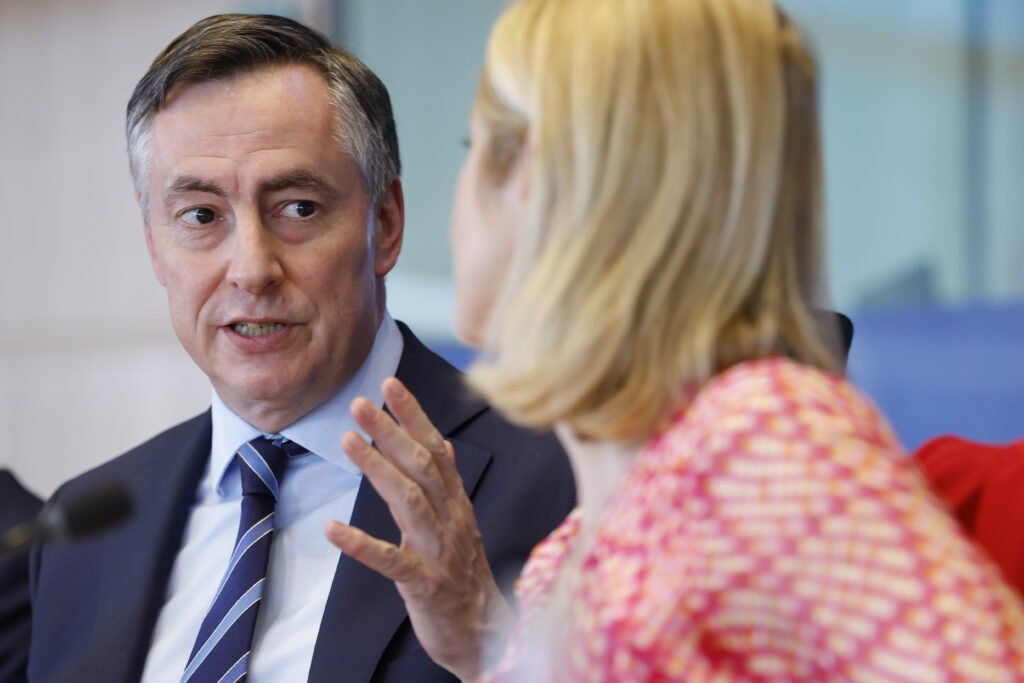
Kaja Kallas, the EU’s High Representative for Foreign Affairs and Security Policy, used a hearing of the European Parliament’s foreign-affairs committee on 17 March to make two related blunt points. First, the bloc intends to deepen hard-security ties even with long-standing friends.
“Tomorrow we will sign the EU-Iceland security and defence agreement, and we await the outcome of the referendum on the reopening of EU accession negotiations on the next August 29. The country wants to join the EU, and that’s a good thing,” she told MEPs. Second, Europe must confront what she called “an erosion of international law”.
An anxious continent
Taken together, the two themes expose an anxious continent. Iceland is already a NATO ally; formalising an EU defence link is therefore less about plugging a military gap than about signalling unity under EU rules. Ms Kallas framed the forthcoming pact as proof that small democracies still see value in Brussels’s legal and institutional shelter at a time when power politics is back with a vengeance.
Iceland’s decision comes as international norms fray elsewhere. Ms Kallas warned that the closure of vital sea lanes in the Gulf underlines how quickly law can give way to force. “The impact of the almost total closure of the Strait of Hormuz is felt worldwide. In fact, 80-90 per cent of the oil that passes through the Strait goes to Asia, and Asian countries depend on this passage,” she said.
You might be interested

“Furthermore, 54 per cent of Sudan’s fertiliser passes through Hormuz, and if there is a shortage of fertiliser this year, there will be famine next year. Food supplies also pass through Hormuz and go to Middle Eastern countries. It also impacts Taiwan’s semiconductor market. So, the impact is truly global,” the HR/VP stressed.
The Hormuz choke-point has knock-on effects in Europe’s own war. Ms Kallas noted that “Russia is getting rich off high oil prices,” a trend that will “finance a longer war,” coming at “one of the worst moments for Ukraine”.
Oil, war and law
Iran-centric disruptions boost the Kremlin’s revenue at the front just when Kyiv struggles for funds and ammunition. The High Representative therefore urged tougher curbs on illicit Russian tankers. “The EU must mitigate these Russian gains with increased pressure through sanctions, targeting Moscow’s ghost fleet,” she argued.
That linkage—Middle-Eastern turmoil empowering Russia—feeds a broader thesis. Europe’s twin crises, she said, “is the product of the erosion of international law.” When norms weaken in one theatre, revisionists elsewhere feel emboldened. Hence her plea to defend “what we believe in, including international law, to protect our union, build stability in our neighbourhood, and create the broadest network of international partners.”
The EU must mitigate Russian (oil) gains with increased pressure through sanctions, targeting Moscow’s ghost fleet. — Kaja Kallas, EU’s High Representative for Foreign Affairs and Security Policy
The Iceland deal serves that strategy. By anchoring Reykjavik more firmly to EU decision-making in cyber-security, maritime surveillance and hybrid-threat response, Brussels hopes to show that law-based structures can still expand. NATO handles collective defence; the EU offers sanctions machinery, industrial policy and rule-setting clout. Ms Kallas believes those civilian assets gain credibility when wrapped in codified security pacts.
A covert mission
The committee probed whether the Middle-East crisis might drag Europeans into unwanted adventures. Ms Kallas was crisp. “We did not start this conflict, we were not consulted, and we don’t even know what the objectives are. Member states have no intention of being dragged into this war,” she said.
Europe will continue to back civil society inside Iran, yet covertly. “Obviously, we can’t talk about it openly, otherwise these people would be exposed to retaliation. The same goes for various NGOs. But the point is that regimes rarely change from the outside; they always change from within. And that’s why our approach has always been to empower the population, so they can take charge of their own future,” Ms Kallas explained.
Lebanon looms as another test. “The UNIFIL mandate in Lebanon expires soon, as you know, and so it would create a vacuum. This doesn’t mean we, UNIFIL, will replace them. We need to understand whether member states are interested in us organizing an operation to help Lebanon,” Ms Kallas said, hinting that the EU may yet field its own stabilisation mission if the UN falters.
From Reykjavík to rules-based order
The afternoon exchange left committee members in no doubt that legal agreements still matter. An Icelandic treaty, a Hormuz crisis and a grinding land war might seem disparate. Ms Kallas stitched them together as symptoms of a single malady—the corrosion of rules—and as reasons to shore up the EU’s own.
All in all, Europe must widen its circle of legally bound partners, choke off revenue that fuels aggression and help regional actors police their waters before rogue states do it for them. In that light, tomorrow’s handshake with Iceland is more than diplomatic housekeeping. It is Brussels’s latest rebuttal to those who dismiss international law as a relic.