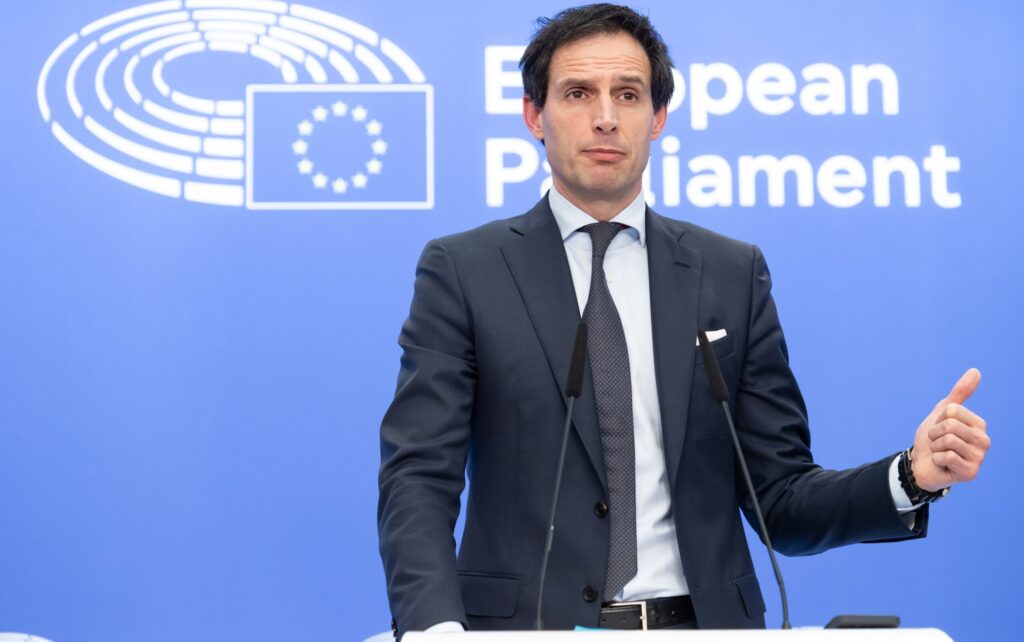

Do not make the good enemy of the best, EU Climate Commissioner Wopke Hoekstra warned after Tuesday’s Environment Council. He acknowledged that the EU may not succeed in hoisting its climate agenda on the rest of the world, and that multilateralism itself has become too tricky to be effective.
“Let’s just acknowledge that there is a significant group of countries out there who might have different objectives in terms of what they call success of a COP than we have,“ the commissioner told reporters after Tuesday’s meeting of EU environment ministers.
Cyprus’s transport minister Alexis Vafeades hailed the council session as “very productive” at the following press conference. The show, however, belonged to Mr Hoekstra. The latter defended the bloc’s emissions-trading system and mapped the path towards COP31. His case mixed urgency, hedging, and flashes of the Calvinist straight talk for which Dutch politicians are famed.
Hands off carbon pricing
“The COP 28 in the UAE was an unexpected victory of diplomacy, but quite a number of countries have thereafter sought to walk back the commitments that were made at that point in time,“ he said before recognising the EU’s limited impact on the international stage.
“It is probably more effective to focus, together with coalitions of the willing, on what you can deliver in terms of electrification, what you can deliver in terms of energy security, what you can deliver in terms of decarbonizing our industries,“ he said.
You might be interested
The Commissioner sounded a similar note on the emissions trading system, a flagship Brussels policy that generates mixed reactions among Europeans. The first task, Mr Hoekstra insisted, is to keep carbon pricing intact.
Critics had urged a pause after a Middle-East energy shock sent electricity bills soaring. The commissioner declared those calls doomed. “As part of that debate, and I think that is noteworthy given the conversations that have been in the press also recently, very significant support for the ETS framework has been voiced,” he said. Industry, heavy and light alike, now treats the market in allowances as a fact of life, not an academic experiment.
Tweaks needed
That confidence, the commissioner argued, reaches beyond climate. “Many have articulated that this is absolutely the cornerstone of our policy, and others have jumped in to say that even if this would never have been designed for climate, it is hugely important to continue on this route given the fact that we also need to have more independence.”
External shocks—three weeks of turmoil in oil routes—only strengthen the logic. “There is no alternative than to double down on clean tech, on renewables, on nuclear, on grid investments, storage investments, all with more speed,” he added.
It is probably more effective to focus, together with coalitions of the willing, on what you can deliver. — Wopke Hoekstra, EU climate commissioner
The Commission still needs to tweak the machinery. A letter from Ursula von der Leyen floated a “fast-track bridging instrument” for poorer member states alarmed by high allowance prices. Mr Hoekstra refused to name a figure but hinted at fresh money once EU leaders offer guidance. He also promised a quick overhaul of the market-stability reserve (MSR).
“We feel that we can do the MSR and the benchmark in the relatively short term, let’s say in the next couple of months,” Mr Hoekstra said. The aim is to widen the corridor in which prices may swing — high enough to bite, low enough to avoid revolt.
Guard-rails for a carbon market
He knows reform can misfire. “The way you set the parameters gives you a larger or smaller bandwidth,” he warned. The art lies in balancing price signals against revenue loss if a crash follows. A formal review of the ETS waits downstream, but changes to the MSR and industrial benchmarks must be ready by 1 July. The date marks a legal deadline that leaves scant room for political theatre.
The second half of Mr Hoekstra’s tour d’horizon focused on COP31, to be hosted by Turkey later this year. His diagnosis of multilateral frailty was blunt. “One is clearly we have concerns about the lack of effectiveness of the international system,” he said. “It is hugely important that we make this the whole endeavour of the COP as effective as possible.”
Yet the commissioner refused to indulge fantasies of treaty surgery. “The overall design with unanimity at its core is as difficult to reform as the UN is itself,” he observed. “So, there I would be realistic.”
Diplomacy is very much about talking to those with whom you do not yet agree. — Wopke Hoekstra
Realism leads to outreach. “We will continue to do, and member states have done that in the past, but we basically recommit to outreach to those with whom we very much agree,” he said. Then came the diplomat’s footnote: “But as you know, diplomacy is also very much about talking to those with whom you do not yet agree.” In other words, China, India and a clutch of oil-rich hold-outs still matter, however irksome they seem in climate chat rooms.
Mini-alliances on the horizon
Brussels plans to multiply smaller deals. “Given that multilateralism and the fact that there is unanimity comes with so many barriers, could we then focus on more plurilateral initiatives?” Mr Hoekstra asked.
The Dutchman cited the Commission’s work to spread carbon pricing, a Colombian-Dutch summit on methane, and Germany’s fledgling Climate Club. All things not literally in the domain of the COP, but a much better chance of success, even though maybe not the whole family of 195 is joining.” Expect Europe to pitch itself as convenor-in-chief of these mini-alliances.
There was strong agreement on safeguarding multilateral processes and addressing gaps in global ambition. — Alexis Vafeades, Cyprus’s transport minister
Mr Vafeades supplied the presidency gloss. “There was strong agreement on safeguarding multilateral processes and addressing gaps in global ambition,” he said. He wants a multi-year COP strategy signed before Cyprus passes the baton at year-end—a tall order, but useful leverage on the Commission draft.
Jessika Roswall, Commissioner for Energy and Environment, chimed in from a resource-security angle. “We can replace imported fossil feedstock and build resilience based on renewable European resources in so many areas of our economy,” she said while trumpeting a swift accord on the EU bioeconomy strategy. Her wider lesson matched Mr Hoekstra’s: diversified supply equals geopolitical calm.
Pressure from both ends
The upshot is a delicate ETS timetable. Markets crave predictability; finance ministers count on auction revenue; green groups fear political back-sliding. The Commissioner sees comfort in numbers. “There have been very significant declarations of support by companies from literally all walks of life,” he said. Member-state endorsements stretch beyond the eight capitals that last month urged a tougher carbon floor price. A revolt, he reckons, is no longer imminent.
Still, sceptics circle. Some governments want cheap international offsets folded into the system after 2030. Mr Hoekstra conceded that the idea floated in today’s debate. “It was mentioned by a couple of member states, but with different views. Some have spoken out in favor. I think others were more mixed,” he noted.
For now, he hides his hand. “Until we come up with a proposal, I hope you forgive me that I’m not going to speculate on what elements I like more than others.”
Recruiting the negotiators
COP31 preparations face a staffing twist: Brussels must replace its head of delegation, who doubles as lead negotiator. The Commissioner kept gossip off-limits, though he lavished praise on the outgoing envoy’s “absolutely phenomenal job”.
He waved away talk of a Beijing-style hard line for New Delhi. Each capital, he suggested, requires bespoke treatment. “What I have been sharing with you are concerns about the modus operandi of China in partially the domain of climate,” he said.
We can replace imported fossil feedstock and build resilience based on renewable European resources in so many areas of our economy. — Jessika Roswall, EU energy commissioner
Coal expansion jarred with green rhetoric, and Europe frets about supply-chain gambits. But “every country is different and what is different needs to be treated differently.” India, still without a fresh national-determined contribution, may yet escape the harsher glare.
Faster, higher, tighter
Much now depends on the bridging instrument Ms von der Leyen trailed. Design it badly and carbon prices wobble; design it well and poorer states bank cash for heat-pump grants and grid upgrades. Mr Hoekstra promised no blank cheques. First, he needs “the guidance from the leaders,” then another dash to the drawing board. Watch June’s European Council for signals.
Time is short. Allowance auctions fund the Innovation Fund for clean technology and a slice of the Social Climate Fund. A slump would hurt both, just as populist parties test the European Parliament in 2027. By fast-tracking MSR tweaks, the Commission hopes to keep prices roughly where they stand—high enough to spur investment, low enough to survive talk-radio outrage.
Steelmakers, power utilities and speculators will parse every comma. So will environment ministers tortured by summer droughts and winter bills. For now, Mr Hoekstra keeps them guessing, confident that “We can craft a path forward that does justice to what is needed for Europe at large.” The big decisions come in the next few months.