
Linking the Ukraine and Iran war theatres, the German chancellor pushed the argument that Europe should back the US in the Gulf to keep Washington engaged in the Donbas. Whether the Americans view the connection in similar terms remains uncertain.
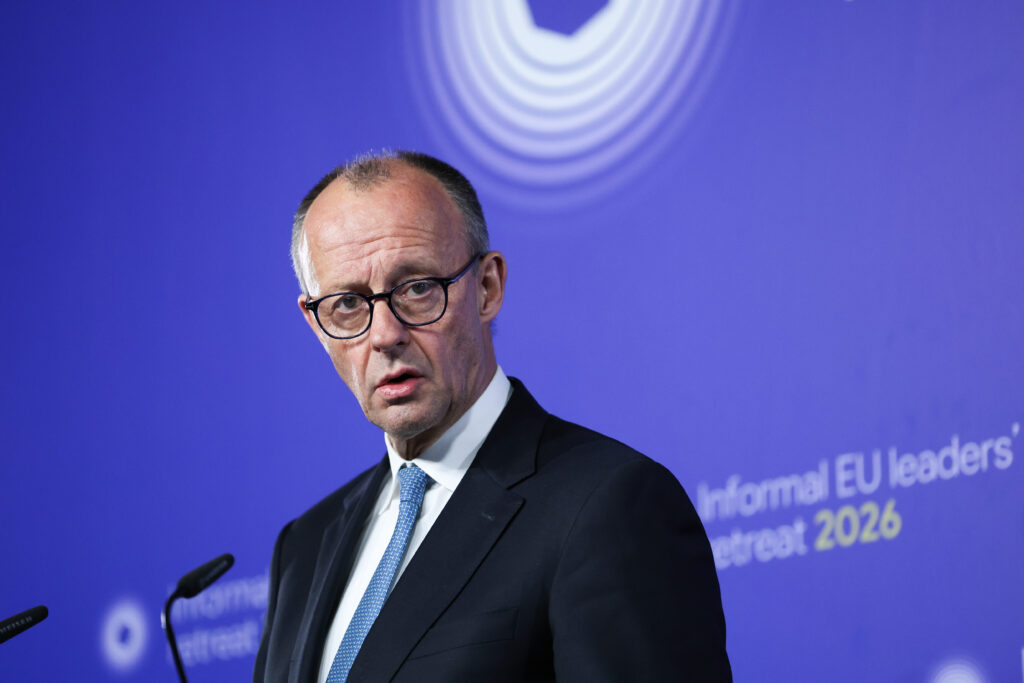
German Chancellor Friedrich Merz began March on a sprint that spanned ten time zones. On 2 March he touched down in Beijing, posed for a boiler-plate communiqué and hurried to the airport. Late that night he landed in Washington, where US President Donald Trump monopolised a 35-minute Oval Office press event, leaving the guest only three minutes of airtime. The dpa news agency clocked Mr Trump at “at least 30 minutes”, much of it looping digressions; Mr Merz’s remarks could be recited in one breath. The contrast summarised a mission long on travel and short on leverage.
Mr Trump called the chancellor “a very, very successful man” and “a friend”. The flattery cost nothing and, as one German official muttered afterwards, delivered nothing. Tariffs stayed, clarity on Iran proved elusive and fresh promises on Ukraine were hazy. Beijing, for its part, pocketed a German endorsement of “free trade, rejection of protectionism” and offered no structural concessions.
A handshake in Beijing
Back in Berlin, coalition partners asked what the trip had achieved beyond photo-ops. Mr Merz insisted substance lay beneath the optics. “We all want to see this war coming to an end as soon as possible,” he told reporters, referring to the American-Israeli assault on Iran that began on 28 February. Few doubted his sincerity; many doubted the influence behind it.
Mr Merz’s China leg, a followup on last week‘s vist, lasted barely 24 hours. It produced little beside the sort of agreements Beijing churns out by the dozen. Airbus reconfirmed a preliminary order for up to 120 single-aisle jets, while four minor memoranda covered climate pilots and agri-trade.
You might be interested
No movement came on subsidies, market access or export controls, issues Brussels deems existential. Chinese officials merely “took note” of Mr Merz’s plea for pressure on Moscow over Ukraine.
Between a rock and a hard place
The chancellor used a transit-lounge press huddle to frame his visit as “de-risking, not decoupling”, a mantra designed to soothe both German exporters and wary EU partners. Yet EU trade officials see the lack of Chinese concessions as licence to press ahead with anti-subsidy probes on electric vehicles and low-value e-commerce. Berlin can still plead for dialogue, but the centre of gravity has shifted towards tougher instruments.
For Xi Jinping the encounter served a different purpose: to show that Europe’s biggest economy still courts China despite American hawkishness. Mr Merz granted that photo-op and received in return only vague promises to keep talking.
The Washington segment was even starker. Flanked by flags and cameras, Mr Merz began by stressing common ground. “We have to strategise on this entire region,” he said, urging a joint approach on Iran that safeguarded American, European and Israeli security interests. He pivoted to Kyiv: “But Ukraine has to preserve its territory and their security interests and well, we will talk about that.”
Slapping tariffs and thighs
Mr Trump listened politely, which alone is a measure of diplomatic success. The US strongman then abandoned any semblance of debate, launching a monologue on tariffs, Spain’s perfidy, and his own knack for winning wars.
When questions turned to the cost of conflict Mr Merz warned that the spike in oil and gas prices “is of course damaging our economies”. He added: “We are hoping that the Israeli and the American armies are doing the right things to bring this to an end.”
We all want to see this war coming to an end as soon as possible. — Friedrich Merz, German Chancellor
The plea hung in the air while Mr Trump joked about hitting Germany “very, very hard” with duties. Then he slapped—presumably just as hard—the chancellor’s leg for emphasis.
Uncertainty rules
Asked whether Europe could expect tariff relief, the former leader of the once-free world said, in a successful departure from facts: “Tariffs have made our country very rich.” Mr Merz’s quest for a clarity and a tariff cap yielded only a promise to keep talking. The global 10 per cent levy—and Mr Trump’s authority to raise it to fifteen—stays in place. German executives at a round-table later in the day, keen for refunds, left muttering about uncertainty.
The futility sharpens EU resolve. Brussels now faces simultaneous fights: Chinese over-capacity at one end, American tariffs at the other. Mr Merz’s dash, meant to ease both, instead demonstrated that bilateral charm cannot trump collective leverage. Officials preparing the April Trade Council plan a package of counter-measures and an accelerated economic-security strategy covering outbound investment and critical minerals.
Mr Merz did, however, nudge defence diplomacy. “We are on the same page: This terrible regime in Tehran must go. We will talk about the day after. And we must talk about Ukraine. We want an end to these wars,” he wrote on X after leaving the White House. Linking the two theatres suits Germany’s argument that Europe should back America in the Gulf to keep Washington engaged in the Donbas. Whether Congress or Mr Trump see the bargain the same way is uncertain.
Costs without cover
Within the EU, hawks note that China ignored Mr Merz’s request to lean on Moscow. Doves counter that even limited dialogue reduces risk. Both camps agree the chancellor returned pretty much empty-handed.
Europe’s bond traders noticed. Energy-related jitters pushed yields higher, while an uptick in euro-area inflation revived talk of an ECB rate rise. Bloomberg Economics warned that prolonged conflict could “put pressure on government coffers”. The chancellor’s coalition partners fret that any economic downturn will erode support for his already wobbly administration.
Tariffs have made our country very rich. — US President Donald Trump
Domestically Mr Merz must also placate parliament. Greens and Social-Democrats demand a vote before Germany provides military assistance in the Gulf. They recall that he assured Mr Trump of “coordinated defensive action if needed”—a line sceptics read as mission creep. For a leader famed for fiscal prudence, the prospect of higher defence outlays and dearer energy is politically toxic.
Modest positives
The press corps back home replayed the Oval Office footage. Satirists compared it to Mr Merz’s previous White House visit, when he also clocked just three minutes. His supporters argue that substance happens off-camera; critics counter that substance was absent everywhere.
EU sherpas were to be de-briefed on 4 March. Mr Merz could list a few modest positives. Ties are open, escalation channels exist and a summit in June could yet trade tariff ceilings for co-ordination on Iran and Ukraine.
Mr Merz likes concise phrasing, as he demonstrated by insisting on Ukraine preserving its territory. On this, he was crystal clear. The larger question is whether clarity without clout can still shape events. Caught between an assertive Beijing and an impulsive Washington, Europe is soon to find out.