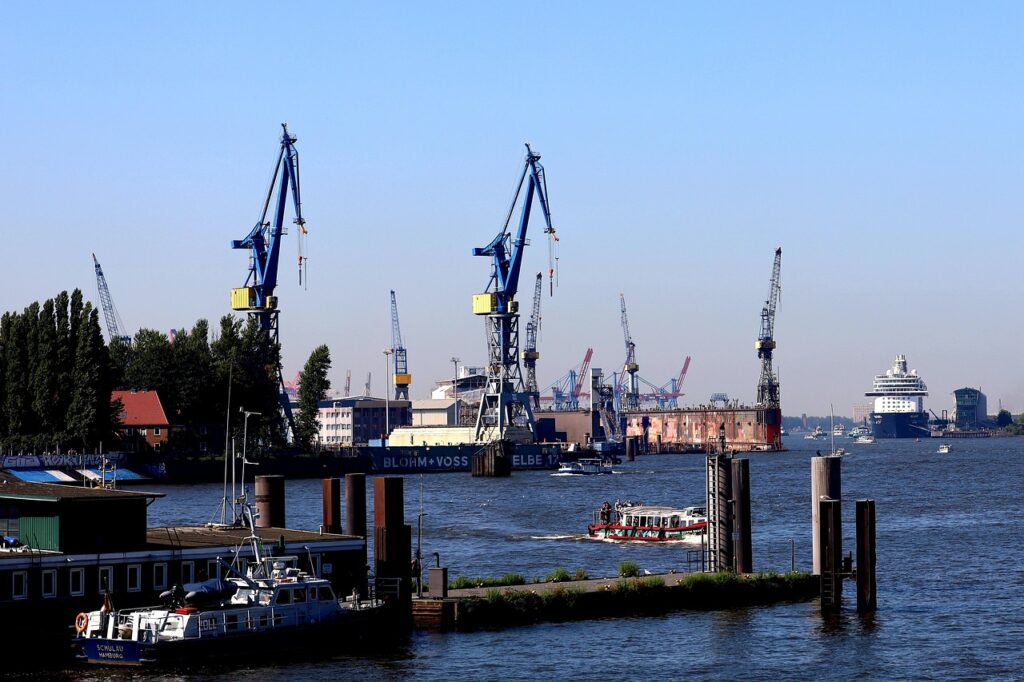

The new Industrial and Maritime Strategy aims at strengthening Europe’s maritime manufacturing and shipping. The EU Ports Strategy positions ports as vital gateways for trade, logistics, energy, and military mobility. The ultimate aim is to strengthen the long-term competitiveness of EU ports, promoting fair competition and benefiting major hubs as well as islands and outermost regions.
On Wednesday, 4 March, Commission adopted an EU Industrial Maritime Strategy and a Ports Strategy to drive competitiveness, sustainability, decarbonisation, security and resilience within the EU’s wider waterborne sector.
Europe is a waterborne continent, with the world’s largest collective maritime area. Its maritime manufacturing sector is a global leader in high-end shipbuilding and advanced technologies. The shipping sector is also a leading provider of maritime services worldwide, accounting for more than one third of global shipping tonnage across all segments.
Focus on hi-tech, digital solutions
The EU Industrial Maritime Strategy will leverage decarbonisation, circularity, digitalisation, the emergence of new blue economy segments, military mobility and defence to bolster the EU’s maritime industrial base. It will mobilise different tools to support investment, innovation, research and development in maritime manufacturing facilities and improve the global level playing field while ensuring the availability of a skilled workforce.
The Strategy will mobilise different tools to support investment, innovation, research and development in maritime manufacturing facilities. — EU Industrial Maritime Strategy
The Strategy will help foster the digital and circular transformation of European shipyards. It will support the testing and demonstration of innovative technologies with a view to replicating and scaling results.
Addressing foreign investment risks
The EU’s ports remain open to investment from third countries, but this must not result in structural dependencies or risks to European security. The Commission ensures this through horizontal instruments, including the revised Foreign Direct Investment Screening framework, the Foreign Subsidies Regulation, and the EU’s broader economic security approach.
The Ports Strategy foresees additional guidance and criteria for assessing foreign ownership and control of ports, as wellas mitigating existing ones. It also proposes a framework to map and monitor foreign investment in EU ports, particularly where ports play a critical role for supply chains, energy security or military mobility.
You might be interested
Support for outermost regions
The Ports Strategy recognises the specific challenges faced by ports in islands, as well as in remote and outermost regions, where maritime links are essential for territorial cohesion and for connecting people and goods. A new roadmap for competitive small and medium-sized ports will highlight their specific needs and bring together available EU funding options, particularly under the Connecting Europe Facility and Cohesion policy funding.
The roadmap also refers to specific measures like support for financial capacity building and project preparation, to be developed by the EIB advisory hub, and the updated rules on Services of General Economic Interest, which will directly support these ports.
New roles of EU’s ports
Ports are the backbone of Europe’s economy. They facilitate around 74 per cent of external trade, handling more than 3.4 billion tonnes of goods and nearly 395 million passengers each year. The EU’s ports are already evolving beyond their traditional roles, serving as hubs for new industry and innovation clusters. They also play a pivotal part in the EU’s energy supply, security, defence and blue economy.
To accelerate this transformation and ensure the competitive position of EU ports, the Commission will promote their innovation, digitalisation and integration with other transport infrastructure, develop guidance on foreign ownership of EU ports and for EU funding and investments in third- country ports. To advance EU ports’ clean energy transition, the Strategy presents measures promoting electrification and improved grid connection.