Thirty years after its inception, Europe’s single market remains unfinished business. Increasing geopolitical pressure and a widening competitiveness gap have thrust the project back to the top of Brussels’ agenda, with the Commission pledging to fully integrate the market by 2027. But as a European Parliament debate last week made clear, deep divisions remain over how—and how fast—to get there.
When operating across borders, European companies still face a patchwork of national rules, regulatory procedures, and administrative barriers. As global competition intensifies, this fragmentation is increasingly seen as a structural disadvantage. Despite having the world’s second-largest economy, Europe functions more like a ‘market of 27’ than a unified one.
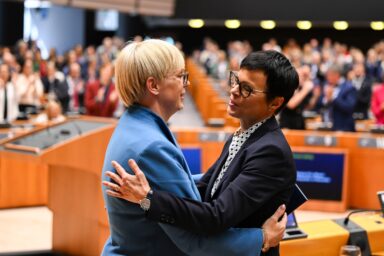
The issue was at the centre of a debate in the European Parliament in Strasbourg last week on how to move from an ‘incomplete single market to one market for one Europe’. Opening the discussion on behalf of the Council presidency, Cyprus’ Deputy Minister for European Affairs Marilena Raouna stressed that strengthening the internal market has become a strategic priority. “There is no European competitiveness without a fully functioning single market and we must deliver with a sense of urgency,” she said.
A competitiveness challenge
In that spirit, the Commission launched the One Europe, One Market initiative last month. President Ursula von der Leyen presented it as a plan to fully integrate the single market by 2027, helping the bloc catch up with the US and China. The strategy targets the main drivers of Europe’s competitiveness gap: complicated regulations, weak capital markets, high energy costs, and barriers to internal trade.
The renewed focus on the single market comes amid growing concern about Europe’s economic position globally. Reports by Enrico Letta and Mario Draghi have both warned that internal barriers—from regulatory fragmentation to administrative complexity—increasingly undermine the bloc’s competitiveness.
You might be interested
For the Commission, the single market remains the EU’s strongest economic asset. “The single market is our best asset to respond to external pressures… but important obstacles persist, particularly at national level,” said Commissioner Stéphane Séjourné, who oversees industry policy.
Removing those barriers, he argued, requires both legislative reforms at EU level and stronger commitment from member states in implementing EU rules. But many prefer to see their own rules copied by Brussels rather than adapting them to European standards. The divergence of national interests has long been a core obstacle.
MEPs divided
Last week’s debate made clear that MEPs are far from united. Andreas Schwab (EPP/DEU) called the single market one of the EU’s greatest achievements, but warned that fragmentation continues to hold back its potential. “While our global competitors operate on large integrated markets, European companies still face different national rules and bureaucratic procedures when they want to operate across borders,” he said.
The consequences are particularly visible in the services sector. MEP Alex Agius Saliba (S&D/MLT) warned that significant barriers remain despite years of efforts to liberalise the market. “After twenty years, around 60 per cent of barriers in the services market are still there,” he said, adding that fragmentation increases costs for consumers and weakens Europe’s economic resilience.
The most terrible barrier in our internal market is Brussels. — MEP Virginie Joron (PfE/FRA)
MEP Virginie Joron (PfE/FRA) argued that Brussels itself has contributed to Europe’s competitiveness challenges through excessive regulation. “The most terrible barrier in our internal market is Brussels,” she said, calling for simplification rather than further centralisation.
MEP Gheorghe Piperea (ECR/ROU) called further integration “hypocritical,” arguing that the EU still enforces policies that do not benefit citizens. He pointed to differences in state-aid rules across member states, insisting these issues must see resoultion before the bloc can meaningfully advance integration.
The next step
Alongside the One Europe, One Market strategy, several initiatives are in the pipeline this year to advance the single market. Concrete measures are already planned to develop the Savings and Investment Union (SIU). These include a review of the rules for European Venture Capital Funds (EuVECA) and the development of mechanisms facilitating investor exits from private capital shares via multilateral intermittent trading, expected in Q3.
Other initiatives include deploying the TechEU scale-up investment programme to support Europe’s fast-growing tech companies. A review of the Shareholders’ Rights Directive is due in Q4. A comprehensive report on the banking system is in the works, including an assessment of competitiveness.