
The European Commission on Monday walked a thin line when responding to the US-Israel-Iran war. The Security College—a gathering that not even Russia’s invasion of Ukraine generated four years ago—went to great lengths not to appear to endorse neither the Tehran regime nor the US-Israeli attacks.
A clash of missiles and drones between the US, Israel and Iran jolted Brussels into rare acceleration. On 2 March, the European Commission’s Security College—an emergency gathering of all 27 commissioners—met to decide what the Union could, and should, do.
A curt read-out framed the task in two lines: the Commission will “support member states” and “protect EU citizens from the adverse consequences of the events unfolding in Iran and the Middle East”. In the technocratic language of the Berlaymont, that is as close to a call to arms as you get.
Urgency replaced ritual
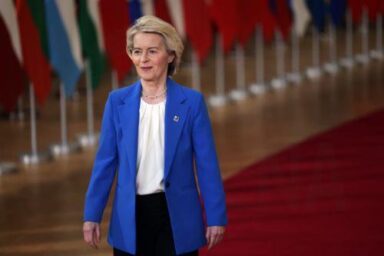
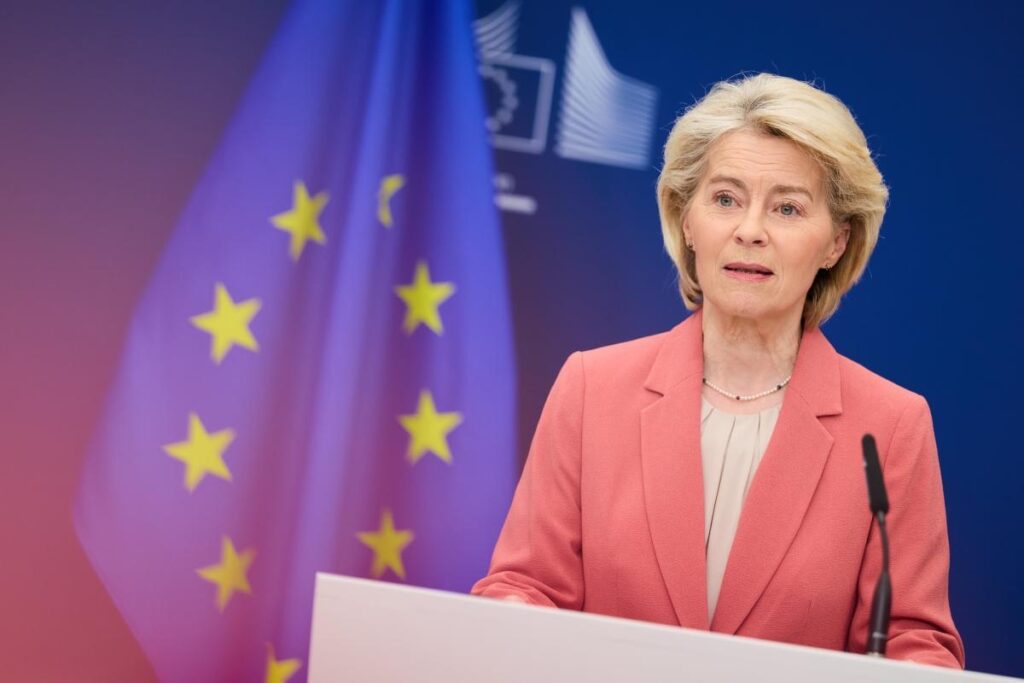
Ursula von der Leyen, Commission president, chaired the session. Ordinarily, security debates run through written procedures and inter-service consultations that take days. This time departments were ordered to file action plans the same afternoon. Energy, transport, migration and internal-security units received marching orders to meet daily until further notice. Whether that pace can be sustained is another matter; for now, urgency has replaced ritual.
The short communiqué listed five work streams. Evacuation and repatriation come first. The EU Civil Protection Mechanism and the Emergency Response Coordination Centre will help capitals extract their nationals and, where necessary, organise medical flights.
You might be interested

Second, transport security: the Commission will “reinforce monitoring of transport disruption risks“. This notably concerns the Strait of Hormuz and the Red Sea, and will “intensify coordination with airlines, shipping companies and national authorities”.
Third, an Energy Task Force, meeting this week, will “closely track both price and supply developments” in concert with the International Energy Agency. Fourth, Europol and interior ministries will operate at “heightened vigilance” to gauge potential security threats on EU soil. Fifth, migration services will “enhance preparedness through closer monitoring of trends and reinforced cooperation with relevant UN agencies and partner countries”.
Immediate steps
The practical meaning of those pledges surfaced at the Commission’s lunchtime press briefing. Journalists, scenting institutional rivalry, asked why Antonio Costa, President of the European Council, had not joined Ms von der Leyen’s late-night calls with regional leaders.
We call for full respect of international law, including the principles of the United Nations Charter. — Paula Pinho, the Commission spokeswoman
Paula Pinho, the Commission’s chief spokesperson for security files, offered a crisp answer. “The President is very regularly and constantly in touch with President Costa,” she said. “The reason for not joining these calls is one of efficiency.” In a crisis, Brussels has discovered, too many voices on a line can slow decisions.
Reporters then probed the legal terrain. Had the Commission watered down its injunction that all parties respect international law? Ms Pinho insisted not. She quoted Ms von der Leyen’s Saturday statement in full: “The President mentioned the call on all parties to exercise maximum restraint, to protect civilians, and to fully respect international law.” The line survives intact, she said, and binds friends and foes alike.
Legality, not loyalty
Attention turned to Iran’s domestic upheaval. Ms von der Leyen had urged “a transition” in Tehran, language some read as a nod to regime change. Ms Pinho bridled. “We strongly support the right of the Iranian people to determine their own future,” she said, nothing more.
A few minutes later Anouar El Anouni, spokesman for the High Representative, reminded the room that “the EU 27 statement is the highest form of statement”. It, too, underscores solidarity with Iranians and their “fundamental aspirations for a future where their universal human rights and fundamental freedoms are fully respected”.
Was the weekend’s American-Israeli strike on Iranian soil itself illegal? Ms Pinho would not bite. “Our position is quite clear and outlined in the EU 27 statement. We call for full respect of international law, including the principles of the United Nations Charter.”
Beyond remit?
A second attempt to extract a verdict met the same response. The Commission, she noted, has “always prioritised diplomacy” and believes “the only lasting solution is a diplomatic solution”. That formulation lets Brussels avoid endorsing allies’ actions while still condemning Tehran’s drones.
Some MEPs complain that Ms von der Leyen has strayed beyond her remit. The treaties give foreign-policy primacy to member states and the High Representative. Ms Pinho disagreed. “The President is acting within her remit,” she said. She also defended the College itself: a “meeting of the College of Commissioners, an ad hoc gathering when circumstances demand a dedicated meeting on security matters”. Given the weekend’s events, few could contest the need.