
A package of accords signed in Brussels renews Switzerland’s privileged access to the EU single market, aligns labour and safety rules, opens electricity and transport links, restores research funding and commits Bern to cohesion payments.
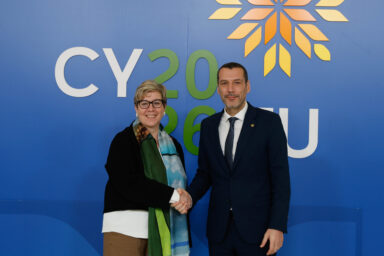
Ursula von der Leyen, president of the European Commission, and Swiss President Guy Parmelin inked a bundle of long-delayed accords on Monday, 2 March. “Today, we deliver,” the Commission chief proclaimed. Her relief was audible after two years of fraught talks.
The signing ends a period of legal drift. Bern’s 2021 walk-out froze Swiss access to Horizon research funds and tested patience in Brussels. Now a fresh framework promises clarity for commerce, mobility and energy.
Renewing a fraying bond
Talks resumed in late 2024 under threat of tariffs. Ms von der Leyen told reporters: “These agreements bring concrete and lasting benefits.” For a market of four-hundred-and-sixty million consumers, fracturing links with a neighbour that sends over half its exports to the EU made little sense.
People come first. “We will improve their daily lives.” she insisted. Dynamic alignment means Swiss quotas on EU migrants disappear. Bern preserved leeway on expulsions and permanent residence, but a safeguard clause is policed by an arbitral tribunal, not ministers.
You might be interested
Academic mobility receives equal billing. “EU and Swiss students are treated equally concerning tuition fees and support mechanisms.” the text states. That pledge secures Erasmus+ entry from 2027 and ends years of uncertainty for undergraduates who shuttle across the Alps.
Money, markets and migrants
Business demanded certainty. “This package strikes a fair balance between both our interests.” Ms von der Leyen said. A revamped mutual-recognition annex covers twenty product sectors, sparing exporters double testing. State-aid rules in air, rail and electricity will match EU norms, enforced by a new Swiss watchdog.
Transport perks follow. EU rail firms may run domestic legs inside Switzerland; Swiss carriers gain cabotage rights within member states. Road hauliers keep seamless transit through Alpine tunnels, a point Vienna lobbied to protect.
Electricity integration capped two decades of wrangling. “We are bringing our electricity markets closer.” the Commission chief noted. Bern will graft EU codes into national law, opening auctions and winter reserves; grid operators foresee stabler flows and lower balancing costs.
Food, farms and safety
Veterinary rules also converge. The Common Food Safety Area creates a single inspection regime from Geneva to Gdansk. Animals, plants, food and feed will move under one certificate. Consumers win uniform standards; producers gain simpler paperwork. Brussels accepted Swiss bans on genetically modified crops so long as trade stays smooth.
The EU and Switzerland may be neighbours by geography, but we are partners by choice. — President Ursula von der Leyen of European Commission
Tariff concessions on cheese and beef remain untouched, soothing French farmers who feared fresh competition. Nor does Brussels meddle in Bern’s domestic farm subsidies. Autonomy for agricultural policy survives; hygiene for cross-border trade tightens.
Pandemic lessons loom large. “We will be better equipped to protect our citizens from future health threats.” Ms von der Leyen said. Switzerland joins the EU’s early-warning network run by the European Centre for Disease Prevention and Control, sharing lab data at speed.
Health and research
Science is already rebooting. Provisional deals last November restored Swiss links to Horizon Europe and Digital Europe; full association requires ratification of the whole package by 2028. Failure would end funding streams that Swiss universities prize.
Money proved hardest. A permanent formula links Swiss GDP to EU cohesion coffers. Bern will pay roughly €140m this year, then €375m annually until 2036. The calculus enrages Swiss populists, yet Brussels notes that Norway contributes more while lacking comparable trade volume.
Should either party breach the deal, the other may seek redress through arbitration and, if needed, suspend market access. The European Court of Justice keeps the final say on points of Union law. That is an arrangement Bern once resisted but now swallows in exchange for stability.
Politics and peril
The accords now head to the European Parliament, where approval looks assured, and to Switzerland’s Federal Assembly, where critics will force a referendum. Ms von der Leyen pre-empted dissent: “These agreements are an investment in our shared future.” Rejecting them would end Swiss participation in Horizon, freeze Erasmus+ and let regulatory divergence erode trade.
Even success carries risks. Swiss wages may lure more EU workers, stoking migration rows. Brussels could bridle at Swiss state-aid laxity. Yet the alternative—legal entropy and rising transaction costs—would hurt both sides more.
The Swiss model has earned some keen attention in London. It shows access can be bought through alignment, cash and ECJ oversight. Britain’s ministers demur, but companies chafing under Brexit frictions will study the Swiss outcome with interest.
For now the deal offers Brussels a rare win. Amid global tumult, the EU proves it can still craft detailed, mutually beneficial agreements. Ms von der Leyen closed in hopeful tones: “The EU and Switzerland may be neighbours by geography, but we are partners by choice.” In a brittle world, dependable neighbours matter.