
What looked like a routine tweak to EU organic farming rules quickly turned into a heated political debate. MEPs clashed over imports, fairness for farmers, and whether demand can keep up with green ambitions. Behind the technical details lies a bigger question about the future of Europe’s food system.
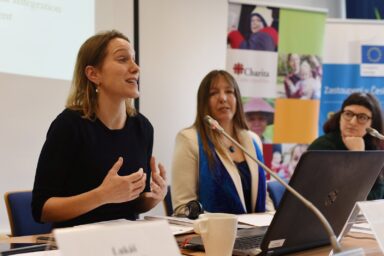
Several MEPs took the opportunity of the debate on proposed amendments to EU organic farming rules to highlight the wider concerns associated with the sector.
One of the most dramatic contributions came from Jessika Van Leeuwen (EPP), a Dutch MEP. “The world is on fire around us, and the Commission continues on this stubborn road to increase our organic farm production,” she stated.
Van Leeuwen acknowledges that organic farming might be beneficial from an environmental point of view. However, it often involves lower yields from farmland and increased land use. She spoke of how organic farmers might find themselves in financial difficulties if demand is not strong enough.
You might be interested

That’s why, in her opinion, organic farming will only succeed “if there is a market demand, not a Commission that pushes ideology top down”.
Concerns over imports and fair competition
The debate became increasingly passionate when it came to discussion of imports and whether European farmers are getting a fair deal.
Valérie Deloge (Socialists and Democrats, France) said: “European farmers make a huge effort with organic farming. We apply the most demanding standards in the world. If not, we’ll end up with imports from outside coming on the market with the organic label, but more lax rules. This is unacceptable.”
Organic farming is a fundamental issue for an important part of the agricultural sector. – Herbert Dorfmann, Chairman of European Parliament’s Agriculture Committee
Irish MEP Ciarán Mullooly (Renew Europe) stressed that while organic farming is being practised only on about 11 per cent of the EU’s total farmland, organic products account for 8–10 per cent of food consumption.
“All food labelling must be clear, transparent and trustworthy,” he said. Consumers must be able to identify the country of origin of products they buy.
Commission defends proposal
Speaking on behalf of the Commission, Elisabeth Werner rejected these criticisms. The proposed reform is needed to strengthen consumer trust in organic products, she insisted. It is also necessary to ensure fair competition between EU producers and third-country imports.
The Commission is already engaged in detailed discussions with third countries to ensure that their organic production meets comparable standards.
The aim of such equivalence agreements, she said, is to guarantee that imports meet these standards before they can carry the EU’s organic label.
A broader question for EU agriculture
The proposals put forward by the European Commission relate to changes introduced by European Court of Justice rulings and, among other things, concern the continuation until 2036 of “equivalence” agreements allowing imports from third countries produced under equivalent though not identical rules.
Organic farming presently accounts for only 5 per cent of total agricultural production. However, European leaders regard organic farming as an important part of the drive towards “sustainable food production”. In reality, demand for organic produce lags far behind these ambitious political targets.
MEP and Chairman of Parliament’s Agriculture Committee Herbert Dorfmann (EPP, South Tyrol) argued that the debate goes far beyond a technical change. “It might appear that we are dealing with an ordinary, even a boring, legislative amendment. But organic farming is a fundamental issue for an important part of the agricultural sector,” he said.
The present debate may seem quite specialised and technical in nature. However, what began as a discussion about modifying an existing regulation has turned into an expression of concern about all aspects of European agriculture, highlighting environmental targets, global instability, economic pressures on farmers, and much more.