Leaving Ukraine, Moldova, and the Western Balkans outside the EU is increasingly seen as a security risk rather than a technical delay, one that Russia is well-placed to exploit. The European Parliament has voted to push for faster enlargement, arguing that the cost of inaction now exceeds the cost of integration. The catch: a single member state can still block the entire process.
In a report adopted on 11 March with 385 votes in favour and 147 against, MEPs made the case that countries left waiting on the EU’s doorstep risk falling under the influence of hostile powers, above all Russia. The longer the process drags on, the deeper that vulnerability grows.
Montenegro and Albania are currently the most advanced candidates: both governments have set targets to conclude their accession negotiations by 2026 and 2027 respectively. Parliament is calling on member states to support that momentum and remove whatever obstacles exist on the EU’s side. For Ukraine and Moldova, MEPs want negotiating clusters—the formal stages in which candidate countries align their laws with EU standards—opened as quickly as possible.
One member state, one veto
EU enlargement debate, however, keeps running into the same wall. Under current rules, every key step in the accession process requires unanimity among all 27 member states. In practice, any single government can delay or block progress, regardless of how well a candidate is performing on reforms.
Parliament wants this to change. MEPs are calling for qualified majority voting to replace unanimity at the intermediate stages of accession talks, particularly when opening or closing negotiating clusters. The aim is to prevent individual member states from tying enlargement progress to their own political or bilateral disputes. Hungary, which adopted a parliamentary resolution against Ukraine’s accession on 10 March and has blocked or delayed several EU-level decisions related to Kyiv in recent months, is the most visible example of how the current system can be used — or abused.
You might be interested
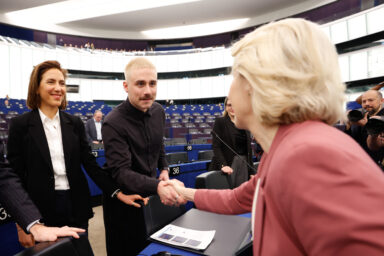
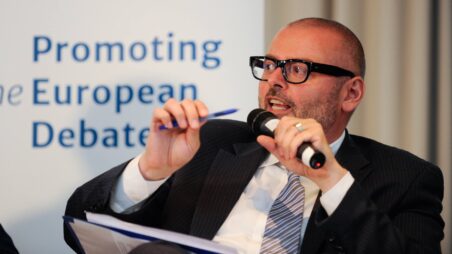
“EU enlargement must go hand in hand with internal reforms to safeguard the EU’s functioning and improve decision-making processes, including the greater use of qualified majority voting,” said MEP Petras Auštrevičius (Renew/LTU), who authored the report. Mr Auštrevičius added that the EU must complete those reforms before frontrunner candidates are ready to join.
No shortcuts
Speed does not mean lower standards. Parliament was emphatic: accession must remain merit-based and reversible. Every candidate country still has to meet strict conditions on the rule of law, judicial independence, media freedom, and the fight against corruption. Backsliding is grounds for freezing—or even reversing—negotiations entirely.
EU enlargement must go hand in hand with internal reforms to safeguard the EU’s functioning and improve decision-making processes. — MEP Petras Auštrevičius (Renew/LTU)
MEPs are also calling on the Commission to establish a monitoring group to track reform progress in the fundamentals cluster, and for adequate pre-accession funding in the next long-term EU budget covering 2028–2034. Alignment with the bloc’s common foreign and security policy matters too: Parliament noted that the most worrying democratic backsliding is occurring in the candidate countries with the lowest foreign policy alignment.
Why it matters beyond Brussels
For citizens in candidate countries, a faster process means earlier access to the single market, EU structural funds, and freedom of movement. For EU citizens, it means a larger internal market and a more stable neighbourhood.
The alternative—a ring of countries neither anchored to Brussels nor fully shielded from outside pressure—is precisely what the Parliament’s report warns against. According to the EU Legislative Train, most candidate countries are still years away from concluding negotiations. The gap between political ambition and reality remains wide. Whether reforming the voting rules can bridge it is the question that will define EU enlargement for the rest of the decade.