
In the EU’s initial response to the US-Israeli strikes, Kaja Kallas read the agreed wording calling of “maximum restraint, protection of civilians, full respect of international law”. The question of the war’s legality has laid bare a union roughly split into three camps — one applauding Washington, one hedging, one condemning.
Meanwhile, the world responded in its own ways. By Wednesdeay, oil had climbed for three straight days; European natural-gas prices have leapt by as much as 34 per cent. Bloomberg Economics warns that a prolonged conflict “could put pressure on government coffers” as capitals shield voters from dearer energy.
Stocks have tumbled and a bond sell-off has deepened. With euro-area inflation unexpectedly higher last month, analysts now wager that the European Central Bank may lift rates later this year.
Waiting for Trump to go
European public opinion wobbles alongside markets. A Euronews/YouGov flash poll taken between February 28th and March 2nd finds that 20 per cent of respondents in the five largest EU economies see the United States as a “major threat”. In Spain that share rises to 31 per cent. The same survey shows majorities in France, Italy and Spain—54, 52 and 55 per cent respectively—believing trans-Atlantic tensions will abate “once Donald Trump is gone”.
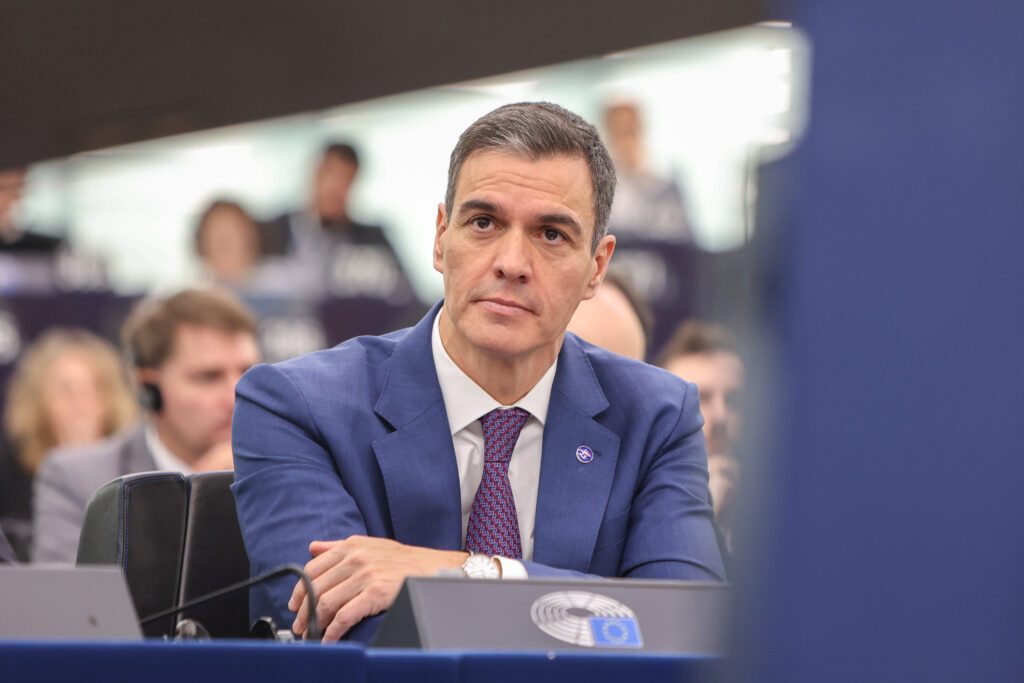
Spain leads the anti-strike bloc. Foreign Minister José Manuel Albares was quoted as saying: “We want military actions always under the United Nations charter and under collective effort.” He then added: “When we don’t see that, Spain raises its voice to signal that’s not the right way to go.”
You might be interested
Madrid has barred American aircraft from using the bases of Rota and Morón. Defence Minister Margarita Robles was equally categorical, saying Spain would provide “absolutely none” of the assistance Washington requested.
Mixed reaction
The domestic response is far from uniform. The conservative Partido Popular accuses Prime Minister Pedro Sánchez of “breaking Atlantic solidarity”. Yet the poll numbers give him room to persist. So far no other EU capital has matched Spain’s language, though opposition parties in Italy demand something close. Giorgia Meloni, the Italian prime minister, promises to address parliament on 5 March, her coalition divided over whether to echo Madrid.
France and Germany form the cautious core. Paris, Berlin and London have urged a restart of talks with Tehran, condemned Iran’s retaliation and stopped short of criticising the first American bombs.
Chancellor Friedrich Merz set a more forthright tone, stating: “We do not lecture our partners on military strikes against Iran.” Greens and Social-Democrats in his coalition want a parliamentary vote before any military help is dispatched; Mr Merz resists, but knows he cannot ignore them.
Atlanticists to the east
Mark Rutte, NATO’s secretary-general, supplied verbal cover in North Macedonia, insisting there is “widespread support” in Europe for the campaign. His confidence is shared in the Baltic. Lithuania’s president, Gitanas Nausėda, and his foreign ministry “condemn Iran’s retaliation, support allies” and demand de-escalation. Latvia and Estonia have copied that wording. All three governments see firmness toward Tehran as an indirect shield for Ukraine.
Poland straddles two stools. The government calls for restraint, opens helplines and refuses a direct combat role. President Andrzej Nawrocki, a Trump ally, praises the strikes and labels Iran “menacing”. Foreign Minister Radosław Sikorski even says Warsaw had prior knowledge of the attack. Public opinion tilts toward moderation: 57 per cent back the government’s non-military stance, while 31 per cent want open military support for Washington.
We do not lecture our partners on military strikes against Iran. — Friedrich Merz, Germany’s Chancellor
Cyprus, struck by stray Iranian rockets and keen not to look partisan, has remained mute. Hungary has done the same, though government-friendly outlets call the war a “US provocation”. In Brussels, Hungarian diplomats have slowed work on fresh Iran sanctions, prompting Dutch Prime Minister Rob Jetten to argue that unanimity hurdles must be lowered.
Silence in the centre
A dozen governments—Austria, Belgium, Bulgaria, Croatia, Denmark, Finland, Greece, Luxembourg, Malta, Portugal, Romania and Slovakia—have issued no official statements. The Czech Republic took part in the 1 March video-call but stayed quiet. Sweden, run by a caretaker cabinet awaiting a confidence vote, also holds its tongue. Officials in these capitals say privately they do not wish to inflame tensions they otherwise cannot influence.
The European External Action Service tries to herd the flock. Ms Kallas’s careful language gives each camp something to cite: Atlanticists applaud the condemnation of Iranian missiles; sceptics hail the call for legality.
That balance may fail if the battlefield widens. Spain vows to block any request for fresh base access. The Baltics and perhaps Poland would press for tougher action. France and Germany might disagree over who should command it.
Divergent futures
Economic worries grow. Energy bills rise, bond yields climb and the prospect of an ECB rate increase chills finance ministries already paying to cushion households. Any prolonged spike in oil and gas prices will strain the weaker southern economies first, widening the north-south fiscal divide the Union worked hard to narrow after the pandemic.
Three maps now compete. The first—Atlanticist and Iran-hard-line—includes Lithuania, Latvia, Estonia and the Polish presidency. The second, cautious mainstream, embraces France, Germany, Italy and most of central and northern Europe. The third—skeptical or openly anti-strike—is led by Spain, joined by left-wing and Green parties elsewhere, with Hungary shadow-boxing in the background.
Minimal unity endures because all condemn Iran’s actions and promise humanitarian aid. Strategic ambiguity over Washington’s role hides deeper fractures. Unless civilian casualties soar or Gulf shipping halts, Brussels will likely stick to its current law-first, arms-length posture while capitals manoeuvre inside the three camps. The poll data suggest more voters distrust America than before; southern Europe in particular prizes calm over confrontation.
One wording, incompatible readings
That mood matters. If Spain rallies even a handful of governments, sanctions policy could stall. If the Baltic trio persuades Germany that firmness deters Moscow, naval patrols could sail. Much turns on Mr Trump’s next decision and Tehran’s response. Europe can agree on “maximum restraint” yet interpret the phrase in incompatible ways.
The Union has seen such quarrels before. In 2003 France and Germany opposed the invasion of Iraq while Poland and Britain joined it. The EU survived. It will probably survive this crisis, too. But each clash chips a little more paint off the façade of strategic unity. Between Madrid’s rebuke, Berlin’s caution and Vilnius’s zeal, common foreign policy remains as elusive as ever.