
Seven in ten Europeans feel unprepared for emergencies — and Commissioner Hadja Lahbib says the risks are only growing. One year after the EU’s controversial ‘What’s in my bag?’ survival guide, Brussels is pushing harder: more funding, a new firefighter exchange programme, and a call to bring preparedness into schools. Whether member states will keep pace is another matter.
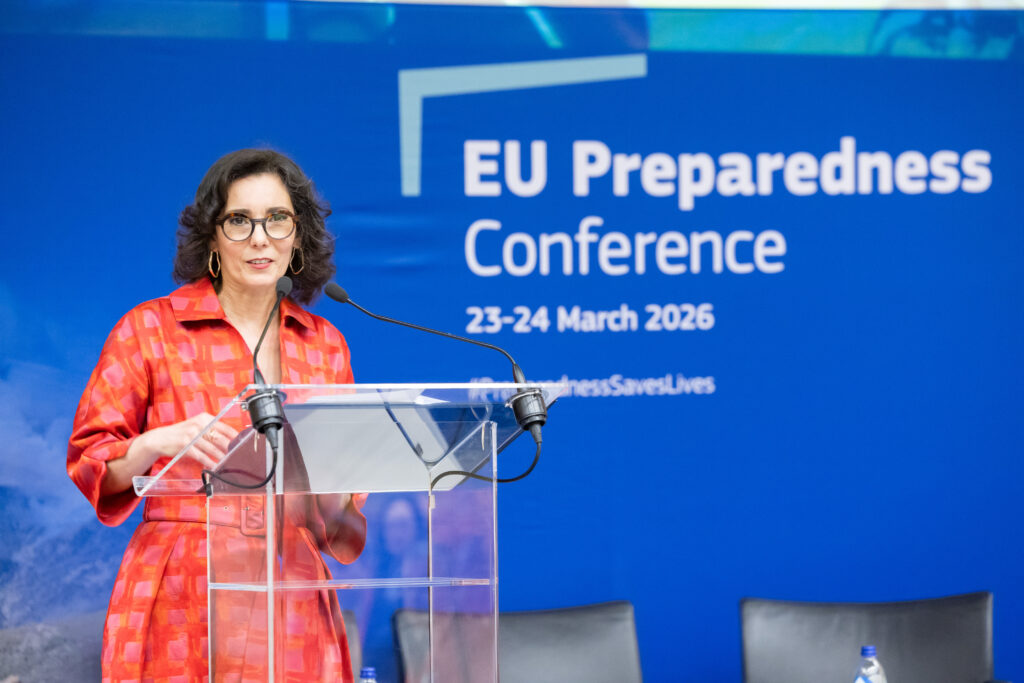
Speaking at the EU Preparedness Conference in Brussels, Ms Lahbib marked one year since the ‘What’s in my bag?’ strategy — a Brussels initiative that prompted pushback from several member states when it urged citizens to stockpile supplies for 72 hours. “The world around us is more unpredictable than ever,” she said, adding that recent events had made the case for preparedness “even more evident”.
Wars and wildfires are stretching European security in ways that increasingly overlap. Ms Lahbib pointed to the conflict in Ukraine, the war in the Middle East, and last summer’s record fire season as evidence that crises no longer respect borders — or policy silos. “Two very different crises, but they teach us the same lesson,” she said. “When a crisis arrives, people expect society to continue functioning.”
War, wildfires, and hybrid threats
The threats facing Europe are not evenly distributed. Spain faces different risks than Finland, and Ms Lahbib was quick to acknowledge that. Geography, climate, and proximity to conflict all play a role.
Last summer offered a stark reminder of how quickly danger can escalate. More than one million hectares burned across Europe — an area larger than Cyprus. “Can you imagine that?” Ms Lahbib asked. Homes were lost, forests vanished, and entire communities were forced to flee. It was the worst fire season the continent had seen in decades.
You might be interested

But Ms Lahbib insisted that no country can afford to think in isolation. In recent years, Europe has weathered a pandemic, hybrid attacks, cyberattacks, and drone incursions that forced airport closures in European capitals. Crises do not stop at borders. “Fires spread, cyberattacks jump from one country to another, war disrupts markets and supply chains far beyond the battlefield,” she said. “Our response must be collective.”
Europe’s preparedness problem
The Commission’s next budget proposal includes increased funding for preparedness across major programmes, from national investment to research. But Lahbib framed the challenge as more than a fiscal one. “Preparedness isn’t just another policy — it’s a way of thinking. It’s about people, it’s about all of us,” she said.
Nearly seven in ten Europeans feel unprepared for emergencies, and vulnerable groups feel it most acutely. “This must change,” Ms Lahbib said. The Commission is working with member states to change that, offering people practical tools: knowing local risks, knowing where to find information, and being able to cope independently for 72 hours — the core message of the ‘What’s in my bag?’ strategy.
If we want to change our mindset, we must start early, so that preparedness becomes second nature.
— Hadja Lahbib, Commissioner for Preparedness
Ms Lahbib also argued that the shift must begin in schools. “If we want to change our mindset, we must start early, so that preparedness becomes second nature,” she said. Lithuania has already introduced programmes teaching the basics of civil defence to schoolchildren — a model Brussels is now eyeing more broadly.
EU exchange programme for firefighters
The Commission announced the launch of an EU exchange programme for young firefighters later this year. “Volunteers and young professionals training together, learning from each other, building the next generation of European civil protection,” Ms Lahbib said.
The initiative draws on the spirit of the European Solidarity Corps, which brought young volunteers together across borders under the previous EU budget. With that scheme set to merge with Erasmus+ in the next financial framework, Brussels is quietly building a broader culture of cross-border civic engagement.
But the ambition runs deeper than logistics. A year after the Preparedness strategy/trend sparked debate across the continent, Ms Lahbib’s message is consistent: preparedness must be built from the ground up — in schools, in fire stations, and across borders.