
As Washington retreats from global health financing, the EU is moving to fill the gap. At this week’s One Health Summit in Lyon, the European Commission put the first concrete numbers behind its Global Health Resilience Initiative. Three funding commitments — totalling nearly €800 million — mark Europe’s bid to lead on global health at a moment of mounting geopolitical fragmentation.
The Commission announced three concrete commitments at the summit. A €700 million pledge to the Global Fund to Fight AIDS, Tuberculosis and Malaria — slightly below the previous €715 million cycle but spread over four years rather than three. A €46.5 million package to strengthen health security and antimicrobial resistance response in Africa. And €50 million for research and development into new antibiotics and treatments for neglected diseases.
The backdrop is one of accelerating geopolitical fragmentation. France’s G7 presidency has put global health firmly on the agenda, with Paris pushing to fill the vacuum left by US retrenchment. For Brussels, the One Health Summit was an opportunity to signal that Europe intends to lead.
From political concept to policy instrument
Commission President Ursula von der Leyen first announced the initiative in her 2025 State of the Union address. She positioned health security as a core pillar of the EU’s broader economic and geopolitical strategy. The initiative builds on lessons from the COVID-19 pandemic, the rise of antimicrobial resistance, and increasing climate-related health threats. All of these have exposed structural vulnerabilities in European and global health systems.
A public consultation on the initiative remains open until 13 April. The Commission is expected to present a more detailed proposal before the summer.
You might be interested
A familiar channel, with limited step change
The Global Fund supports health systems and pandemic preparedness in low- and middle-income countries. It also finances the fight against AIDS, tuberculosis and malaria. The European Commission has been a longstanding contributor since the Fund’s creation in 2002. The previous cycle saw a €715 million pledge for 2023–2025. The latest commitment is a signal of continuity rather than a step change.
Global health security is a shared responsibility and a strategic investment in our common future.
—Jozef Síkela, Commissioner for International Partnerships
Positioning the move as both a geopolitical and health investment, Jozef Síkela, Commissioner for International Partnerships said in a statement: “Global health security is a shared responsibility and a strategic investment in our common future.”
The Global Fund welcomed the pledge. “We are very grateful for your renewed commitment… It reaffirms Europe’s leadership in the fight against AIDS, tuberculosis and malaria.” Together, the Commission and member states have contributed more than €3 billion to the latest replenishment. That is around one third of total contributions since 2002.
Civil society: mixed response
Civil society organisations echoed both support and caution. Aidsfonds, Friends of the Global Fund Europe, Alliance for Public Health, Global Health Advocates and the ONE Campaign called the pledge “a clear sign of the EU’s ambition to lead on global health”. But they also noted it is “slightly lower than in the current funding period”, and are calling for an increase to €800 million ahead of upcoming budget negotiations.
Looking ahead, they also warn that the debate goes beyond a single pledge. They call on the EU to safeguard the overall envelope of the Global Europe instrument and introduce clearer benchmarks for human development. They also want sufficient resources for global health in the next long-term budget. Without this, they argue, the EU risks falling short of matching its policy ambitions — including the forthcoming Global Health Resilience Initiative.
Global financing squeeze reshapes the landscape
More broadly, the EU move reflects a wider contraction in global health financing. The latest replenishment round of the Global Fund fell short of its target. Major donors including the United States and Germany scaled back contributions. This increased pressure on remaining contributors to fill the gap.
The power vacuum is real. As the United States steps back, the question is no longer whether Europe should lead on global health — but whether it can afford to. France’s G7 presidency has made that argument explicit, pushing health security as a pillar of the new geopolitical order. Lyon was Brussels’ answer.
Recent signals from Washington point in the same direction. As reported by Devex, the US administration’s proposed budget for 2027 includes $5.1 billion for global health. This represents a significant reduction compared to previous funding levels. The proposal also restructures how funding is allocated, eliminating disease-specific budget lines and consolidating financing into a more flexible framework.
While the proposal still requires Congressional approval, it signals a broader shift in global health financing priorities — with potential implications for multilateral mechanisms such as the Global Fund.
Beyond the Global Fund: Africa investments
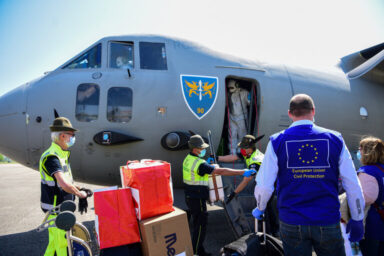
Alongside multilateral financing, the Commission announced €46.5 million in new programmes to strengthen health security in Africa. The focus is on antimicrobial resistance, surveillance and workforce capacity. The funding will support laboratory systems, diagnostics and coordination at national, regional and continental level, as well as cooperation between European and African health agencies.
Implementation will involve key partners: the European Centre for Disease Prevention and Control, the Africa Centres for Disease Control and Prevention, the European Food Safety Authority, and the European and Developing Countries Clinical Trials Partnership.
AMR and preparedness: pressure to move faster
Alongside financing, the Lyon discussions pointed to a renewed focus on long-neglected areas of global health. Chief among them are antimicrobial resistance (AMR) and broader preparedness gaps.
Framing this as a core element of EU security, Hadja Lahbib said in a statement: “With this action, the Commission, through its Health Emergency Preparedness and Response Authority (HERA), is strengthening EU preparedness by supporting innovation for antibacterial products and other countermeasures against antimicrobial resistance (AMR).”
The Commission has earmarked €50 million for research and development in this area, including €30 million to support the development of new antibiotics through initiatives such as CARB-X and the Global Antibiotic Research & Development Partnership (GARDP).
An additional €20 million will go to the Drugs for Neglected Diseases initiative (DNDi) for treatments for neglected diseases, including dengue. This reflects growing concern over the spread of vector-borne diseases in Europe driven by climate change.
Leadership abroad, capacity challenges at home
Some stakeholders point to gaps closer to home. The European Federation of Nurses Associations (EFN) argues that global health leadership must be matched by stronger investment in Europe’s own systems. “Unless the EU’s own health systems are resilient and well-prepared, the EU cannot hope to lead on the global arena”, the federation warns.
Unless the EU’s own health systems are resilient and well-prepared, the EU cannot hope to lead on the global arena.
—European Federation of Nurses Associations
Taken together, the One Health Summit announcements are the clearest sign yet of how the Commission intends to translate its Global Health Resilience Initiative into action. But with US financing retreating and civil society calling for more, the pressure on Brussels will only grow. The consultation closes on 13 April — and that is just the beginning.