
European established defence contractors—the likes of Airbus, BAE Systems, Rheinmetall, Leonardo, and Thales—stand to capture most of the EU’s €131bn defence-space envelope and the first EDIP awards already totalling €345m over 2028-34. Companies outside the EU, such as Raytheon and Lockheed Martin, as well as startups supplying vital technologies, are to follow.
“The European Union is entering into a complex and constrained negotiation on its next seven-year budget, the Multiannual Financial Framework (MFF), which will cover the period 2028-2034,” wrote Bertrand de Cordoue, defence and armament expert at the Jacques Delors Institute, in a February paper named The uneasy equation of the future EU defence budget. The talks negotiations will be structured by the proposals that the Commission will have formally tabled by mid-July. The broad outlines, however, are already known.
Brussels already dishes out grants thick and fast. France scooped €376.1m in European Defence Fund (EDF) money across the 2021-22 calls, i.e., fully a quarter of the pie. Germany bagged €281.9m, Spain €256.2m and Italy €257.5m. Military-mobility grants, worth €1.74bn so far, tilt eastwards: Poland leads with fourteen projects and about €200m, while Lithuania’s six schemes attract roughly €105m. The EPF, financed by national treasuries on a gross-national-income key, has ballooned from €5.692bn to €17bn, with €11.647bn ring-fenced for Ukraine.
The giants at the trough
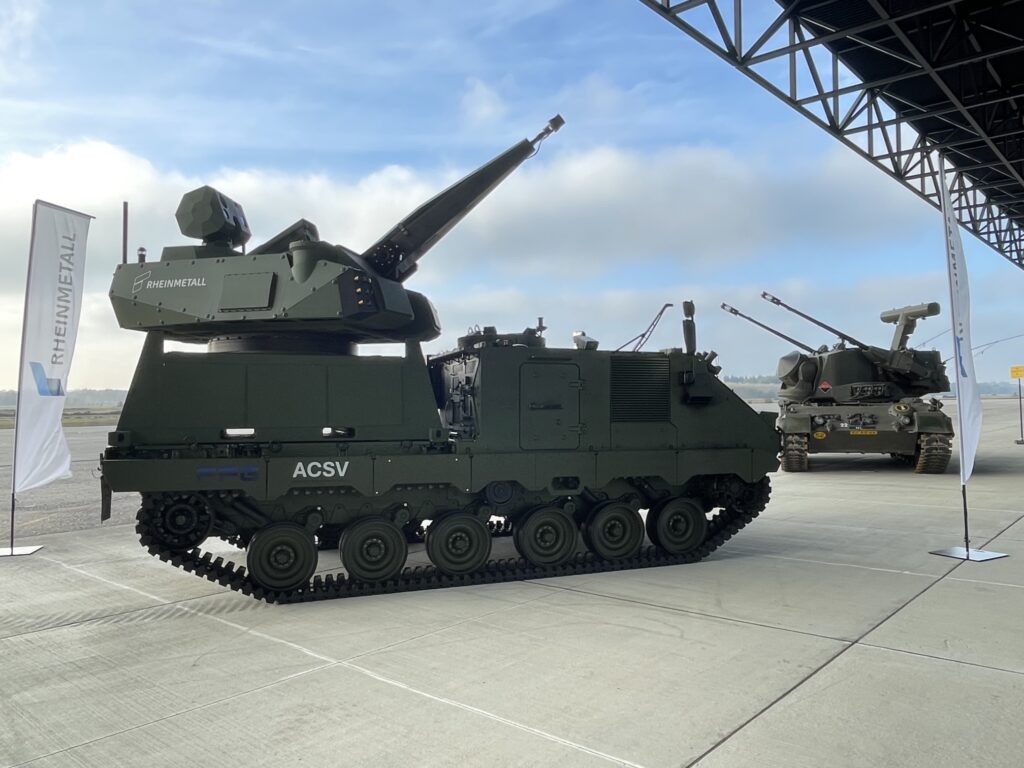
Eight European primes stand first in line to pocket the bulk of platform spending (startups will be the subject of another article on the topic). Airbus Defence & Space straddles satellites, Eurofighter upgrades and even the beleaguered Future Combat Air System (FCAS). BAE Systems covers maritime combat, artillery and tempers post-Brexit access via continental subsidiaries. Rheinmetall is rushing to treble shell output and develop the KF-51 Panther main battle tank.
Leonardo, long a helicopter and naval-electronics champion, leads the €65m AURIGA ground-combat command project. Thales dominates C4ISR electronics, is the lead coordinator on the €74.8m EICACS combat-cloud and designs Galileo’s secure overlay. Saab, Safran, MTU Aero Engines and HENSOLDT round out the list, each with clear hooks into EU funding streams.
You might be interested
Established EU-based Prime Contractors
• Airbus Defence & Space (FR/DE/ES) – combat aircraft, mobility satellites, secure communications; Bloomberg lists it as a top beneficiary
• BAE Systems (UK) – maritime combat, Eurofighter partner, Tempest sixth-generation fighter, artillery.
• Rheinmetall (DE) – KF-51 tanks, infantry vehicles, ammunition, air-defence; fastest growth among European primes
• Leonardo (IT) – helicopters, sensors, naval electronics; joint-venture leader in cross-border programmes
• Thales (FR) – C4ISR, radars, cyber-security, space; upside from electronics demand
• Saab (SE) – air-defence, electronic warfare, Gripen fighters, submarines
• Safran & MTU Aero Engines (FR/DE) – jet engines for FCAS and drones
• HENSOLDT (DE) – sensors, optronics; partners with Helsing on autonomous combat air
Transatlantic primes will not be locked out. Europe still buys F-35s, Patriot batteries and missile seekers. Raytheon’s tie-up with MBDA, Lockheed’s pairing with Saab and Anduril’s drone venture with Rheinmetall show how non-EU firms can wrap themselves in European partnerships to keep Brussels happy while tapping a surging market.
First cheques written
That the final bargain are to conclude, before the end of 2027, with haggling likely guided more by accounting considerations than sectoral logic. The stakes are large. The Commission’s orientation paper of February 2026 sketches a €131bn Security, Defence & Space heading—a ten-fold leap on the current cycle. That sum will be poured into research, joint procurement, production ramp-ups and dual-use infrastructure. The plan promises to lift a clutch of prime contractors and a crop of nimble startups, even as it forces them to prove they can deliver at speed.
European Defence Industry Programme’s (EDIP) early awards total €345m. They may look modest beside the €131bn horizon, yet they offer pointers. Brussels prefers projects that mesh research, scaling and joint operation. ASR’s fire-control kit builds on earlier EDF software. Airbus’s satellite work dovetails with IRIS², the Union’s secure-constellation successor. GDELS’s armoured vehicle aligns with Military-Mobility upgrades.
Forthcoming deals follow the same logic. Thales’s cyber bid exploits France’s EDF-backed research in AI logistics. Rheinmetall’s €300m ammunition plan couples ASAP propellant lines with EDIRPA/EDIP joint orders. The MBDA–RTX proposal wraps American radar seekers in European missile bodies.
Contracts already awarded/considered under EDIP
Awarded
– ASR Technology (FR): €50m automated artillery command, January 2026.
– Airbus Defence & Space (DE): €200m secure military satcom, February 2026.
– General Dynamics European Land Systems (ES): €95m medium-armoured vehicle, March 2026.
In the pipeline
– Thales (FR): €120m cyber-security, decision due June 2026.
– Rheinmetall (DE): €300m ammunition logistics, Q3 2026.
– MBDA – RTX (EU/US): €150m enhanced air-defence, August 2026.
– Lockheed Martin – Saab (US/SE): €250m border reconnaissance, September 2026.
Winners so far
Tracking EU cheques from 2022-26 shows who already thrives. Thales leads with the €74.8m European Initiative for Collaborative Air Combat Standardization (EICACS) cloud. Leonardo draws €162.4m in EDF money and €65m for AURIGA. Rheinmetall, Eurenco and HENSOLDT scoop thirty-plus-million-euro grants each to fix Europe’s powder crisis.
Spain’s Sener Aeroespacial pockets €100m for a hypersonic interceptor demo. French IT giant Atos nabs €40m for AI combat logistics. A Latvian UAV maker joins transport-infrastructure schemes. Even Baschieri & Pellagri, a shotgun-powder niche player from Bologna, wins €3.69m to green its propellant chemistry.
Biggest EU’s beneficiaries of defence spending 2022-2026
• Thales Group (FR) – €74.8m EICACS flagship
• Leonardo S.p.A. (IT) – €162.4m EDF total; €65m AURIGA command project
• Rheinmetall AG (DE) – €47m IPCP propellant; €20.56m ProMa shell line
• Eurenco (FR) – €47m POURPRE propellant line
• HENSOLDT AG (DE) – share of €175.3m EDF funds
• Sener Aeroespacial (ES) – €100m EU-HYDEF interceptor
• Atos (FR) – €40m ACHILE AI logistics
• UAV Factory (LV) – CEF-backed UAV mobility projects
• MBDA Deutschland (DE) – €10m E.P.I.C. missile-body casting
• Baschieri & Pellagri (IT) – €3.69m FoLi-PoWeRs propellant upgrade
A bigger pot
The outgoing MFF set aside a mere €7.95bn for the European Defence Fund, sprinkled across upstream research and downstream development. The next cycle changes scale. According to a non-paper circulated by the Commission, funding pillars will include an €16bn EDF 2.0 research window, another €16bn for capability development, €25bn for a permanent EDIP successor and €6bn for Military-Mobility II.
An off-budget European Peace Facility (EPF) ceiling of roughly €40bn will stand alongside. By adding national co-financing—typically three or four times the EU grant—the package could unlock well over €400bn of continental arms orders in 2028-34.
The Union will spend more, but it also wants to spend better. As Ursula von der Leyen, president of the European Commission, put it last December: “At the heart of this must be a simple principle: Europe must spend more, spend better, spend European.” Upstream research has found a cruising speed. The priority now is to tip money into the exploitation of EDF-funded technologies and to stimulate joint buying. EDIP subsidises collaborative orders at up to fifteen per cent of contract value. The lure of Brussels cash is meant to trump the comfort of national preference.
Strings attached
Money will flow only through Brussels-approved channels, and only to firms that keep value inside the Union. Grants come with conditions: cross-border consortia for EDF projects; at least three member states for EDIRPA orders; European preference across the board. That pleases the Commission’s industrial strategists but unnerves treasuries that fear double counting against NATO’s three-and-a-half-per-cent-of-GDP pledge.
Industry’s view is ambivalent. Primes welcome the extra cash yet worry that national budgets might shrink in response. Many mid-sized suppliers, especially in central Europe, cheer the administrative cover: using EU instruments simplifies credit allocation and spreads fixed costs. For startups, EDIP’s grant rates and ready-made supply-chain networks are catnip. Helsing, a battlefield-AI specialist based in Berlin and Paris, clinched a €268m Bundeswehr drone contract and partnered with HENSOLDT on the CA-1 Europa unmanned fighter concept.
Supply-chain capacity, not demand, could become the choke point. Redburn, a brokerage, forecasts a double-digit compound annual growth rate for European defence firms yet flags a dearth of skilled welders, chip designers and explosive-grade nitro-cellulose. Rheinmetall’s €47m IPCP propellant complex in Unterlüß and Eurenco’s €47m POURPRE line in Sorgues will take years to hit full stride. As one French plant manager puts it, you cannot 3-D-print TNT.
Follow the money
Meanwhile, other routes emerge as well. There is SAFE, a common-loan channel which pleased Andrius Kubilius, European defence commissioner: “This is a European success story. In just two months, we prepared a regulation, got it approved, and now mobilized 150 billion euro, an incredible boost for our defense and our industry,” he said in March.
ASAP, launched in 2023 to crank up shell output, selected thirty-one projects worth €500m in EU cash and €1.4bn in industrial investment. Lines are being rebuilt in Vihtavuori (Finland), Lapua (Finland) and Várpalota (Hungary). EDIRPA’s maiden work programme, announced in March 2024, funds five joint buys worth more than €11bn in aggregate. Each bundle receives a €60m EU cheque. Two lots cover 155 mm ammunition, one bankrolls IRIS-T SLM air-defence units, one underwrites new protected troop vehicles and one upgrades maritime close-in weapons.
In just two months, we prepared a regulation, got it approved, and now mobilized 150 billion euro, an incredible boost for our defense and our industry. — Andrius Kubilius, EU defence commissioner
EDIP’s own pot is smaller—for now—yet contracts are materialising. In January 2026 ASR Technology of France won €50m to craft automated artillery command kits. Airbus Defence & Space secured €200m in February to modernise secure satellite-communications links. In March General Dynamics European Land Systems, operating out of Spain, pocketed €95m for a new medium-armoured vehicle.
Pipeline negotiations include a €120m cyber-security bid by Thales, a €300m ammunition-logistics scheme led by Rheinmetall and a €150m enhanced air-defence project tabled by MBDA in partnership with RTX of America. Lockheed Martin and Saab are floating a €250m border-reconnaissance package; Brussels hopes to decide by September 2026.
EU Military-Defence Spending Channels
• European Defence Fund (EDF) 2021-27: €9.453bn, grants up to one hundred per cent for research and development
• CEF-Military Mobility window: €1.74bn committed to ninety-five dual-use transport projects; fifty per cent co-funding
• European Peace Facility (EPF): ceiling lifted to €17bn; Germany, France, Italy and Spain finance about two-thirds
• Act in Support of Ammunition Production (ASAP): €0.5bn to expand 155 mm and missile lines
• EDIRPA joint-procurement act: €0.3bn reimbursement scheme, minimum three member states per order
• European Defence Industry Programme (EDIP) 2025-27: €1.5bn—€1.2bn for industry grants, €0.3bn earmarked for Ukraine
• Proposed MFF 2028-34 “Defence, Security & Space” heading: €131bn, including EDF 2.0 (€32bn), permanent EDIP (€25bn), ASAP+ (€4bn), EDIRPA+ (€5bn), Military-Mobility II (€6bn) and a €15bn European Capability Facility.
Money alone will not guarantee capability. EDF projects often sprawl: the hypersonic interceptor, EU-HYDEF, must herd nine countries and dozens of subcontractors. Military-mobility grants pay only fifty per cent, leaving poorer governments to find matching cash. EPF reimbursements, though large, lag months behind deliveries, pinching donors’ budgets.
What could go wrong
The political calendar is equally knotty. Negotiations on the new MFF collide with elections in France, Germany and the European Parliament. Southern states fret that defence will cannibalise cohesion funds. Northern governments insist on strict conditionality, especially on rule-of-law matters. Hungary, which hosts a new Rheinmetall shell plant, routinely threatens vetoes when grants flow to Ukraine.
At the heart of this must be a simple principle: Europe must spend more, spend better, spend European. — Ursula von der Leyen, European Commission president
Yet even cautious capitals see advantages. Combining national money with predictable EU envelopes cuts unit costs. Joint orders help deeper supply-chain integration. Brussels, which once shunned hard power, now acts as banker, project manager and occasionally matchmaker between American technology and European factories.
Thus the Union will spend about €18.7bn a year on defence at the central level. Add off-budget EPF flows and national top-ups, and European outlays could reach NATO’s three-and-a-half-per-cent target well before 2034. The transformation will be messy. But the direction of travel is clear. The EU will soon rank among the world’s largest institutional defence spenders, wedging itself between Washington and Beijing.
Certainty and scrutiny
That prospect delights investors. Airbus, Rheinmetall and Thales trade at multi-year highs. Venture capital pours into Helsing, Quantum Systems and Stark Defence. Bankers already hawk ‘European defence transition’ bonds, mirroring the green-finance fad of the previous decade.
The Commission must square two aims: justify the headline numbers with concrete projects yet keep enough slack to react to shocks. The war in Ukraine forced three mid-term budget rewrites. Tomorrow’s surprise might be a blockade in the Baltic or AI-driven swarm drones over the Mediterranean. Flexibility will be priceless.
For Europe’s arms industry, the next MFF offers both certainty and scrutiny. Grants will cushion R&D costs but will expose under-performers. Joint procurement schemes reward firms that can align delivery schedules of fifteen nations. Startups relish the chance to sell prototypes into funded capability gaps; late projects risk being cut as the Commission chases headline execution rates.
The Union, once mocked for paper battlegroups, now finances real guns, shells and satellites. Whether that makes Europe safer depends on politics, not procurement. But for the contractors poised to collect Brussels’ cheques, the future already looks bright.