
Europe is racing to rebuild its military strength and expand arms production after years of under-investment. As part of that push, the European Union has approved more than €17bn in defence loans for France and Czechia under its SAFE financing programme.
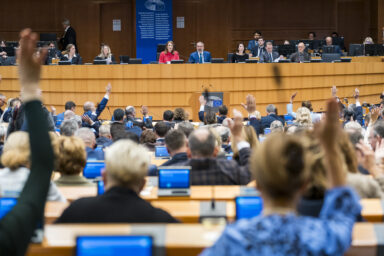
Two more member states, Czechia and France are to receive substantial financial assistance under the Security Action for Europe (SAFE), bringing the total to 18. SAFE is an EU financial instrument that offers long-term loans to member states for joint defence procurement and industrial expansion. The Council of the European Union gave its final approval on 10 April.
France is to receive the larger sum of the two, a maximum loan amount of approximately €15.09bn. Its pre-financing payment amounts to roughly €2.26bn. Initial disbursements are likely within weeks. For Czechia, the Commission has allocated a maximum loan amount of €2.06bn. This includes an initial pre-financing payment of €309m. In both cases, the funds will enable the acquisition of modern equipment and enhance collective defence readiness.
The approval of these loans represents a significant economic intervention. The blended-finance model reduces borrowing costs for member states by an estimated 100 basis points compared to sovereign debt. This crowds in national co-financing. The total approved loans across the eighteen participating states now amount to roughly €94bn. Analysts at the Bruegel think-tank estimate this will translate into €120bn to €130bn of defence procurement contracts between 2026 and 2030.
You might be interested

France’s strategic outlay
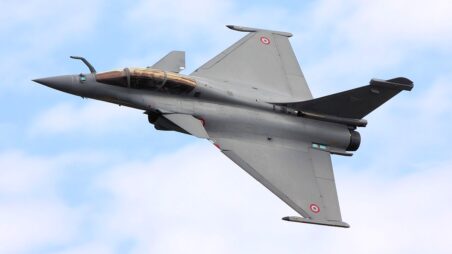
France’s hefty envelope of €15.09bn will fund a modernisation agenda. A paramount objective is the enhancement of strategic air and missile defence. This includes investment in the Franco-German-Italian SAMP/T NG system and its associated Aster-B1NT interceptors, alongside participation in the EU’s modular European Sky Shield initiatives.
The loan will also accelerate next-generation combat capabilities. A portion is to go to the common procurement of low-observable unmanned combat aerial vehicles and advanced networking components that are essential to the Future Combat Air System programme. Concurrently, France will expand its munitions industrial surge lines, co-financing the expansion of powder, explosives, and 155mm shell production capacity with allies.
Maritime security and technological innovation complete the picture. France will engage in pooled purchases of autonomous surface vessels for mine-countermeasures in the Channel and Baltic approaches. Notably, SAFE rules allow up to 20 per cent of the envelope to be channelled into dual-use deep-tech.
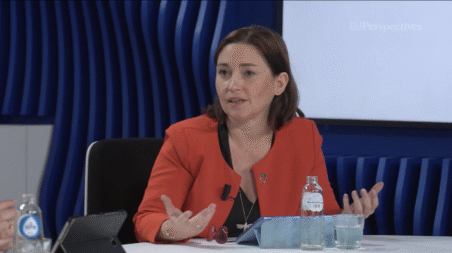
Consequently, Paris has earmarked roughly €3bn for artificial-intelligence-enabled systems, cyber defence, and micro-launcher capacity. This comprehensive programme is expected to support over 100,000 jobs in France. “Two years ago, we observed cognitive fatigue among Ukrainian soldiers dealing with anti-drone efforts, especially against Shahed drones,” Hadrien Canter, CEO of Alta Ares—a French company that sprung to life in Ukraine three years ago—told AeroMorning.com. “AI allows us to automate detection, identification, and intelligence tasks using incredible computing power.”
Czechia’s defensive shield
Czechia’s more modest allocation of €2.06bn will be directed towards several well-defined priorities. A central focus is the establishment of a robust air-defence and anti-drone layer. This involves the procurement of short- and medium-range ground-based air defence systems that are interoperable with NATO’s Integrated Air and Missile Defence framework.
Another critical element is addressing ammunition shortfalls. The plan includes joint framework contracts for 155mm artillery shells and propellant, aiming to replenish stocks heavily depleted by support to Ukraine.
Furthermore, the loan will finance the continued modernisation of land forces. This encompasses follow-on tranches for tracked infantry fighting vehicles and modular armoured support vehicles acquired through multilateral tenders.
Who comes into play: France
In both countries, flagship groups (CSG in Czechia; KNDS/MBDA/Thales in France) will draw the largest tranches, but they rely on networks of SMEs and startups for subsystems, sensors and software, magnifying SAFE’s spill-over.
The group stands to benefit from an accelerating trend of global defence spending. — Michal Strnad, Czechoslovak Group
Paris commands a rather long list of beneficiaries. MBDA France leads the air-defence field. A €600m order for VL-MICA NG launchers and SIMBAD-RC naval systems, signed in January 2026, requires serial production funding. Thales Land and Air Systems, prime contractor for PARADE and SkyDefender counter-drone suites and fire-control partner on VL-MICA NG, shares in that package. KNDS France, formerly Nexter, is developing Serval-based DSA/LAD mobile air-defence vehicles under the same deal.
Orange Business plans to knit its Drone Guardian network—19 700 telecom towers equipped for counter-UAS detection—into the armed forces’ command backbone. SAFE can offset integration costs. KNDS is also marketing RAPIDFire, an AI-guided 40 mm counter-drone turret unveiled in 2026 and ready for land platforms.
Armoured vehicles and innovation
Munitions demand is soaring. France’s Military Programming Law 2024-2030 seeks a four-fold rise in missile inventories. MBDA’s €5bn investment plan, announced on 31 March 2026, fits neatly with SAFE financing. Eurenco, listed in the defence procurement agency’s 2026 notebook, is already enlarging 155 mm shell and propellant lines and is likely to receive working-capital injections.
Armoured-vehicle assembly will absorb further tranches. KNDS produces Leclerc XLR upgrades and Jaguar, Griffon and Serval vehicles; SAFE can finance accelerated domestic batches and export variants. Thales supplies the Scorpion combat information system and vehicle optronics and expects add-on orders as the army prepares for high-intensity conflict.
The innovation budget—up to twenty per cent of the French envelope—targets dual-use startups. Alta Ares, which mass-produces AI-guided interceptor drones for Ukraine and plans to scale to 400 units a year in France, tops the list. The defence agency’s Fast-Track scheme has earmarked €300m for similar AI and robotics firms, all eligible for SAFE co-funding.
Czechia’s beneficiaries
Czechoslovak Group dominates the Czech roster. Retia, a CSG subsidiary, builds ReGuard 3D surveillance radars already earmarked for ground-based air-defence programmes and displayed at World Defence Show 2026. “The group stands to benefit from an accelerating trend of global defence spending, Michal Strnad, the group’s chairman, told Defensenews.com.
Excalibur International, the group’s integrator, offers turnkey multi-layer GBAD packages and recently proved its capacity with $2.5bn of export deals. The Czech Army is retiring 2K12 Kub batteries and bolstering RBS 70NG stocks; SAFE cash accelerates domestic radar, command-and-control and missile output.
Munitions producers stand next in line. MSM Group—another part of CSG—and its ZVS unit operate shell and propellant plants across Czechia and Slovakia and have launched a joint venture to expand modular artillery-charge capacity.
Modernisation rules
Fiocchi Munizioni, yet another CSG holding, adds small-calibre rounds featured in the group’s 2026 catalogue. Brussels insists on closing Europe’s ammunition gap, making high-volume shell makers prime recipients.
With today’s decision, Czechia and France can now receive financial assistance under the SAFE instrument. — Vasilis Palmas, Minister of Defence of Cyprus
Land-forces modernisation feeds the vehicle makers. Tatra Trucks and Tatra Defence Vehicle supply 8×8 and 4×4 chassis for self-propelled guns, air-defence launchers and engineer fleets. Excalibur Army manufactures DITA and MORANA 155 mm self-propelled howitzers and RM-70 Vampire multiple-rocket launchers, all slated for upgrade batches.
SAFE’s innovation window should channel money to Czech dual-use startups. VRgineers sells mixed-reality simulators already fielded by the United States Department of Defense and offers low-cost synthetic training kits. A national push for autonomous and counter-drone technology—showcased at the ‘Czech Drones on the Rise’ 2026 conference—means several small and medium-sized enterprises could scale production with EU funds.
A readiness framework
A final investment axis is digitalisation. Funds are earmarked for the common procurement of software-defined radios and command-and-control middleware. This will replace legacy analogue systems with secure, modern tactical communications. These investments are projected to create up to 13,000 direct and 30,000 indirect jobs within the Czech economy over the programme’s horizon.
The mechanism supports investments in defence-industrial production through the common procurement of priority capabilities. The decision confirms the European Commission’s positive assessment of each country’s National Defence Investment Plan. It brings the total number of participating states to eighteen, following two previous batches approved in February.
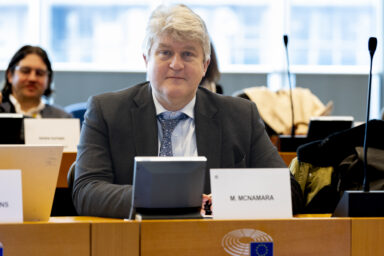
Vasilis Palmas, Minister of Defence of the Republic of Cyprus, emphasised the strategic significance of the move. “With today’s decision, Czechia and France can now receive financial assistance under the SAFE instrument,” he said. Mr Palmas, whose country holds the presidency of the Council, outlined its core objectives. “Strengthening the Union’s defence readiness and strategic autonomy, by reducing dependencies and enhancing the EU’s capacity to respond effectively and proactively, is a Cyprus Presidency key priority.”
From Canada to Ukraine
The SAFE regulation was adopted on 27 May 2025. It forms a central pillar of the ‘Readiness 2030’ defence package—an ambitious effort to provide member states with financial levers to drive a surge in defence investments. The instrument is designed to finance urgent and large-scale investments in the European defence technological and industrial base. Its explicit aims are to boost production capacity, ensure the timely availability of defence equipment, and address existing capability gaps.
The instrument is notably inclusive. Ukraine, EFTA/EEA countries, and Canada—which has concluded an agreement under Article 17 of the SAFE regulation—can participate in common procurement. Acceding countries, candidate countries, potential candidates, and those with Security and Defence Partnerships with the EU may also take part. This broad participation is intended to aggregate demand and strengthen the industrial base.
AI allows us to automate detection, identification, and intelligence tasks using incredible computing power. — Hadrien Canter, Alta Ares
Following the adoption of SAFE, the Commission launched a call for expressions of interest. By 29 August 2025, nineteen member states had responded. Czechia and France submitted their formal requests for financial assistance and their detailed defence-industry investment plans on 28 November 2025. The Commission approved both national plans on 25 March 2026, paving the way for the Council’s final implementing decision.
An economic calculus
Macroeconomic stabilisation is a key benefit. These loans feature very long maturities—up to 30 years—and sit on national balance sheets at low coupon rates. This structure enables a substantial increase in public investment without triggering immediate pressure for fiscal consolidation, supporting GDP growth from 2026 to 2028 while remaining compatible with the EU’s medium-term fiscal rules.
Furthermore, the technological spill-overs are anticipated to be considerable. Investments in digital communications, artificial intelligence, and advanced materials have dual-use civilian applications. This funding is to make the continent less dependent on external suppliers.
Both France and Czechia have also significantly increased their national defence budgets. Czechia moved from spending 1.4 per cent of GDP on defence in 2025 to 1.8 per cent. France increased its outlay from 1.9 per cent to 2.3 per cent. These earlier outlays created a pipeline of projects that the new SAFE financing is now poised to accelerate. Those looking to end the era of European under-investment in defence may draw some modest optimism from this.