
The European Central Bank has waded into climate politics, warning that scrapping the EU’s carbon market would make energy prices harder to control, not easier. The European Commission is pressing ahead with reforms to the Emissions Trading System to curb volatility — even as Italy’s government pushes to freeze it altogether. With Brussels divided and energy bills still high, the ECB’s intervention raises the stakes in a battle over one of the EU’s most consequential climate tools.
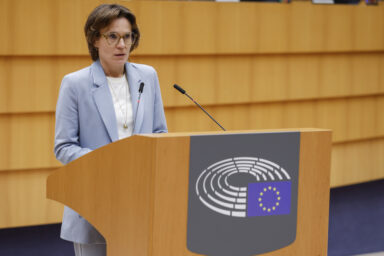
Frank Elderson of the European Central Bank (ECB) did not mince words in a statement published on the organisation’s website on Tuesday. Elderson argued that while the EU cannot eliminate geopolitical risk, it can significantly reduce its exposure to it by cutting reliance on imported fossil fuels. Investing in clean energy would weaken the link between European energy prices and volatile global markets.
Although energy policy is the responsibility of elected governments, Mr Elderson argued that Europe’s energy dependence also influences the ECB. “Our primary mandate is price stability. Yet repeated energy price shocks make achieving this objective increasingly difficult.”
Divided over carbon pricing
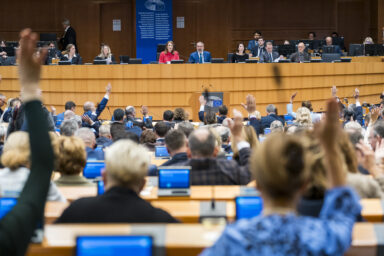
The European Parliament proved deeply divided over the future of the ETS during a recent debate. Centre-left and Green lawmakers argued that the carbon market is a cornerstone of Europe’s climate and energy security strategy. It reduces dependence on fossil fuels and shields the bloc from external shocks. They warned that weakening the ETS over short-term price pressures would undermine long-term resilience. It would also delay the transition to cleaner energy.
On the other side, right-leaning and some centre-right politicians contended that the ETS is exacerbating already high energy costs and harming industrial competitiveness. Critics argued that carbon allowances push up electricity and production costs. This is particularly painful during a period of crisis-driven price volatility. Last month, Italy’s Prime Minister Giorgia Meloni said she wanted to freeze the ETS carbon-permit scheme to soften energy bills entirely.
You might be interested
Reforming, not scrapping
In March, the European Commission announced it would revise the ETS. The goal: combat high energy prices, following calls from government leaders. “The Emissions Trading System is working. It has massively reduced gas consumption. Because of that, it has reduced our dependency on imports of fossil fuels, and it has reduced our vulnerability,” Ms von der Leyen said. “But we need to modernise it and make it more flexible.”
Wopke Hoekstra, Commissioner for Climate, Net Zero and Clean Growth, announced the first step last week. Mr Hoekstra laid out an amendment to the so-called Market Stability Reserve (MSR). The mechanism reduces the supply of allowances when too many circulate and injects them when the market is scarce. The proposed amendment will allow more allowances to be kept as a buffer to support market stability. “By strengthening the Market Stability Reserve, we enhance EU ETS’ resilience to volatility and ensure that it continues to drive decarbonisation, support competitiveness and foster clean investment,” Mr Hoekstra said.
Confusing signals
A recent report by CEE Bankwatch, one of the largest networks of environmental NGOs in central and eastern Europe, expressed concern over the revision. “Recent calls by Italy’s government and others to suspend the ETS are extremely irresponsible and reflect member states’ short-sighted energy policies,” CEE Bankwatch wrote. “Suspending one of the EU’s most successful policies would run totally contrary to the need for regulatory and economic predictability, as well as undermine climate action,” the organisation added. It would also send “extremely confusing signals” to the EU accession countries.
The ETS functions as the EU’s primary carbon pricing tool, embedding greenhouse gas emissions into the cost of electricity generation. Originally launched in 2005 and later reinforced through the European Green Deal, it requires polluters to buy allowances to compensate for the gases they produce. CEE Bankwatch stressed the role of the ETS as a cornerstone of effective climate policy in the power sector.
Our primary mandate is price stability. Yet repeated energy price shocks make achieving this objective increasingly difficult.
—Frank Elderson, European Central Bank
Mr Elderson argued that solutions are within reach — but only if the EU prioritises long-term perspectives over short-term gains. “This starts with delivering on existing decarbonisation targets and preserving the Emissions Trading System as a credible, market‑based instrument for carbon pricing,” he said. The ECB does not set climate policy. But when a central banker warns that scrapping a carbon market threatens price stability, it is harder for governments to dismiss the ETS as a luxury Europe can no longer afford.