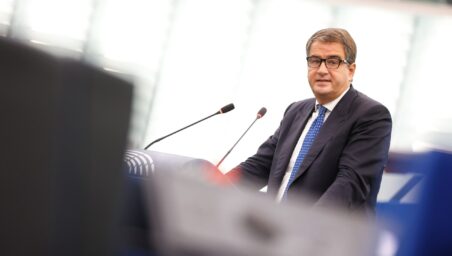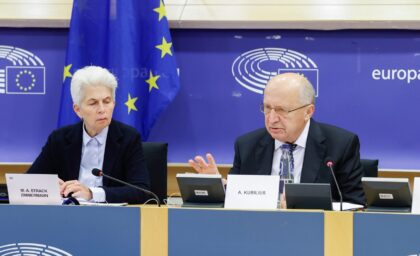
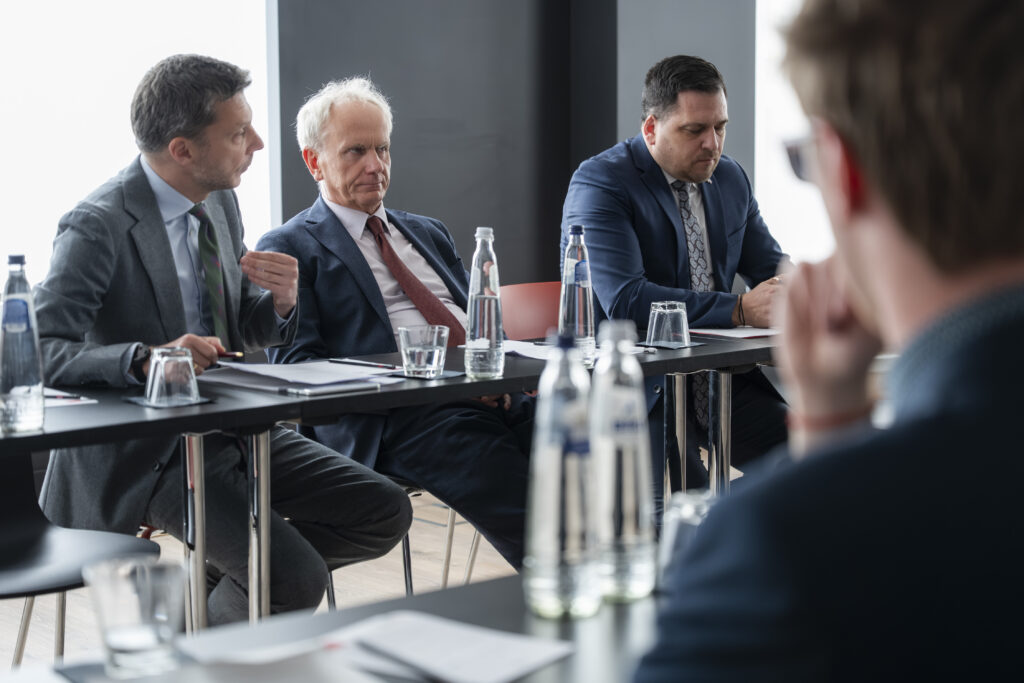
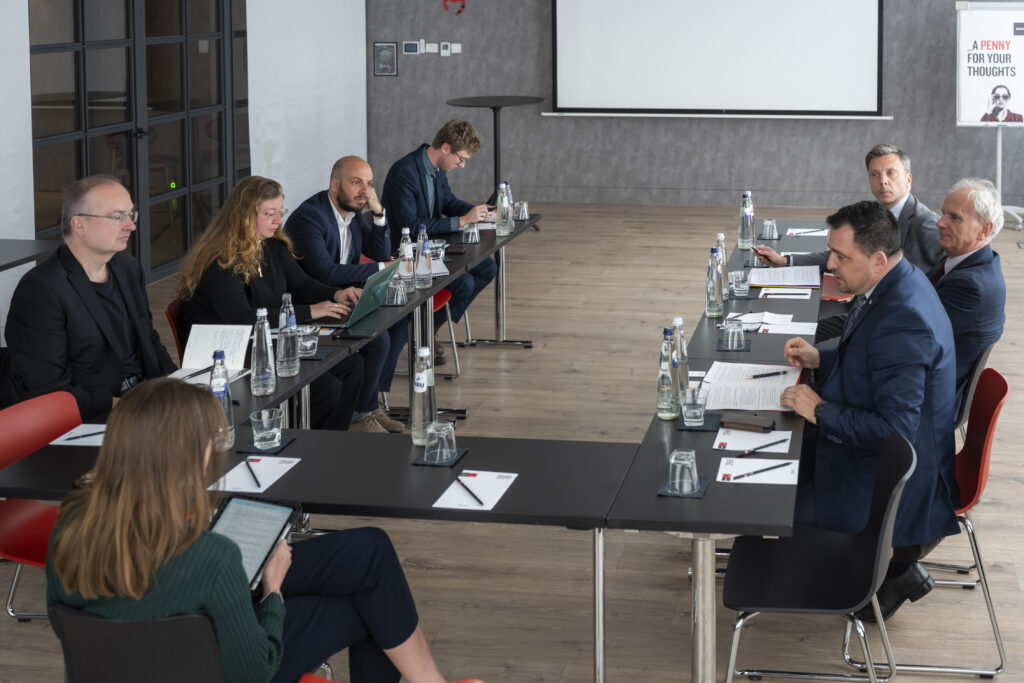
Europe’s defence industry has a clear diagnosis of what ails it. The cure, however, remains politically toxic, says Burkard Schmitt of Aerospace, Security, and Defense Industries Association of Europe. Mr Schmitt spoke at EU Perspectives’ defense roundtable, alongside MEP Tomáš Zdechovský (EPP/CZE) and Melchior Szczepanik, head of the Brussels bureau of the Polish Institute of International Affairs.
At the roundtable debate last week, Burkard Schmitt, Defence and Security Director of ASD-Europe—the Brussels-based federation representing the continent’s major aerospace, security and defence companies—offered an uncharacteristically straightforward assessment of where Europe stands. Mr Schmitt welcomed the surge in political commitment to rearmament but did not pretend it was enough. “I would not take it as a given that we have a consensus today that will last forever,” Mr Schmitt said. “I think we have to be very careful and push hard that everyone sticks to the commitments taken.”
The caution is grounded in arithmetic. Threat perception across the EU remains uneven. Estonia and Poland feel the Russian threat viscerally; Portugal and Spain rather less so. In several member states, non-negligible political parties argue openly for a return to normal relations with Moscow. And even where the political will exists, the fiscal space is shrinking. Germany has committed to spending whatever it takes — but on borrowed money.
From pledges to programmes
From the 2030s onward, debt repayments will consume a rising share of national budgets. “One thing is to announce 3.5 per cent of GDP,” Mr Schmitt observed. “Another thing is to stick to your announcements.”
The deeper problem is structural. Europe is trying to prepare for war while still living in peace. Its institutions, economy, financial markets and society at large are all calibrated for peacetime. A defence company that sees surging demand must still raise loans, convince shareholders and show signed contracts before a single rivet is ordered. Political announcements from capitals alone do not count. “The bank and the investor will only give you that money if you canshow that there are contracts,” Mr Schmitt said, “not the announcement that it will come anyway.”
The legislative scaffolding to convert pledges into programmes does exist, at least in outline. The European Defence Industrial Strategy (EDIS), adopted on 5 March 2024, sets the policy compass and explicitly frames defence-industrial readiness as a capability in its own right — precisely the argument Mr Schmitt has been making for years.
“If there is a military problem in Asia, for example, deliveries to Europe may move down in the priority list of US producers.”
— Burkard Schmitt, Defence and Security Director of ASD-Europe
Alongside it, the European Defence Industry Programme (EDIP) Regulation provides a €1.5bn bridge instrument to scale up production and fund joint procurement. A third file, the extension of the joint procurement incentive regulation that folds the earlier ASAP and EDIRPA schemes into the EDIP package, continues the reimbursement scheme for member states that buy together.
Are they serious?
Mr Schmitt’s calculation of what the EU budget should ultimately deliver is striking. Member states have committed to spending at least 20 per cent of their defence budgets on investment. PESCO and the European Defence Agency both require that 30 per cent of that investment money go to cooperative programmes. If only a third of that flows through EU instruments, the resulting envelope for defence alone would reach €100bn over seven years. “If they are serious vis-à-vis their own commitments,” Mr Schmitt said, “this should automatically lead to an important financial envelope for defence.”
The gap between that figure and what is currently on the table is, to put it mildly, considerable. On the structure of the next Multiannual Financial Framework, Mr Schmitt called for a compromise between flexibility and visibility. The European Competitiveness Fund allocates €132bn across four windows — resilience, space, security and defence. He argued that a guaranteed minimum for each section should sit alongside a buffer that can shift with evolving priorities.
The procurement tangle
The thorniest problem Mr Schmitt identified is not money but method. Europe’s defence procurement is highly fragmented. On any given week, Poland, the Czech Republic, Greece and Germany all arrive separately at the same manufacturer’s door, each with different quantities, different variants and different timelines. “This is not systematic. It hinders industry to really scale up production. It leads to higher costs and delays.”
His proposed remedy is a wholesale overhaul of how demand is organised. Member states already agree national capability targets inside NATO’s Defence Planning Process. They should then aggregate those targets into shared industrial output goals—so many tanks, so many missiles, so many drone systems—and procure them jointly, in identical variants, under a single contract.
The EU Cyber-Defence Policy—Joint Communication JOIN(2022) 49, adopted in November 2022—adds a further layer. It provides the policy umbrella for securing the digital infrastructure that modern joint operations depend upon.
Industry as military capability
Mr Schmitt acknowledged the political difficulty. Ninety per cent of Europe‘s defence industrial capacity sits in a handful of member states. The rest buy elsewhere regardless. National preference is a fact of life, he conceded, but not a showstopper. Joint procurement, he insisted, is the right direction. „The question is, it should be done in a more systematic way,“ he opined.
“We blindly relied on the United States for the last 40 years because this was a given.”
— Burkard Schmitt, Defence and Security Director of ASD-Europe
Perhaps the ASD director’s most pointed argument concerned how Europe thinks about its defence industry. He rejected the idea that it is merely an economic sector. “I always argue that defence industry is a military capability,” he said. The distinction matters enormously. If 150 battle tanks are ordered today and a conflict erupts, many will be destroyed within days. The question is not only how many are in the warehouse — it is how fast the factory can replace them. The same logic applies to every system, from artillery shells to drones. Ukraine has demonstrated this in real time.
This reframing has direct consequences for procurement decisions. Europe cannot wait until hostilities begin to ramp up production. It must maintain what Mr Schmitt called “ever-warm capacities”—a concept borrowed from the Covid-19 vaccine experience—for a range of critical defence products. Deterrence, in this reading, is not just about the size of the stockpile. It is about the credibility of the production line behind it.
A strategic asset
The dependency question sharpened his argument further. Europe relied on Russian gas long after the warnings were clear. It has relied on American systems—Patriot missiles, F-35s, Tomahawk cruise missiles—on the assumption that supply was guaranteed. “We blindly relied on the United States for the last 40 years because this was a given,” Mr Schmitt said.
That assumption no longer holds. American industry faces its own capacity constraints, and its stated strategic priority is China, not Russia. “If there is a military problem in Asia, for example, deliveries to Europe may move down in the priority list of US producers.” A European alternative to the Tomahawk is now in development, but it will take time. “If I have an alternative to the Tomahawk, I can tell Mr Trump: ‘I don’t depend on shifting policies or priorities of others.’ This is the situation that I would want Europe to be in.”
The roundtable ended without resolution, as roundtables do. But Mr Schmitt’s message was unambiguous: the money is largely there, the technology largely exists, and the legislative framework is slowly taking shape. What is missing is the political discipline to spend collectively, procure systematically and treat industrial capacity as the strategic asset it has always been.