Europe’s spending on innovative medicines buys more than health. A new report shows that every euro returns more than five times in economic value. Newer treatments help people live longer, stay in work and spend less time in hospital. Yet health systems still often see medicines first as a cost to cut, not an investment to capture, the pharmaceutical industry argues.
The figure €5.67 comes from a study published this month by the WifOR Institute for the European Federation of Pharmaceutical Industries and Associations (EFPIA). It gave each medicine an approval date, then tracked how the move to newer drugs since 2014 changed deaths and hospital use, and put a price on the result.
Illness is recession. Health is growth. — Dennis Ostwald, WifOR
Its central question is one EFPIA Director General Nathalie Moll poses in the foreword: “Will Europe continue to view spending on innovative medicines as simply a cost to the system or as an investment in the region’s health and economic future?” She sharpens the stakes with one number: without the pharmaceutical industry, the EU’s €133 billion trade surplus would turn into a €93 billion deficit.
Dennis Ostwald, the WifOR founder who led the work, puts it like this when presenting the data at EFPIA’s annual conference: “Illness is recession. Health is growth.”
The health gains, in numbers
According to the report, the health gains are large. Across 29 European countries between 2014 and 2022, the move to newer medicines for cancer, metabolic and digestive disease and respiratory illness helped avoid 1.83 million years of life lost before age 85. It also saved 20.9 million hospital days.
In money terms the gains reach €66.18 billion, set against €11.67 billion in extra spending on newer medicines. That is the “€5.67” return. Most of it is productivity: €38.10 billion from paid work and €18.96 billion from unpaid work, plus €9.11 billion in saved hospital costs. Lower hospital use alone recovers about 78 cents of every euro.
What’s needed according to the author is a shift in mindset: that the pharmaceutical industry is recognised as an economic investment, not just a cost. The returns are not even, though. Cancer and immune drugs pay back 6.8 times, the highest, and every one of the 29 countries clears a return above one.
The contested part: who gets the credit
The weak point is attribution. Cancer drugs drove most of the benefit, and cancer survival has many causes. Cancer is the largest group in the analysis. So do the medicines alone deserve the credit?
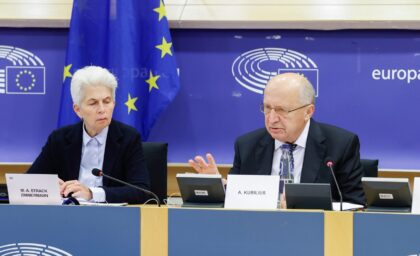
Gloria Ghéquière, deputy head of cabinet to Belgium’s deputy prime minister and health minister, is not convinced. Cancer survival, she argues, also rose because of screening, vaccination and specialised care. “The study just captures the progress that we made in terms of cancer care as progress made by medicines. Which is not entirely true,” she says.
I do not really agree with the premise that we do not value new or innovative drugs. — Gloria Ghéquière, Deputy Head of Cabinet for Deputy Prime Minister and Minister of Social Affairs and Public Health Frank Vandenbroucke, Belgium
The method is built to answer that. It controls for factors that move with a country, such as income, education and the general quality of medical care, and isolates the effect of newer drugs. Mr Ostwald accepts the limits, and calls the work a first step, with the same sums still to be done for hospital and cancer care.
Ms Ghéquière’s deeper objection is to the way the problem is framed. “I do not really agree with the premise that we do not value new or innovative drugs,” she says. Value is already built into how medicines are reimbursed, she argues: each new drug is judged on the life and hospital time it saves, then priced.
A number built to be cautious
Mr Ostwald is the first to call the result a conservative calculation. Medicines are priced at their list prices, not the lower net prices states actually pay. And much is simply left out. “It was most low-hanging fruit just to analyse productivity gains and the reduction of hospitalisation,” he says. “There are much more determinants which have a huge impact, caregiver burden, system impact. This is not included in this calculation yet.” As a scientist, he adds, he would rather be on the conservative side than on the other side.
Timing points the same way. The long-term effects are much larger than the short-term ones, so a one-year view understates the gains. That sits awkwardly with the annual budgets health systems work to.
The real target: finance ministers
For Mr Ostwald, the audience that matters is finance ministers. Health economists, he argues, keep convincing the convinced, while the people who hold the purse still see health as a cost. “Have you ever pitched in front of a minister of finance for more money? They don’t have the argument at hand. They don’t speak the language,” he says.
His pitch is a loop. Invest in innovative medicines and health improves; better health lifts productivity; higher productivity builds wealth and fiscal space; that space pays for the next round of innovation.
Have you ever pitched in front of a minister of finance for more money? They don’t have the argument at hand. They don’t speak the language. — Dennis Ostwald, WifOR
Ms Ghéquière has heard that pitch, and made it herself. She has told her own finance minister that health is a good investment, and he agrees. The money is still finite. “He says I agree, still the government budget is limited,” she recounts. Health is already the second biggest public spending line after pensions, and it competes with police, justice and housing. Agreement, in other words, is not the obstacle. The money is.
The number also lands at an anxious moment. Europe is slipping in pharmaceutical innovation. Its share of global pharmaceutical research and development fell from 41 per cent in 2001 to 31 per cent by the mid-2020s, and the spending gap with the United States widened from €2 billion to €25 billion. Patients also wait. The median time from approval to an available medicine in the EU is 532 days, from 56 days in Germany to 1,201 in Romania.
What comes next
The case for acting is now on the table. Spending on medical innovation is cast as “not only a health imperative but also a highly efficient use of public resources”. Three things, it argues, should move together: stronger conditions for innovation, faster and fairer access to medicines, and protecting Europe’s place in life sciences. The warning is equally direct. “Inaction has a price”: avoidable deaths, lower productivity and slower growth.
But the harder question is the one Ms Ghéquière raised. A strong return on paper still competes with every other call on a finance minister’s budget. Whether €5.67 changes that maths is the open question.