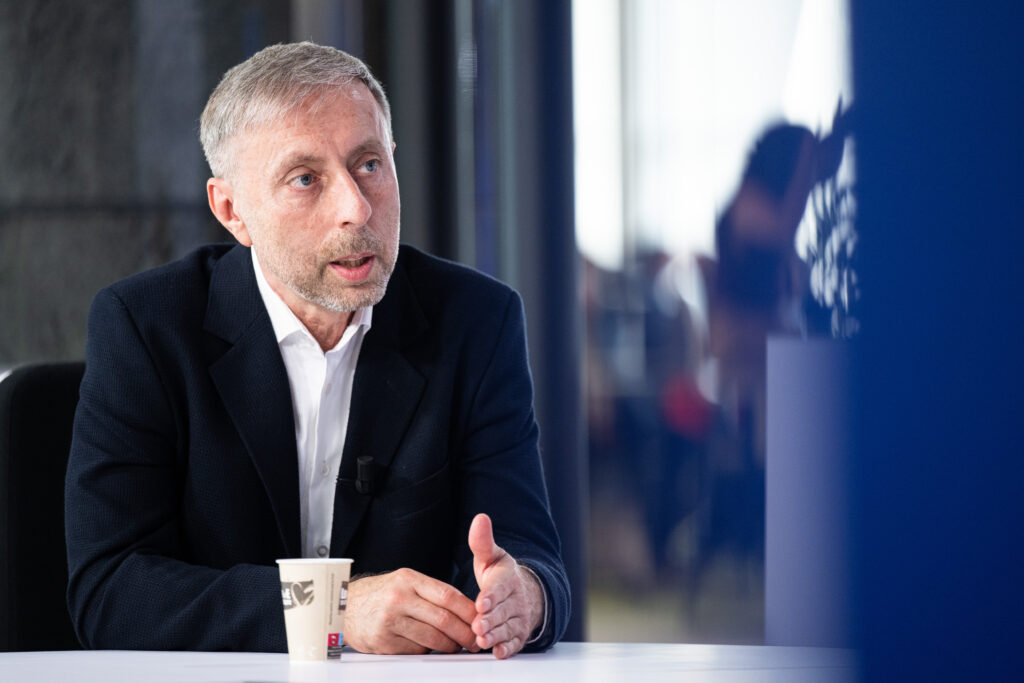
Protecting children and reducing smoking are not competing goals, writes Jindřich Vobořil, a veteran Czech policymaker in an open letter to the WHO’s anti-smoking crusader.
Slogans do damage far beyond their target, argues Jindřich Vobořil, a Czech addiction clinician. In an open letter to the World Health Organisation, he warns that branding nicotine harm reduction as ‘harm creation’ will hurt much more than nicotine policy. “Slogans generalise. Once harm reduction as such is branded as harmful, the damage will not stop at nicotine,” he wrote. “It will reach needle exchange, substitution treatment and overdose prevention, the very services that keep thousands of people alive.”
The specific addressee of Mr Vobořil’s letter is Kristina Mauer-Stender, a tobacco-control adviser at the WHO Regional Office for Europe. In a 23 November interview with Rapporteur she said the EU’s upcoming revision of the Tobacco Products Directive is a major opportunity to protect young people from nicotine. Her verdict on smoke-free nicotine products was damning. “It’s not harm reduction but harm creation,” she said.
A marketing campaign?
That line troubled Mr Vobořil deeply. The interview as a whole, he says, reads like a campaign. “Read as a whole, the interview sounds less like a technical assessment than a prepared marketing campaign, timed for the revision of the EU Tobacco Products Directive.” He does not mince words about the result. “This is a dangerous game with political slogans.”
You might be interested
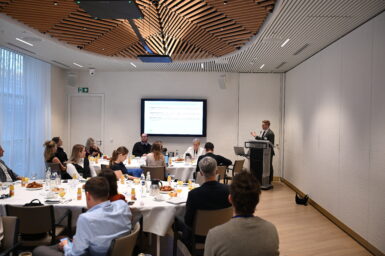
Mr Vobořil is no bystander. He has has over thirty years’ worth of clinical work with addicts under his belt, having served as National Drug Coordinator under eight governments across political lines. In that role, he authored the strategies and the legislation through which Czechia regulates tobacco and nicotine, alcohol, gambling, and drugs according to risk.
The sharpest charge in Jindřich Vobořil’s open letter is that “From all three positions—clinician, regulator and policymaker—I can say with full responsibility that prohibition has never delivered what it promised.” His verdict on the politics is harsher still. “In my experience, prohibitionist policy has always ended up serving interests other than public health. (…) Demand does not disappear when supply is banned; it moves to the illegal market.”
The Czech record
Mr Vobořil points to results at home. “As a policymaker, I am proud of what the Czech approach has achieved.” His figures begin with HIV. “While several EU countries report HIV prevalence above 15 per cent among people who inject drugs, in Czechia it has stayed well below one per cent: only 5–14 new injecting-related infections a year among some 42,000 people who inject drugs.”
Overdose deaths tell a similar story. Czech levels have long been low by European standards. The national monitoring centre links this directly to good coverage of harm-reduction services.
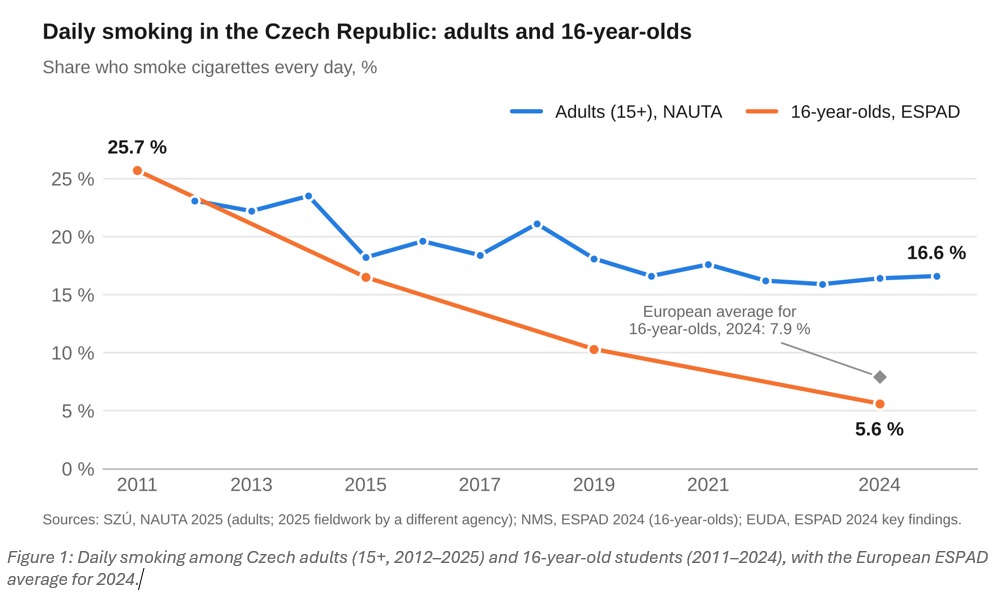
Teenage smoking has also fallen. “And daily smoking among Czech 16-year-olds has fallen from 25.7 per cent in 2011 to 5.6 per cent in 2024, now below the European average of 7.9 per cent, although not long ago our teenagers were among the heaviest smokers in Europe.” He dismisses any link to industry. “None of this has anything to do with tobacco-industry rhetoric. It is what public-health policy built on evidence looks like.”
Adults are a mixed bag. Daily smoking fell from 23.1 per cent in 2012 to 16.6 per cent in 2025. It has stalled at around 16–17 per cent since 2020.
Who may set the agenda
Mr Vobořil asks Ms Mauer-Stender to “stop gambling with people’s lives and health for the sake of an ideology”. He grants that private philanthropy may pursue its own goals. Bloomberg Philanthropies has committed more than $1.58bn to tobacco control since 2005, and the WHO is among its partners. But he draws a line. “A UN health agency is not entitled to adopt that agenda’s prohibitionist slogans uncritically.”
In his view the WHO’s job is different. “The WHO is not here to market a political line.” Its mandate, he says, is to give governments complete, objective evidence. It should promote prevention that works, not a policing route back to prohibition.
Rational policy moves people away from the first and towards the third, under the rules of the second. — Jindřich Vobořil, former National Drug Coordinator of the Czech Republic
Harm reduction, he insists, is not a tobacco-industry invention. “It has been a mainstream public-health approach for decades — in clinical terms, tertiary prevention: when a person cannot or will not stop, we reduce the damage.”
He cites the numbers. Around 505,000 people in the EU now receive opioid agonist treatment. A meta-analysis in the BMJ found mortality roughly three times higher among people out of methadone treatment than among those in it. The rates were 36.1 deaths per 1,000 person-years against 11.3. Across half a million patients, he says, that means thousands of lives saved in the EU every year.
Nicotine and three kinds of market
The WHO itself backs the practice. “Your own organisation lists methadone and buprenorphine as essential medicines and strongly recommends opioid agonist treatment.” He then turns the argument back on her. “If the same logic suddenly becomes harmful when it is applied to nicotine, the problem is not the evidence. It is consistency.”
Mr Vobořil ranks the outcomes. The best is that people never start. The next best is that smokers stop completely. But many will keep using nicotine. “For them, the decisive health distinction is between inhaling the products of combustion and using nicotine without combustion.” He does not call smoke-free products safe. “Smoke-free products are not harmless, but they must be judged against the real alternative, which for many people is continued smoking.”
Selective numbers may serve a campaign; governments need the whole picture. — Jindřich Vobořil
He sorts every market in an addictive substance into three forms. Prohibition produces an illegal market, “which asks no one for identification and answers to no one”. A regulated market can impose age limits, product standards, traceability and accountability. The third he calls a substituted market, in which less risky products replace the most harmful ones. “Rational policy moves people away from the first and towards the third, under the rules of the second.”
Every restriction, he argues, should be tested against real behaviour. Will it lead people to quit, return to cigarettes, switch products or buy from an illegal seller? He takes aim at one idea Ms Mauer-Stender floated, that the EU should examine the legal feasibility of a freeze on new nicotine products. Such a freeze, he says, “would fix the market by date of entry rather than by risk”. His conclusion: “Restrictions that ignore what they do to behaviour are rhetoric drifting towards prohibition.”
Children, honestly
On young people he is firm. “Sales and marketing to minors must be prohibited and enforced.” Retailers who sell to children should face meaningful sanctions. Online age verification must work, and products should meet clear standards. Companies must be regulated: their claims independently tested, their products controlled, their conduct monitored. Where firms deliberately target minors, the evidence should be published and the conduct punished.
But he warns against two errors. “Youth protection cannot rest on the fiction that teenagers will never experiment, and allegations of intent require more than products that young people may find attractive.” He adds: “If a teenager determined to experiment chooses a smoke-free product rather than a cigarette, that is not a public-health triumph, but it is a less dangerous outcome.”
He also rejects a second argument from the interview. Ms Mauer-Stender, he says, holds that the number of young users who have never smoked disproves the claim that these products help adults quit. “It does not.” Both effects can exist at once. The proper task is to measure them separately and weigh the net effect on the population. Trying a product once, occasional use and daily dependence are different behaviours.
He poses the questions that matter. Is total nicotine use among young people rising, stable or falling? Are they moving towards cigarettes or away from them? “An increase in vaping accompanied by a larger fall in smoking is a different public-health picture from an increase in both.” He ends the point with a barb. “Selective numbers may serve a campaign; governments need the whole picture.”
Enforcement, not prohibition
He takes the Czech rise in daily e-cigarette use among teenagers seriously. But he notes that selling e-cigarettes to anyone under 18 is already illegal in Czechia. “Teenagers are not supplied by the law; they are supplied by those who break it – non-compliant shops and an irregular market.” The remedy, he says, is “better enforcement of the ban we already have, not prohibition for adults”. Smoking, total nicotine use and the illegal market, read together, are the complete evidence the WHO should give governments.
He also points to the UN’s human rights machinery. In 2023 the Office of the UN High Commissioner for Human Rights published a report, A/HRC/54/53. It documented how punitive, prohibition-based drug policies led to serious human rights violations, from over-incarceration to the death penalty for drug offences.
The report calls for a shift away from punitive models. It also urges funded harm reduction as part of the right to health and consideration of decriminalising personal use. It even backs responsible regulation to take control of illegal drug markets.
The High Commissioner, Volker Türk, has urged moving away from “an ineffective, and harmful, emphasis on prohibition and punishment”. Mr Vobořil draws the lesson. “Exporting that failed model to nicotine would not be progress.”
The security bill
The interview, he says, leaves out one more thing. “At a time of a growing grey economy, prohibition is also a security question, and the commodity does not matter: cocaine, cigarettes or disposable vapes.” Demand pushed out of the legal market finances organised crime. The same market supplies minors, who buy there “precisely because no one checks their age”.
He offers figures. The EU retail drug market is worth at least €31 billion a year. Illicit cigarettes reached 10.3% of EU consumption in 2025, costing an estimated €16.7 billion in lost tax revenue. A 2026 Fraunhofer study estimated that 48% of the European e-cigarette market is irregular, including 35% supplied through the black market. It put at 90% the share of imported e-cigarettes and liquids that come from China.
It’s not harm reduction but harm creation. — Kristina Mauer-Stender, tobacco control adviser, WHO Regional Office for Europe
Much of that money leaves the EU. It goes to cartels, to unregulated manufacturing hubs and to authoritarian regimes. One channel is Belarus’s Grodno Tobacco Factory Neman, which the US Treasury describes as “a major source of illicit cigarettes in the EU”. Europol warns that criminal networks increasingly act as proxies for hostile state actors.
The WHO has its own tool for this problem. Its tobacco-control treaty system includes a Protocol to Eliminate Illicit Trade in Tobacco Products, in force since 2018. Yet Mr Vobořil says the security consequences are rarely part of the message. “A health agency that leaves them out is not protecting health.” He adds: “And restrictions that push demand beyond public supervision cannot realistically be called tobacco control.”
Four questions and a standard
Mr Vobořil proposes a test for every measure, to be applied by the WHO and by national governments. Does it reduce smoking while preventing sustained youth nicotine use? Does it move existing smokers away from combustion? Can it be enforced? Does it strengthen illegal suppliers?
The test matters beyond tobacco, he says, because the WHO’s role, priorities and accountability are part of a wider reform debate. “A global health institution earns its authority through transparent evidence, measurable outcomes and a willingness to change course when policy produces unintended consequences – not through campaigns.”
Demand does not disappear when supply is banned; it moves to the illegal market. — Jindřich Vobořil
He closes on what he sees as common ground. “Protecting children and reducing smoking are not competing goals.” Both need policy grounded in the world as it is. “The purpose of addiction policy is not to prove moral resolve, but to reduce death, disease and social harm.” That, he writes, “is the standard by which nicotine policy – and the WHO – should be judged”.