Council and Parliament reached a provisional agreement to simplify sustainability reporting and due diligence requirements to boost EU competitiveness. The move, seen as a major victory for Commission President Ursula von der Leyen, comes after European People’s Party joined forces with the far right to get the deal.
Some 80 percent of companies registered in the European Union will be freed from environmental reporting obligations. That is the main practical outcome of the deal between the Council’s presidency and European Parliament’s negotiators on Monday, 8 December.
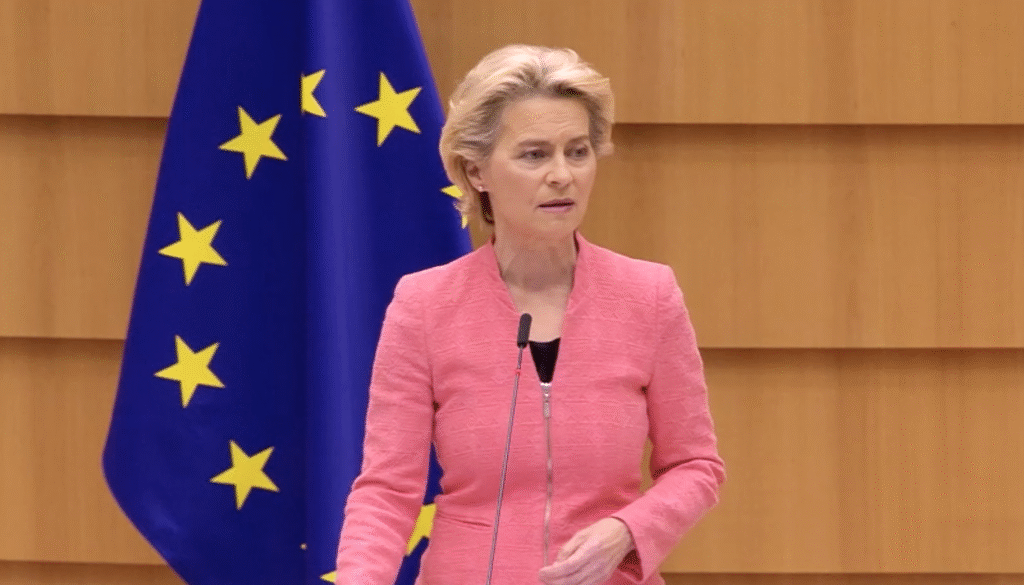
The provisional agreement, however, also has significant political undertones. It is a major legislative victory for Commission President Ursula von der Leyen who pushes to cut red tape for businesses. This topic is one of the crucial missions of her second term.
Relief for small and medium-sized businesses
The agreement, meant to boost EU’s competitiveness, simplifies the directives on corporate sustainability reporting (CSRD) and corporate sustainability due diligence (CS3D). It reduces the reporting burden and limits the trickle-down effect of obligations on smaller companies.
As far as CSRD is concerned, the Commission proposed to increase the employee threshold to 1000 employees. It also proposed to remove listed small and medium companies from the scope of the directive. In the provisional agreement, the co-legislators added a net turnover threshold of over €450m to further alleviate the reporting burden on undertakings.
The obligation for companies to adopt a transition plan for climate change mitigation has been removed.
We are taking a big and important step in the right direction. With clear and simple rules, companies can focus on their core business, so we achieve better value for money in the green transition, create European jobs. – Morten Bødskov, Minister for industry, business and financial affairs of Denmark
“For years, European businesses have faced wave after wave of red tape. This has slowed green investments and weakened our competitiveness. Now we are taking a big and important step in the right direction. With clear and simple rules, companies can focus on their core business, so we achieve better value for money in the green transition, create European jobs and strengthen companies’ ability to grow and invest,” commented Morten Bødskov, Minister for industry, business and financial affairs of Denmark.
A number of companies have been blaming Europe’s green laws and the corresponding restrictions on doing business for relatively low economic growth and job losses. Many argue that overly strict laws hamper the competitiveness of European businesses in competition with U. S. and Chinese companies.
Victory at a cost
Simplification of environmental reporting has been the subject of political wrangling among the various factions in the European Parliament for several months. The coalition that secured reelecting Ms von der Leyen (primarily built on the European People’s Party (EPP), Socialists and Democrats (S&D), Renew Europe, and the Greens) was almost brought at the brink of collapse as EPP teamed up with the far right.
Some commentators argue that the cooperation between EPP and far right on the matter of green reporting has disturbed the balance of power in the Parliament. EPP is blamed for having broken the so-called cordon sanitaire. That is an unwritten rule that forbids mainstream political factions from collaborating with the far right. Whether this will set a precedent for future agreements, however, remains to be seen.