Brussels wants cash to save the climate, investors smell opportunity, regulators brandish taxonomies, critics cry greenwash, and the horizon alarm grows louder. Public budgets, private trillions, central-bank stress tests and a fight over funding dirty firms’ clean-ups collide in the EU’s experiment with sustainable finance.
The European Union has turned finance into the engine of its Green Deal. Daniel Mertens, political economist, and Natascha van der Zwan, political scientist, describe a concept that now “spans from regulatory initiatives at the level of global governance to an ecosystem of environmental and financial NGOs as well as business associations to a multi-trillion-dollar segment of international financial markets” (Journal of European Public Policy). At first glance the idea looks straightforward: money steered toward climate goals. In practice it sits at the fault-line between public ambition and private calculus.
Brussels provides the canonical definition. Sustainable finance is “the process of taking environmental, social and governance considerations into account when making investment decisions in the financial sector, leading to more long-term investments in sustainable economic activities and projects” (European Commission, quoted by Mr Mertens and Ms van der Zwan). A second passage adds nuance: it should “support economic growth while reducing pressures on the environment to help reach the climate- and environmental objectives of the European Green Deal, taking into account social and governance aspects.” The ranking is clear; green aims come first.
That tilt matters. The authors observe that EU policy remains “both tilted towards ‘green’ objectives and linked with the EGD being understood as a new economic growth strategy.” Growth is to be rescued, not restrained. The Commission promises jobs, competitiveness and global clout. The choice of words may soothe sceptical capitals, yet it also binds the strategy to measurable results. If emissions fall but investment stalls, ministers will cry foul.
Counting on two purses
Money arrives from two directions. Public finance flows through EU and member-state budgets or the lending arm of the European Investment Bank. Private finance comes from banks, insurers, pension funds and asset managers. Mr Mertens and Ms van der Zwan remind readers that “public budgetary instruments and funding tools such as subsidies, grants or concessional loans are just as much an integral part of the sustainable finance landscape.” Subsidies mobilise private investors; private investors amplify public cash. Neither side can deliver the Green Deal alone.
The authors frame EU sustainable finance as “both an emergent policy regime and a political project that is constitutive of the EU’s dominant approach to achieve climate neutrality by 2050.” They borrow four tests from governance theory: multiple policies, institutional arrangements, power coalitions and a guiding paradigm. Each test is met. A sprawling rulebook, a thicket of agencies, an army of lobbyists and a growth-oriented narrative now encircle the files.
The 2018 Sustainable Finance Action Plan sits at the centre. The Commission called it “a roadmap to boost the role of finance in achieving a well-performing economy that delivers on environmental and social goals as well.” Six priorities leap from the page: a common language, a green label, tougher corporate disclosure and more besides. The promise, in the words of then vice-president Frans Timmermans, was sweeping: “Moving to a greener and more sustainable economy is good for job creation, good for people and good for the planet. Today we are making sure that the financial system works towards this goal.”
Plumbing the market
Three flagship rules form the regime’s spine. The EU Taxonomy defines what counts as a green activity. The Corporate Sustainability Reporting Directive forces firms to reveal how far their revenues align with that list. The Sustainable Finance Disclosure Regulation compels fund managers to publish sustainability data. Together, the trio aims at “making markets work for sustainable economic activities.” Without a taxonomy, labels would blur; without disclosure, investors would grope in the dark.
Supervisors fret about marketing puff. The European Securities and Markets Authority castigates any statement that “does not clearly and fairly reflect the underlying sustainability profile of an entity, a financial product or financial service.” Its target is greenwashing, a practice that misleads consumers and inflates bubbles. Banks grumble about paperwork, yet the reputation risk of loose claims now outweighs the cost of accurate data.
Rule-making spills into other corners. The European Banking Authority, the European Securities Markets Authority and the European Insurance and Occupational Pensions Authority integrate climate risk into stability mandates. Member states’ own multilateral lender, the European Investment Bank, brands itself “the EU’s climate bank.” The European Central Bank issues “action plans, prudential guidelines and roadmaps” that embed a “pro-climate narrative” inside monetary policy. Each institution pulls levers it controls; together they tighten the net.
Budgetary alchemy
Money from Brussels carries green strings. The Recovery and Resilience Facility, crown jewel of the €800bn post-pandemic fund, demands that 37 per cent of every national plan target climate goals. The Sustainable Europe Investment Plan seeks to raise €1tn by 2030 from public and private sources. As Mr Mertens and Ms van der Zwan put it, public funds “become redesigned to mobilize private investment for the objectives of the EGD.” The alchemy echoes an earlier credo: use markets to govern when budgets are small.
Lobbyists swarm. The Association for Financial Markets in Europe defends incumbent banks; the European Sustainable Investment Forum pushes greener metrics. Environmental NGOs and corporate giants share seats on the Platform on Sustainable Finance and the European Financial Reporting Advisory Group, drafting technical standards line-by-line. The result is what the authors call “a power arrangement that includes both traditional and new political interests.” Old finance meets new climate science round the same tables.
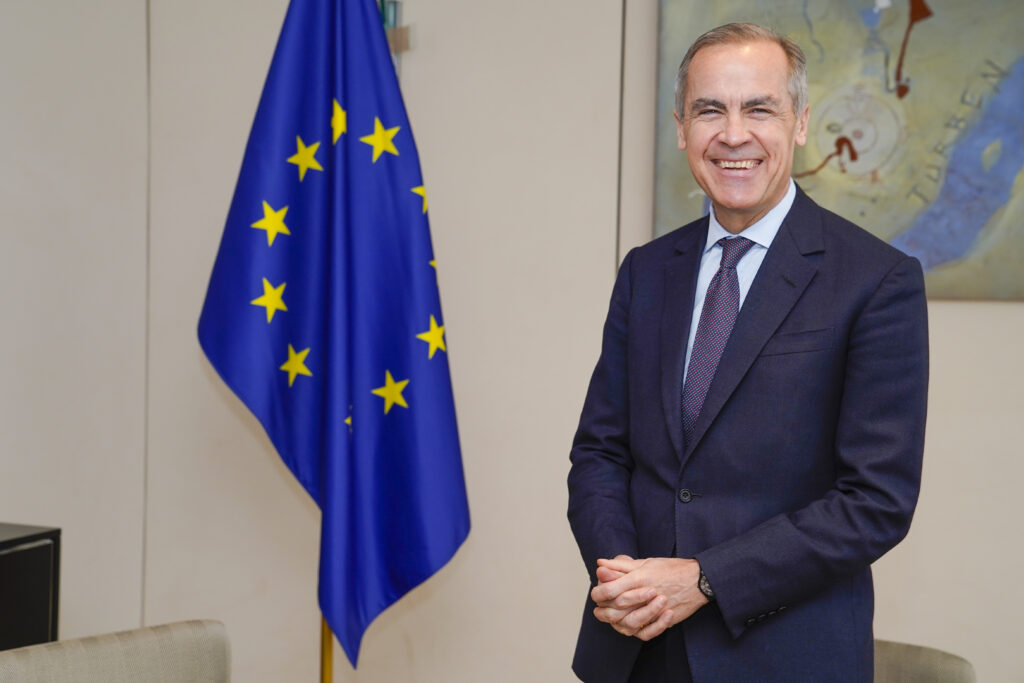
Climate damage lurks beyond executives’ time frames, imposing a cost on future generations that the current generation has no direct incentive to fix. — Mark Carney, Bank of England governor (current PM of Canada)
Yet the edifice still wobbles. Mr Mertens and Ms van der Zwan deliberately label it “emergent” to signal that “the creation of this sustainable finance policy regime is by no means complete and can – at least in part – also be dismantled.” Their warning is timely. The second Von der Leyen Commission has floated Omnibus legislation that “waters down important parts of previous EU sustainable finance regulation, most notably the EU Taxonomy for Sustainable Activities and the CSRD.” Cuts follow complaints about cost and red tape.
Backlash beyond Brussels
Opposition also travels west. In the United States “conservative and radical-right politicians have accused banks and fund managers of being hostile to fossil fuels and taken regulatory action against ESG practices.” Legal threats coax Wall Street to retreat from climate alliances. European officials fear contagion. Finance ministers already mutter about bureaucracy; farmers block roads. If politics sours, rules can shrink as fast as they grew.
The authors see a deeper pattern. They describe sustainable finance as “a programmatic initiative that reshapes governance structures and social relations.” Private capital fills fiscal gaps; public rhetoric soothes voters; together they promise a “positive-sum game” of green growth.
Critics note a twist. By putting the financial sector in the driving seat of transformation, they claim, Europe indulges the financialisation of climate policy. Alexander Dimmelmeier, analyst with Foundation for European Progressive Studies, calls sustainable finance an oxymoron because “dominant return-seeking practices…may be anything but sustainable.” The charge touches a nerve.
Carney’s clock
Mark Carney brought alarm bells into the boardroom. A decade ago, the then-governor of the Bank of England warned of a “tragedy of the horizon” where climate damage lurks beyond executives’ time frames, “imposing a cost on future generations that the current generation has no direct incentive to fix.” He cautioned that “by the time those climate impacts are a defining issue for financial stability, it may already be too late.” His remedy was information: firms must disclose climate risks so that lenders can price them.
The speech worked. A global taskforce sketched standards; governments rolled them out. Green-bond issuance “has grown exponentially” since 2015. Success, however, is partial. The Network for Greening the Financial System now says climate change is “no longer a tragedy of the horizon, ‘but an imminent danger’.” It could slash EU GDP by 5 per cent by 2030, a shock equal to the financial crisis of 2008.
Capital must flow to “nature protection, emerging markets, climate adaptation, health systems and Indigenous-led enterprises. — Simon O’Connor, Ben Neville, Brendan Wintle (The Conversation)
Numbers tell the gap. Climate finance reached $1.9 tn in 2023, far below the $7tn needed every year to honour the Paris goals. Biodiversity loss opens another hole: up to half of global GDP depends on nature, yet only $100bn is spent annually against a projected need of $700bn. “The finance sector is falling well short of delivering the level of capital needed,” lament Simon O’Connor, Ben Neville and Brendan Wintle in The Conversation.
Taming incentives
Why the shortfall? The Conversation authors fault skewed incentives. “Plenty of money is still being made from unsustainable finance that continues to benefit from policies (such as subsidies for fossil fuels) and a lack of pricing for negative environmental impacts.” Quarterly profit beats long-term resilience. Valuation models ignore external harm. State-owned enterprises and unlisted firms remain “invisible”, uncaptured by disclosure rules.
Their remedy is systemic. Tools of finance must “evolve, in terms of the way assets are valued and performance is measured.” Investors obsessed with the next quarter undermine portfolio health. Capital must flow to “nature protection, emerging markets, climate adaptation, health systems and Indigenous-led enterprises.” That requires backbone from lawmakers and imagination from bankers.
Mr Mertens and Ms van der Zwan add another lens: policy-making is both “puzzling and powering.” Officials grapple with data gaps while interest groups push agendas. Expertise morphs into influence; influence shapes the definition of problems; and the circle closes. The risk is capture disguised as consultation.
Debating the bridge
A newer fight concerns “transition finance”—money to help dirty sectors clean up. Planned amendments to the Sustainable Finance Disclosure Regulation would force any transition fund to exclude “sectors deemed ‘harmful’ such as weapons, coal and tobacco.” The rule mirrors climate benchmarks that drop sinners by default. Critics say the ban blocks the very companies that need capital most.
It creates a system where the companies that most need to transition are categorically barred from accessing transition finance. — Jennifer Motles, Chief Sustainability Officer of Philip Morris International
Jennifer Motles of Philip Morris International is blunt. Article 7 claims to aid firms “moving from higher harm to lower harm, investing in credible plans, making measurable progress toward better outcomes,” yet “prohibits entire company categories from qualifying.” She concludes that it creates “a system where the companies that most need to transition are categorically barred from accessing transition finance.” Because her firm still sells cigarettes, “we’re out. Completely. No matter how far we’ve come.” The logic, the company’s sustainability chief complains, saps motivation: “If a company invests billions in transformation and still can’t qualify for transition finance, what’s the incentive to transform?”
Regulators counter that exclusion prevents greenwashing. If a fund owns coal or tobacco, investors may assume the worst regardless of transition plans. The clash pits origin against trajectory: should finance judge what a firm is or what it tries to become? The answer will echo beyond tobacco into cement, steel and aviation.
An unfinished bargain
Europe’s bet is bold. It wants to prove that capital markets can steer the real economy towards climate neutrality without crippling growth. Success would vindicate the union’s habit of “governing through financial markets” in times of fiscal constraint. Failure would confirm fears that finance dresses up as saviour while pursuing its old self-interest.
For now the regime remains in flux. Rules tighten, then loosen; alliances form, then fracture. Lobbyists occupy corridors; NGOs scour footnotes; central bankers refine stress tests. The process looks messy, yet democracy rarely moves tidily. What counts is direction and speed.
The next five years will test both. If Mr Carney’s clock is right, the cost of delay rises exponentially. Europe has built disclosure templates, taxonomy screens and bond standards. It must now align taxpayer funds, private risk appetite and political will. Sustainable finance promises a bridge; only concerted action will ensure it does not collapse before the journey ends.