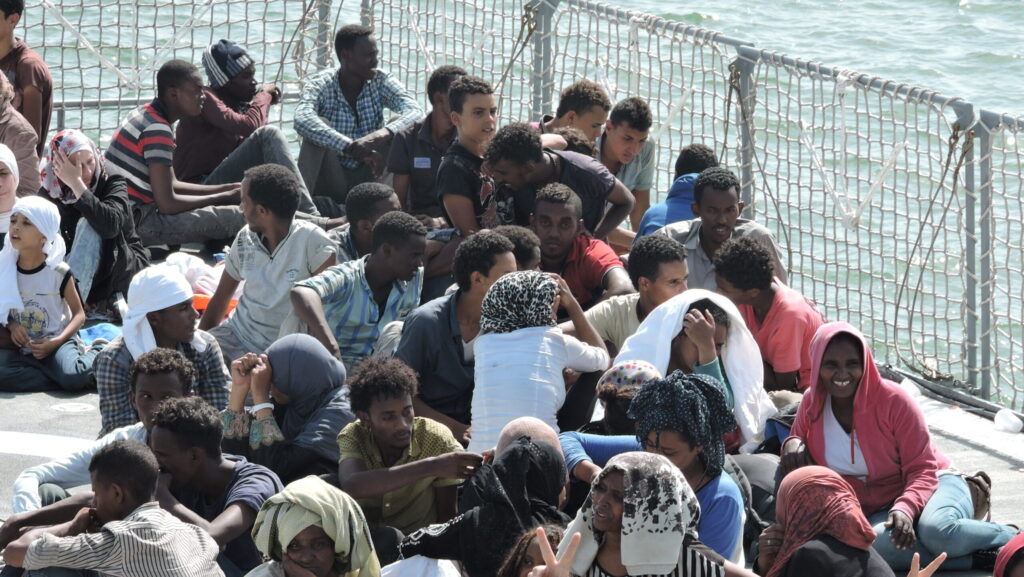
While Europe and the United States have historically approached migration differently, certain elements of the EU’s new measures are reminiscent of the American immigration model, Silvia Carta from the Platform for International Cooperation on Undocumented Migrants says. That includes expanded use of detention and plans for so-called return hubs in third countries where migrants awaiting deportation would be kept.
Silvia Carta, Advocacy Officer at the Platform for International Cooperation on Undocumented Migrants (PICUM), emphasizes to EU Perspectives that the latest developments are part of a broader trajectory within the EU. “Some measures tackling migration may be inspired by U.S. practices,” Ms Carta explains. “But the EU has long been developing its own restrictive toolkit. What we see now is the normalization of proposals that, until recently, would have been considered unthinkable.”
According to Ms Carta, human rights advocates find some of the EU’s new measures—including home searches targeting undocumented migrants, expanded detention, and externalized return mechanisms—deeply concerning.
Detention at the core of enforcement
A central feature of the latest Council’s proposals is the expanded use of detention. Administrative detention, often for prolonged periods, is increasingly positioned as a primary tool for migration control rather than an exceptional measure.
“We are looking at a dramatic increase in detention used as a punitive measure,” Silvia Carta says. “This is particularly concerning given the well-documented impacts on mental and physical health, as well as the restrictions it imposes on access to basic rights and services.”
Expert notes that excessive reliance on detention risks violates EU legal principles, including proportionality, necessity, and individual assessment. In addition, it places vulnerable individuals—such as children, survivors of trauma, and those with chronic medical conditions—at heightened risk. Recent experience from EU member states demonstrates the negative effects of administrative detention: higher levels of stress, mental health deterioration, and barriers to accessing legal counsel and protection mechanisms.
’Return hubs’ in focus
Among the most contentious proposals are so-called return hubs, facilities in third countries where migrants awaiting deportation would be kept. These hubs are framed as ’efficiency tools’, designed to accelerate returns and reduce administrative burden within the EU. Ms Carta warns, however, that externalization poses significant legal and ethical risks. “Fully externalizing return procedures allows member states to evade their responsibilities under international and human rights law,” she explains. “It exposes people to countries where they have no connection, reduces transparency, and weakens democratic oversight.”
Externalization of migrants exposes people to countries where they have no connection, reduces transparency, and weakens democratic oversight. – Silvia Carta, Advocacy Officer at PICUM
Even the European Commission had expressed serious concerns in 2018, noting that such arrangements could violate the principle of non-refoulement, complicate monitoring, and risk undermining EU values. From a policy perspective, return hubs shift the focus of decision-making outside EU borders, making accountability more diffuse and enforcement less transparent. This raises questions not only about compliance with human rights obligations but also about the Union’s capacity to maintain coherent governance standards across multiple jurisdictions.
The EU’s focus on returns extends beyond its immediate borders. Countries in the Western Balkans, as well as selected African states like Uganda, are increasingly being included in bilateral agreements to facilitate returns. While these partnerships aim to accelerate deportations, they raise significant questions about human rights compliance and accountability. Negotiations often take place under asymmetrical conditions, with third countries having limited capacity to provide protection or monitor treatment. “Such arrangements carry high risks of human rights violations and create accountability gaps. The individuals affected often have no connection to these countries, which increases their vulnerability”, Silvia Carta emphasizes.
Expanded surveillance, identity verification
In addition to structural changes to detention and returns, the proposals anticipate expanded surveillance and identity verification practices. Experts and advocacy groups have raised concerns about racial profiling and discriminatory targeting. “Enhanced surveillance and profiling will disproportionately affect racialized communities,” Ms Carta warns. “These practices undermine anti-discrimination protections and normalize approaches that conflict with the EU’s equality framework.”
Practices like enhanced surveillance and profiling undermine anti-discrimination protections and normalize approaches that conflict with the EU’s equality framework. – Silvia Carta, Advocacy Officer at PICUM
The introduction of data-driven enforcement mechanisms, combined with increased border and internal checks, may institutionalize racial and ethnic profiling. This creates systemic risks not only for individuals but also for the EU’s broader legal and ethical standards.
Safe countries—for whom?
Another key element of the Council’s approach is the expanded use of ’safe third country’ and ’safe country of origin’ designations. These mechanisms allow authorities to designate certain countries as safe for deportation purposes, even if the individual has no personal ties to the country.
“If a country is declared safe for a group, deportation becomes possible even when the individual has no connection to that country,” Silvia Carta notes. “This effectively limits access to asylum and undermines the right to seek protection in the EU.”
Human rights organizations warn that this could result in systematic barriers to asylum procedures. Accelerated processes may reduce opportunities for individuals to present their cases in full, while inadmissibility decisions could increase the number of deportations to countries without functional protection systems. Such measures risk violating the EU Charter of Fundamental Rights and international obligations under the 1951 Refugee Convention.
The Cypriot presidency is setting up for 2026 and appears likely to continue this trajectory, prioritizing a securitarian and deportation-focused agenda. “There is near-unanimity in the Council on this approach,” Ms Carta observes. “But alignment should not come at the expense of fundamental rights or the EU’s legal obligations. As Europe moves toward more enforcement-centered migration policies, the question remains whether these measures can be reconciled with the Union’s legal and ethical framework or whether the EU is drifting toward a model where control supersedes protection.