The European Commission has proposed a package to toughen the Carbon Border Adjustment Mechanism, or CBAM. It also seeks to widen its reach from raw materials to the goods made from them. The plan responds to complaints from firms that still worry about being undercut by dirtier rivals abroad.
Europe’s carbon border levy, just a year old, already shows wrinkles. On 16 December the European Commission tried to iron them out. EC Vice-President Stéphane Séjourné explained the move a day later, at Wednesday’s press conference. “The first challenge of this reform is to reinforce the level playing field and to ensure greater climate and economic justice in the application of the CBAM,” he told reporters.
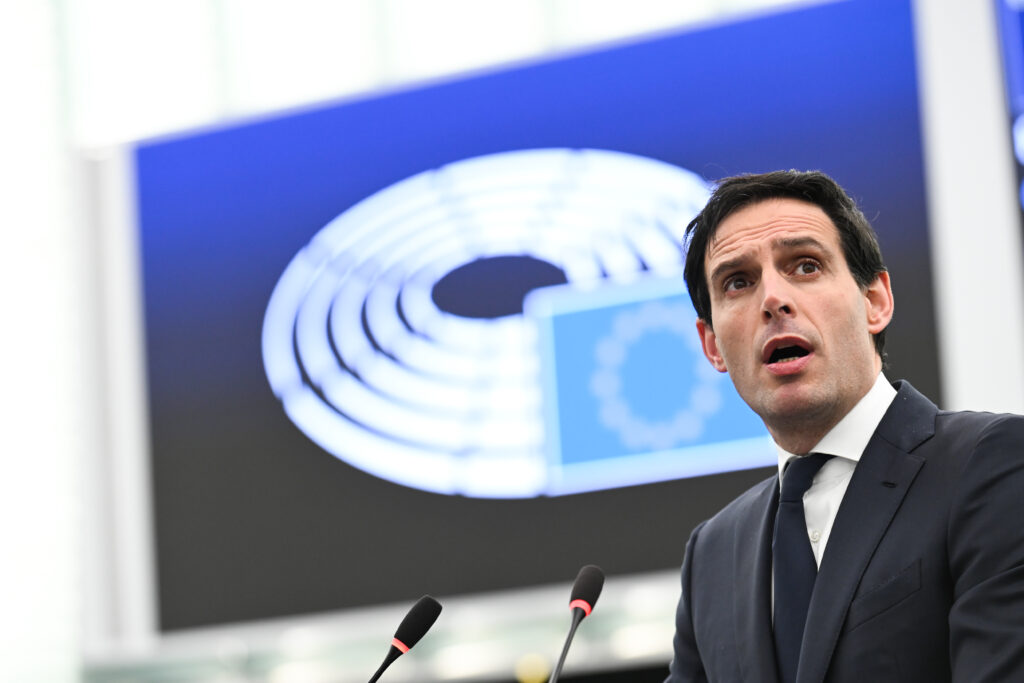
Climate Commissioner Wopke Hoekstra, standing beside him, repeated the aim. “We want to make sure that the system works, that it’s simple, that it is fair to everyone in Europe and abroad, and that it is effective,” he said.
The two know they must placate industry. Mr Séjourné reminded listeners that the levy has been tested since October 2023 and that Brussels has listened. “CBAM is now simpler, more robust in implementation and fairer,” he declared.
Closing the gaps
The most urgent task is to stop carbon leakage through downstream products. The press release spells out why. From January the levy already covers aluminium, cement, electricity and steel. From 2026, 180 steel- and aluminium-intensive goods—from washing machines to hydraulic cylinders—will join the list. According to the Commission, 94 per cent of the new items are industrial components stuffed with metal; the rest are household kit. That, officials hope, will prevent factories from hopping the border and exporting the finished products back tariff-free.
Mr Séjourné put it crisply. “It’s not so much steel and aluminium and cement per se, but rather the product at the end, metal cables, car doors, domestic appliances, they’re all going to be now affected by CBAM,” he said. The broadening should also raise revenue: Mr Hoekstra expects the change to lift CBAM takings by 23 per cent by 2030. Yet the need for tough policing is obvious.
“CBAM truly is a very good idea, but it’s also a bit like a good cheese with some holes in,” Mr Hoekstra quipped. The proposal therefore arms the Commission with new anti-circumvention claws. It will demand extra evidence when importers offer dubious emissions data and, if necessary, will impose default country values. “We will be able to take strong anti-circumvention measures whenever we are confronted with evidence of fraud,” the commissioner warned.
A cheque for exporters
Even so, companies fear higher costs when they compete abroad. To soothe them the Commission will create a two-year decarbonisation fund. “We’re putting in place a temporary decarbonisation fund,” Mr Hoekstra said. “The fund will be there for two years.” It will refund part of the carbon costs that EU producers still bear under the emissions-trading scheme (ETS) for goods that face leakage.
Industry lobbied hard for that cushion, and Mr Séjourné defended it stoutly. “It is actually a very necessary measure. We cannot expect that the whole world looks exactly like the European Union’s market,” he argued. The fund, he stressed, merely squares the circle until a fuller fix—probably more free allowances under the ETS—can be written into law.
Money will come from member states. A quarter of the receipts from CBAM certificates in 2026-27 will feed the fund; the rest will flow into the EU budget as an own resource. Mr Hoekstra brushed off fears that capitals will balk. “We’re helping the industry of member states. This money is immediately spent on the companies of member states,” he said. For perspective, he put the kitty at “roughly half a billion” euros.
Sharper pencils, cleaner scrap
Another tweak targets tricks that shuffle carbon from one product to another. Importers must now report more data and trace goods better. If their numbers look fishy, Brussels can demand extra proof. The package also adds pre-consumer scrap to the carbon maths. By crediting recycled steel and aluminium, the Commission hopes to push both EU and foreign producers to melt more scrap and burn less carbon.
Mr Hoekstra wants the new powers used sparingly but firmly. “Obligatory country values will be used when it is necessary to tackle widespread evasion, because we should facilitate trade, but we should not facilitate fraud and evasion,” he said. His deputy agreed. “We’re also bringing in new measures to make sure that people can’t circumvent the system, which was a little too easy to circumvent in the past,” said Mr Séjourné.
CBAM truly is a very good idea, but it’s also a bit like a good cheese with some holes in it. — Wopke Hoekstra, EU Climate Commissioner
The package nods to foreign partners as well. It sketches the idea of “equivalence” in carbon pricing, hinting that countries with credible levies of their own could earn deductions. Mutual recognition of trustworthy accreditation bodies should further trim red tape. Such carrots, Brussels hopes, will blunt accusations of green protectionism.
Power lines, plug-ins
Electricity imports pose another headache. Today CBAM taxes the marginal power station assumed to keep the grid running—often a dirty one. From 2026 the levy will use the average grid emission instead. “The aim is to calculate CBAM not on the marginal production, but on average emission of the grid,” Mr Hoekstra explained. That, he says, will encourage exporters to green their entire mix.
The Commission also promises “technical adjustments” to ease market coupling once neighbours are ready, a hint at future links with Britain, the western Balkans and beyond. On 17 December Mr Hoekstra sounded optimistic about London. “We are in very good conversations with our UK friends and counterparts on how to link our ETS system with theirs,” he said. An eventual linkage would all but wipe out CBAM paperwork for British exporters, though officials insist the sequence must be linkage first, exemption later.
America need not fret either, the duo suggested. Imports from the United States make up a sliver of the total. “The exposure is absolutely minimal,” Mr Hoekstra said. Mr Séjourné added that, thanks to a carve-out that spares most small firms, “this is not really a big issue at all.”
Friends under fire
Ukraine, battling war as well as tariffs, had asked for special treatment. Mr Hoekstra offered sympathy but not exemption. “Our assessment is that the impact is maybe not zero, but not nearly in the domain that some have been fearing,” he said, pointing to its nuclear-rich power mix. Brussels will keep talking to Kyiv but sees no need to rewrite the rule book.
Farmers also fret, worried that pricier fertiliser will squeeze margins. Mr Séjourné tried to calm them. “We have taken exceptional measures on fertilisers to prevent price increases and further costs for farmers,” he said. By keeping imported plant food on par with European output, officials hope to shield agriculture until the levy bites harder.
Legal doubts linger. Some fear the fund looks like an export subsidy and could anger the World Trade Organisation. Mr Hoekstra insists otherwise. “We do feel that this is truly compatible,” he said, noting that Europe spends eight times more on climate aid abroad than it expects to raise from CBAM. He promised swift monitoring: “We are going to start monitoring right away.” Three months after the new rules enter force Brussels will publish its first circumvention check.
A fair fight
Commission officials admit CBAM remains a work in progress. They will review performance during the 2023-25 transition and refine administration before full pricing begins in 2026. The levy will mirror the phase-out of free ETS allowances that runs until 2034. By then, Brussels hopes the world will have followed its lead and priced carbon everywhere.
For now, though, Europe ploughs on alone. Mr Hoekstra claims momentum. “We are rewarding investments in low carbon,” he said, noting that Brazil, Mexico, China and bits of North America now copy Europe’s carbon markets. Yet he also concedes CBAM must stay nimble. “A more targeted scheme will ease compliance burden for thousands of companies while ensuring that those that really matter are actually paying for the carbon they use,” he said.
We have taken exceptional measures on fertilisers to prevent price increases and further costs for farmers. — Stéphane Séjourné, European Commission Vice-President
Mr Séjourné framed the overhaul as part of a broader industrial strategy. “We’re putting an end to unfair foreign competition through CBAM,” he said. His mantra is twin—decarbonisation and competitiveness. With the loopholes smaller, the levy broader and a chequebook ready for exporters, Brussels thinks the circle is squarer. The proof will come when factories decide whether to stay or go.
Green borders, grey areas
Critics will still gripe about complexity. Even trimmed, the scheme demands fresh paperwork and constant updates to carbon values. Trade partners mistrust Brussels’ claim that CBAM is an “environmental measure”. They may test that in Geneva. Some EU governments may also bridle at losing a quarter of their border-tax receipts to the Brussels-designed fund.
Yet the Commission sounds undaunted. “First, we’re addressing the risk of downstream carbon leakage,” Mr Hoekstra said. He called the rest—scrap incentives, anti-fraud powers, grid averaging—“simple conditions linked to decarbonisation”. Mr Séjourné, ever the salesman, summed up: “It’s a good reform, something that was keenly awaited in many industrial sectors.”
Europe’s climate arsenal still bristles with complexity, but the direction of travel is clear. Carbon must carry a cost, wherever it hides in a supply chain. By tightening CBAM now, Brussels hopes to prevent a flight of emissions just as the bloc starts to pay its own full carbon bill. If the plan holds, washing-machine makers in Poland or Portugal will no longer lose out to rivals who burn cheap coal abroad. They might even invest in cleaner kit at home.
Success expected
The next steps are predictable. The proposal heads to the Parliament and the Council. Both backed the original CBAM, so final tweaks should sail through. If that happens, importers of the newly listed products will need to buy certificates from 1 January 2026. Firms that cheat risk default carbon values, or worse. And exporters will line up for their two-year refund.
As Mr Hoekstra put it in closing, the plan is to send “Important signals to our industry, important signals on climate action.” Brussels believes it has stitched the holes in its cheese. Europe’s factories will soon discover whether the slice still tastes as good.