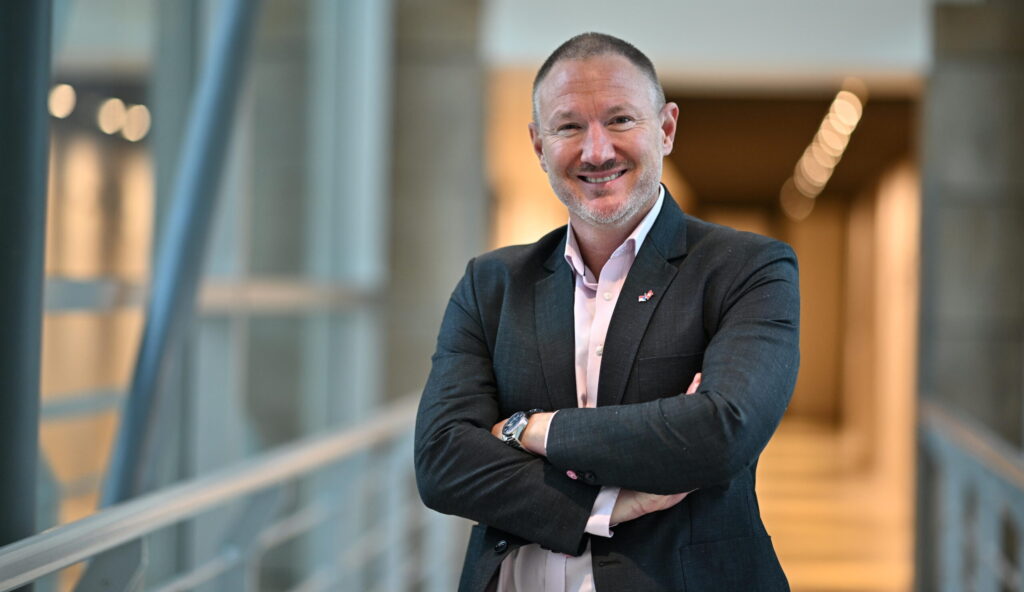
Healthcare should be seen as an investment, not merely a budget item, says James Rouse, General Manager of Roche Czech Republic. Mr Rouse speaks openly about why Europe and the Czech Republic are at a critical crossroads, what barriers still prevent patients from gaining real access to innovative treatments, and why the state and the pharmaceutical sector must be prepared to engage in difficult—but constructive—debates.
As a new member of the Association of Innovative Pharmaceutical Industry (AIFP) Board, you bring a fresh perspective. What are the top three priorities you intend to champion within the association, and how specifically can they contribute to improving access to innovative treatments for Czech patients?
I think the Czech Republic—just like Europe as a whole—is really at a crossroads right now. Healthcare and the pharmaceutical sector are not just a cost anymore, they are increasingly being recognised as a key part of the economy. The Czech Republic is actually in a very, very good position to look at this problem.
I see three main priorities.
The first is a change in mindset: we need to think about healthcare as an investment in the population, not just as a cost that needs to be managed. When we evaluate medicines, we shouldn’t just look at their price and their impact on a particular disease, but also at the broader societal value—meaning that patients stay healthier for longer, they can go back to work, they become productive members of society, they pay taxes, and all of those things.
The second priority is broader and real-life access to innovative medicines. Medicines are becoming more and more innovative—for example, gene therapies, cell therapies, or treatments based on genetic mutations—and regulatory systems are often not fully set up to deal with this complexity efficiently. In the Czech Republic, there is a formal access system to innovation, but over 80 per cent of these treatments are restricted in some way, either by indication or by the limited number of specialised centres. The net result is that many patients are unable to access these treatments in practice.
The third area is therefore improving real-world access: enabling more physicians to prescribe innovative treatment and providing enough capacity in specialised centres. At the end of the day, we are all on the same side—government, the healthcare system, and pharmaceutical companies, trying to ensure better outcomes for patients. If there is an innovative medicine that adds value, it is in all of our interests for patients to get it. We need to work much more closely together and modernise the system so that this can happen faster.
The Czech Republic today has a fantastic opportunity to modernise its system, accelerate access to innovation, and become an attractive partner for investment. I would like to work in partnership on that.
Level of innovation is changing
The pharmaceutical industry is undergoing rapid changes. How do you think the AIFP needs to evolve to remain a relevant and strong partner for the government and payers over the next five years?
I don’t think it’s necessarily the pharmaceutical industry that is going through a radical change. What is changing is mainly the level of innovation and the kinds of medicines being developed. The world is changing, AI is playing an increasingly bigger role, and healthcare is adapting to that. At the same time, we are treating increasingly complex diseases, which makes assessment, reimbursement, and regulatory approval more complicated because the data is more complex. The older systems that a lot of countries, including in Europe, have, they work, but they work slowly and with bureaucracy, and that needs to change.
The basis of AIFP’s cooperation with government is to be seen as a partner on the same side. That works very, very well in the Czech Republic, and I want to recognise the work of my predecessors and the AIFP leadership. The partnership here is at a very high level.
I do think, however, that we should have more constructive dialogue and challenge each other. That’s a healthy part of partnership. There are difficult decisions ahead, and the goal must be better outcomes for patients. That requires the courage to challenge the status quo.
An aging population puts enormous pressure on healthcare budgets. How can pharmaceutical companies collaborate with the government to ensure the long-term sustainability of the system without restricting patient access to cutting-edge care?
I think the first thing I would say is that an ageing population is actually the result of better healthcare. So we should see it as a success rather than a problem. It’s a demographic challenge, but it’s also signalling progress. The key goal is that people of older age need to stay healthier. Today, many people do not have access to medicines that exist that would help them remain healthy. The pressure in healthcare has shifted from acute diseases to chronic diseases.
We need to look at this as an investment in healthy and productive lives, not just as a cost. Effective and early treatment of chronic disease ultimately reduces overall costs. If we just wait until people become ill, costs will increase.
New technologies as a challenge
The future of oncology lies in precision medicine. Roche is strong in both pharmaceutical and diagnostics. Is the Czech system ready to fund not just expensive drugs, but also the complex genomic testing required to ensure treatment is truly effective and that resources are not wasted?
The Czech system is as ready as most other European countries. Future medicines will increasingly be launched with companion diagnostics. Reimbursement and approval systems are not yet fully prepared for that.
Genomic medicine allows us to identify exactly which patients will benefit from treatment, which can increase effectiveness and cost-effectiveness. That’s a positive development. Regulatory systems, however, need modernisation.
The integration of new technologies, including AI and digital diagnostics, is a challenge for the whole system—the industry, healthcare providers, regulators, and payers. The only way to do it is through close collaboration to maximise benefits for patients.
Europe is facing pressure regarding its competitiveness against the US and Asia, which is reflected in the discussions on the EU pharmaceutical legislation revision. Do you see the European Commission’s current proposals as a step that will foster innovation or do you fear that investment may be drained from Europe?
The current steps are going in the right direction, for example the maintenance of periods of regulatory data protection. What is really key, however, is to create a stable and attractive environment for investment. The Czech Republic is very attractive for clinical trials. Roche currently has 39 ongoing trials here, and I would love to double that. The key, however, is the speed of patient recruitment. That is where we need to be competitive against the US and Asia.
Europe is moving in the right direction, but there is still a way to go. The Czech Republic has the opportunity to take national-level steps that make it even more attractive.
You live and work in the Czech Republic. What has surprised you the most about the Czech working or business environment—whether positively or negatively—compared to your previous international experiences?
Nothing has really surprised me. I knew that the Czech Republic has a modern healthcare system, high-quality science, and great universities. What has pleasantly surprised me, however, is the level of collaboration with government and the healthcare system. They are very open to partnership and finding solutions.
That is not a given in every country. I see a real desire here to improve patient care together. With the new government, there is a fantastic opportunity to make improvements in healthcare in the Czech Republic—and that is very positive.