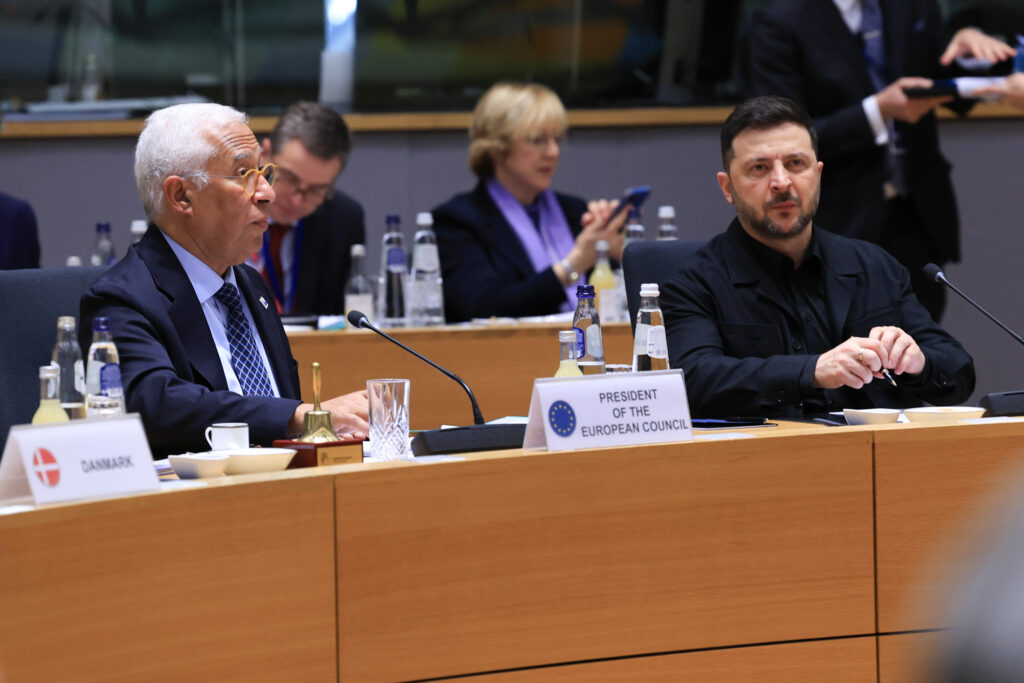
In the wee hours of Friday, December 19, after many hours of negotiations, the Council agreed on a surprising solution. Instead of using frozen Russian assets as expected, the EU will secure financing for Ukraine through a huge loan on the financial markets. Czechia, Hungary, and Slovakia, however, refused to guarantee the loan.
“We committed, we delivered.” With these words, Council President António Costa announced short before 4am on Friday morning an agreement on financial support from the EU for Ukraine.
It is a very different deal, however, than expected. Before the summit began, it was assumed that member states would agree to use frozen Russian assets to benefit Ukraine. However, it proved impossible to to overcome Belgium’s resistance as most of the frozen Russian assets are located in Brussels. The Belgian government was concerned about the legal consequences that such use of Russian money may have in the future.
Temporary solution?
During night-time negotiations, representatives of member states finally agreed that the EU would borrow €90bn on the financial markets for the benefit of Ukraine. Such an agreement provides a crucial lifeline to Ukraine’s economy battered by the war. Without that assistance, Kyiv may face a cash crunch as early as next spring.
However, the summit’s accord state that work will continue on the use of a so-called reparation loan for Ukraine. That would be secured by frozen Russian assets. These conclusions were supported by 25 member states only, i.e. the EU-27 minus Hungary and Slovakia. Thus, in Brussels, the loan is seen as a last minute solution—and a temporary one.
However, this is not the solution Commission and big member states like Germany or France originally preferred. Belgium’s Prime Minister Bart De Wever who had firmly opposed the ’reparation loan solution’ tried to explain the matter in a pragmatic manner. “Some people may not like this as they wanted to punish (Russian President Vladimir) Putin by taking his money,” Mr De Wever said. He added that “politics is not an emotional job (…) rationality has prevailed.”
“Step for lasting peace”
The commitment should cover Ukraine’s financial needs for the period 2026 and 2027. It is an interest-free loan.
The only way to bring Russia to the negotiation table is to strengthen Ukraine. – António Costa, Council President
“This will address the urgent financial needs of Ukraine. And Ukraine will only repay this loan once Russia pays reparations. The Union reserves its right to make use of the immobilised assets to repay this loan,” Coucil President Costa said after the deal had been struck.
Mr Costa added that member states have also agreed to roll over our sanctions against Russia. “Our goal is not to prolong the war. Today’s decisions are a crucial contribution to achieve a just and lasting peace for Ukraine. Because the only way to bring Russia to the negotiation table is to strengthen Ukraine,” Council President added.